What it is
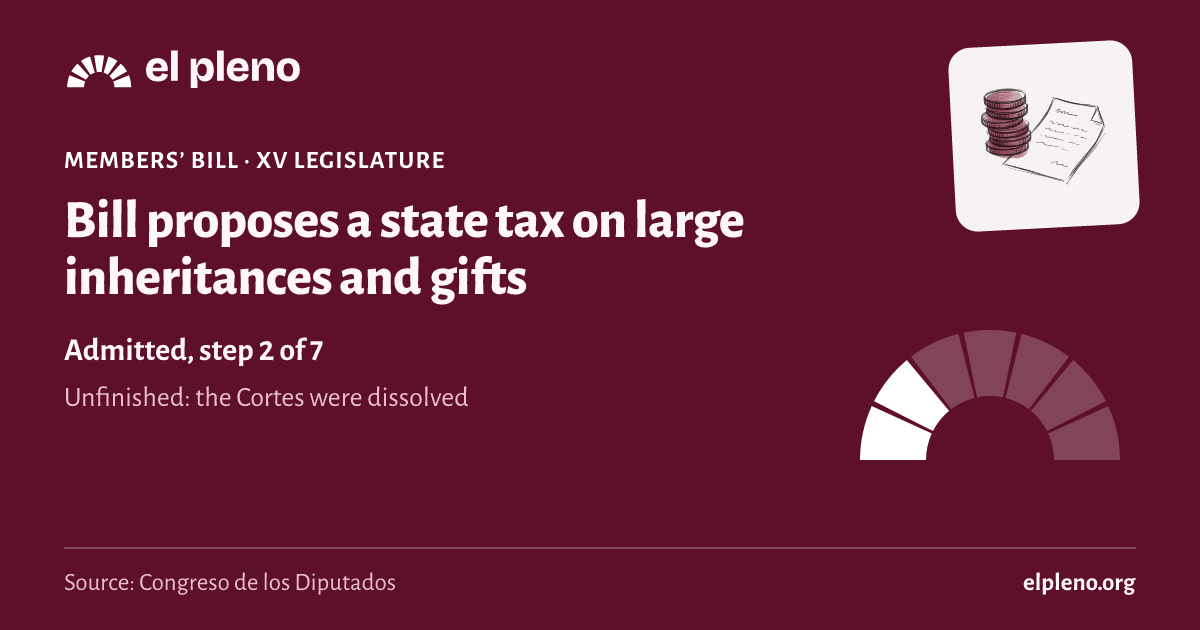
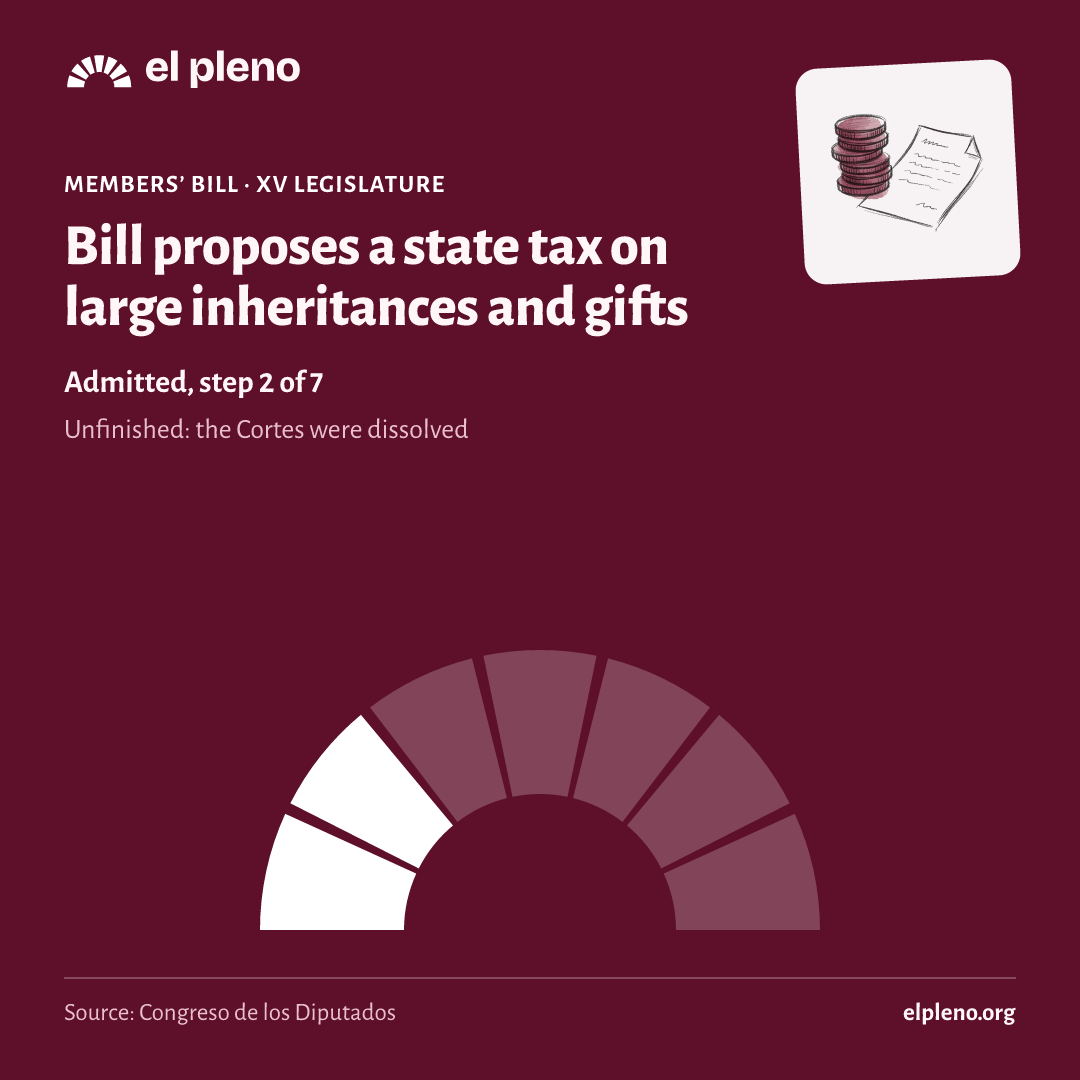
Bill proposes a state tax on large inheritances and gifts
It is a members’ bill. Introduced by parliamentary groups, the Senate, regional governments or citizens. It was introduced on 22 May 2026. Introduced by: Grupo Parlamentario Plurinacional SUMAR.
Official title: Private member's bill to create the Tax on Large Inheritances and Donations.
Source: Congreso de los Diputados, file 122/000283· updated 11 Nov
Automatic summary, not yet reviewed
- The bill would create a Tax on Large Inheritances and Donations, a state tax complementing the Inheritance and Gift Tax, taxing free transfers of wealth to individuals above one million euros.
- The tax would apply across all of Spain, could not be transferred to the autonomous communities, and the state would handle its management and assessment.
- Inheritances, legacies, gifts and life insurance payouts above 1,000,000 euros would be taxable. Gains obtained by legal entities would not fall under this tax but under corporate tax rules.
- The taxable base would include reductions based on kinship, and a 95% reduction for businesses, professional practices or company shares kept for ten years, among other cases. The tax due would come from a progressive scale starting at 0% up to one million euros and reaching 34% above 1,797,555.08 euros.
- Taxpayers could deduct the Inheritance and Gift Tax they actually paid for the same year from this new tax, to avoid paying twice on the same wealth.
- The revenue would go to the Public Treasury and be used to fund policies supporting the most vulnerable. The law would take effect the day after its publication in the Official State Gazette.
Who it affects
- People who inherit or receive gifts worth more than one million euros net: They would pay this state tax, deducting what they already paid under the Inheritance and Gift Tax.
- Beneficiaries of life insurance policies above one million euros: The amounts received would be subject to the tax.
- Families passing on businesses, professional practices or primary homes: They could apply 95% reductions if they keep the assets for ten years, and use deferrals and installment payments.
- Autonomous communities: The tax would be a state tax that cannot be transferred to them, and regional rebates would not prevent payment of this tax.
- Financial institutions and insurance companies: They would be subsidiary liable parties in some cases and could not deliver assets or pay out policies without proof the tax was paid.
Words worth knowing
- Causahabiente
- Person who receives assets from someone who has died, by inheritance or legacy.
- Hecho imponible
- The event that triggers the tax, such as receiving an inheritance.
- Base liquidable
- The amount on which the tax is calculated, after reductions.
- Devengo
- The moment the tax becomes due, for example the date of death.
- Obligación real
- Duty to pay the tax on assets located in Spain when the person does not live there.
It summarizes the text as it was introduced. It is written by artificial intelligence and may contain mistakes: the official text is what counts. Read the official text · How we make summaries
Where it stands
How far did it get?
It took 2 of 7 steps. It reached Admitted, and today it is unfinished.
- Introduced22 May 2026Someone registers the text in the Congreso.
- Admitted26 May 2026The Bureau of the Congreso accepts it and, for a members’ bill, the plenary decides whether to consider it.
- Amendmentsnot reachedGroups propose changes.
- Committeenot reachedA committee goes through the text in detail.
- Plenarynot reachedAll 350 deputies vote.
- Senatenot reachedThe Senate can pass it, amend it or veto it.
- BOEnot reachedIt is published in the Official State Gazette (BOE) and comes into force.
See the 6 official steps on a timeline
Was there a plenary vote?
We have no plenary vote linked to this law in the Congreso’s data.
What happens next
What happens now?
The legislature ended before it finished. To go on, someone would have to introduce it again in the new Cortes.
It has not been presented again yet.
Sources
Where does all this come from?
- Congreso de los Diputados, file 122/000283
Official title, type, author, dates and stage.
Retrieved 11 November 2026
- Congreso de los Diputados, procedure
The date of each step, with its official wording.
Retrieved 12 November 2026
- The data comes from the open files of the Congreso, the Senate and the BOE, unaltered.
- Each deputy’s province is the one of their seat on the day of the vote.
- We only say “passed” or “rejected” when the majority needed is certain; otherwise we say which side had more votes.