What it is
Proposed law to protect great apes and end their captivity
It is a members’ bill. Introduced by parliamentary groups, the Senate, regional governments or citizens. It was introduced on 20 May 2026. Introduced by: Grupo Parlamentario Mixto.
Official title: Private member's bill on great apes.
Source: Congreso de los Diputados, file 122/000282· updated 11 Nov
Automatic summary, not yet reviewed
- The bill would recognize great apes (chimpanzees, bonobos, gorillas and orangutans) as holders of rights derived from their nature, such as living free in their natural habitat and not suffering abuse, without equating them to humans.
- It would ban breeding in captivity, trade, experimentation, use in shows or advertising, and the killing of great apes. Keeping them would only be allowed in authorized centers, and euthanasia only on veterinary criteria to prevent suffering.
- It would create the State Register of Great Apes (Registro Estatal de Grandes Simios), with mandatory registration and public, free-access information, plus an advisory committee that advises and reports on authorized transfers.
- Transfers within Spain would only be allowed for behavioral reasons, overcrowding or welfare improvements, and transfers abroad only to sanctuaries, never for breeding in captivity.
- It would set up a penalty system with fines from €500 to €200,000 depending on whether the offense is minor, serious or very serious, plus additional measures such as closing centers or banning people from keeping great apes.
- Centers that already have great apes would have 12 months to request a keeping permit and 24 months to adapt; the law would take effect three months after publication in the official state gazette.
Who it affects
- Zoos and authorized centers: They would have to request permits, register the animals, prevent breeding, and meet housing conditions and emergency plans.
- People keeping great apes without authorization: This would be a very serious offense, and authorities could rescue the animals and move them to approved centers.
- Spain's autonomous communities: They would handle welfare and keeping permits, and carry out annual inspections of facilities.
- Ministries acting as the CITES authority: They would manage the register, transfers and penalty proceedings.
Words worth knowing
- CITES
- An international treaty regulating trade in endangered species. The 'autoridad administrativa CITES' is the Spanish state body that applies it.
- Santuario (sanctuary)
- An authorized center for housing great apes for reintroduction into the wild or permanent care, with no breeding, public display or commercial exploitation.
- Medidas cautelares (precautionary measures)
- Temporary decisions, such as taking custody of an animal or closing a center, taken during proceedings to protect the animals while the case is resolved.
- Protección in situ (in situ protection)
- Protection carried out in the species' natural habitat, not in captivity.
It summarizes the text as it was introduced. It is written by artificial intelligence and may contain mistakes: the official text is what counts. Read the official text · How we make summaries
Where it stands
How far did it get?
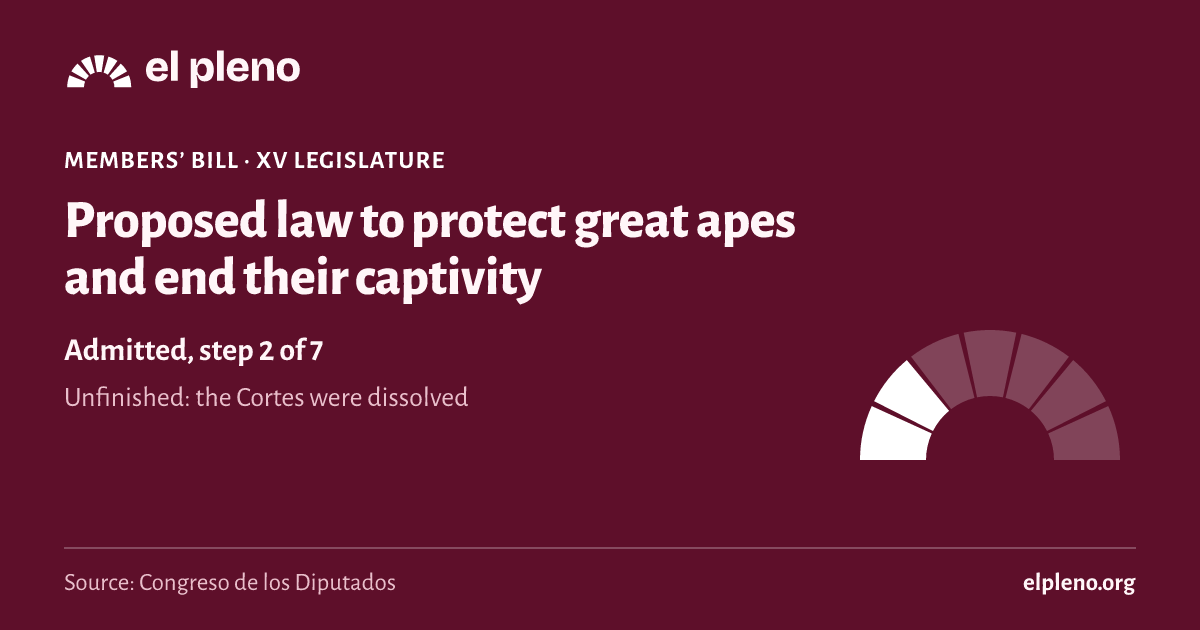
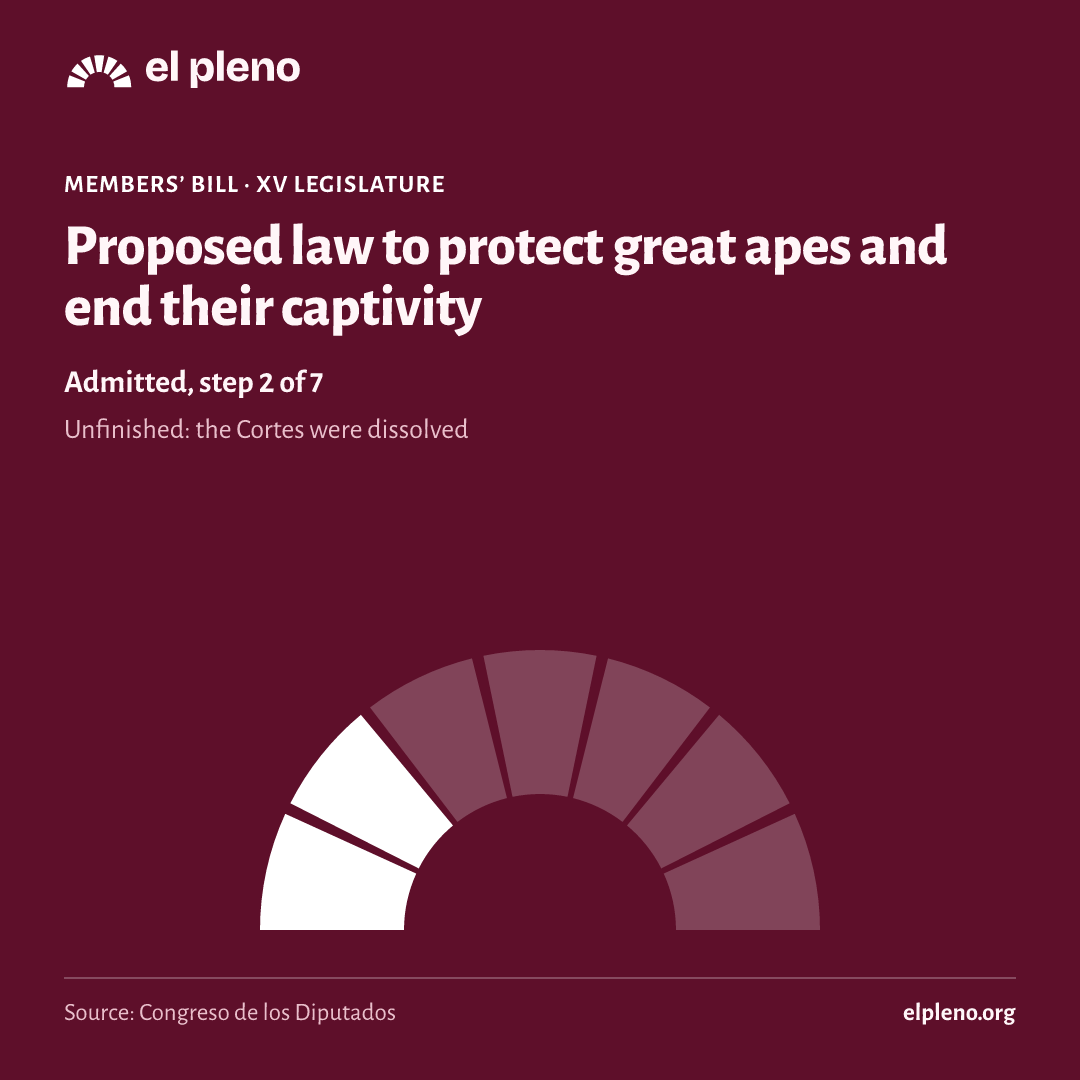
It took 2 of 7 steps. It reached Admitted, and today it is unfinished.
- Introduced20 May 2026Someone registers the text in the Congreso.
- Admitted26 May 2026The Bureau of the Congreso accepts it and, for a members’ bill, the plenary decides whether to consider it.
- Amendmentsnot reachedGroups propose changes.
- Committeenot reachedA committee goes through the text in detail.
- Plenarynot reachedAll 350 deputies vote.
- Senatenot reachedThe Senate can pass it, amend it or veto it.
- BOEnot reachedIt is published in the Official State Gazette (BOE) and comes into force.
See the 6 official steps on a timeline
Was there a plenary vote?
We have no plenary vote linked to this law in the Congreso’s data.
What happens next
What happens now?
The legislature ended before it finished. To go on, someone would have to introduce it again in the new Cortes.
It has not been presented again yet.
Sources
Where does all this come from?
- Congreso de los Diputados, file 122/000282
Official title, type, author, dates and stage.
Retrieved 11 November 2026
- Congreso de los Diputados, procedure
The date of each step, with its official wording.
Retrieved 12 November 2026
- The data comes from the open files of the Congreso, the Senate and the BOE, unaltered.
- Each deputy’s province is the one of their seat on the day of the vote.
- We only say “passed” or “rejected” when the majority needed is certain; otherwise we say which side had more votes.