

What it is
Bill proposes new court rules for involuntary psychiatric admissions
It is a members’ bill. Introduced by parliamentary groups, the Senate, regional governments or citizens. It was introduced on 24 April 2026. Introduced by: Grupo Parlamentario Socialista.
Official title: Private member's Organic Bill reforming the processing of involuntary internments under Article 763 of the Law on Civil Procedure.
Source: Congreso de los Diputados, file 122/000279· updated 11 Nov
Automatic summary, not yet reviewed
- The bill adds a new chapter to the Civil Procedure Act that distinguishes three types of involuntary admission for mental health reasons: care-related (long-stay or residential), therapeutic (short-stay), and vital emergency (imminent risk to the person's life or integrity or to third parties). All would require court authorization or ratification.
- Care-related and therapeutic admissions would be handled through voluntary jurisdiction proceedings, with a lawyer from the start and the ruling notified the same day it is issued.
- A vital emergency admission would have to be ratified within a maximum of 72 hours. The facility would send the medical report within 24 hours, the judge would personally hear the person with their lawyer, and an independent physician would issue an opinion. An urgent appeal would be available against the ruling.
- For minors, the court would always have to hear the parents or guardians, and the admission would take place in a facility suited to the minor's age, with a prior report from the minor care services.
Who it affects
- People with a mental disorder who could be admitted without their consent: They would have a court procedure with safeguards: a lawyer, the right to be heard, periodic review, and discharge once the grounds end.
- Families and guardians of admitted minors: They would be heard by the court before the admission is authorized or ratified.
- Health facilities and their staff: They would have to send medical reports within set deadlines and discharge people once the grounds for admission end.
- Judges and the Public Prosecutor's Office: They would have new oversight duties, decision deadlines, and control over the measure.
Words worth knowing
- Internamiento no voluntario
- Admission to a facility for mental health reasons without the affected person's consent.
- Jurisdicción voluntaria
- A type of court proceeding with no dispute between parties, used to authorize or oversee certain decisions.
- Auto
- A ruling issued by a judge or court to decide a matter.
- Recurso de apelación
- A request for a higher court to review a judicial decision.
- Ley orgánica
- A special type of Spanish law, reserved for key matters such as fundamental rights, requiring enhanced majorities to pass.
It summarizes the text as it was introduced. It is written by artificial intelligence and may contain mistakes: the official text is what counts. Read the official text · How we make summaries
Where it stands
How far did it get?
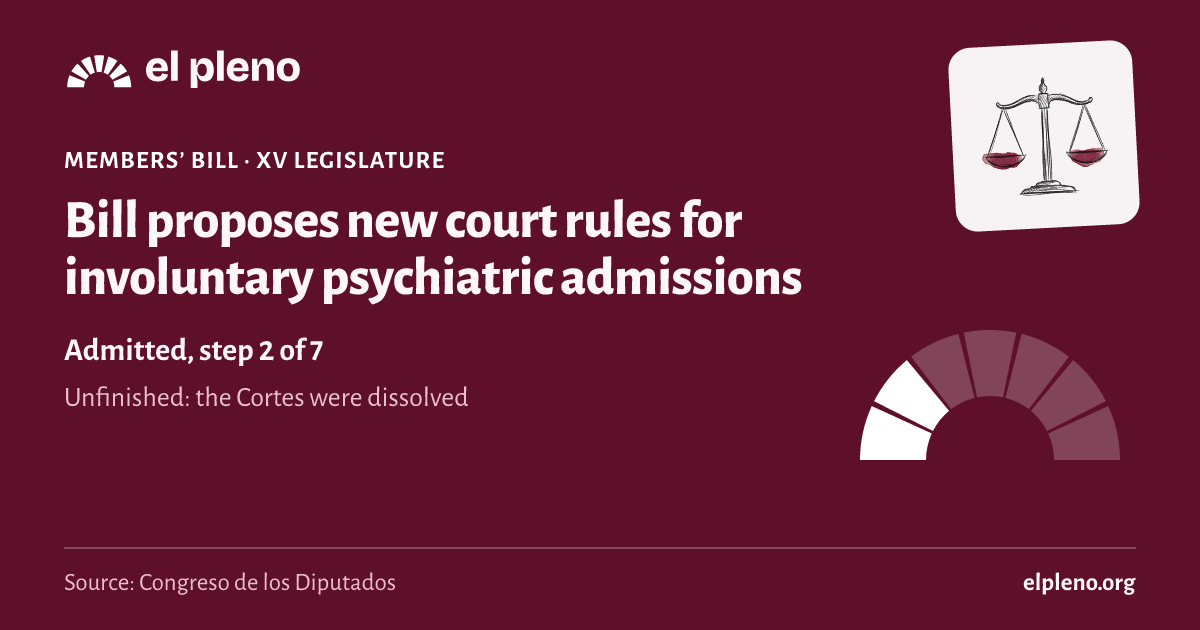
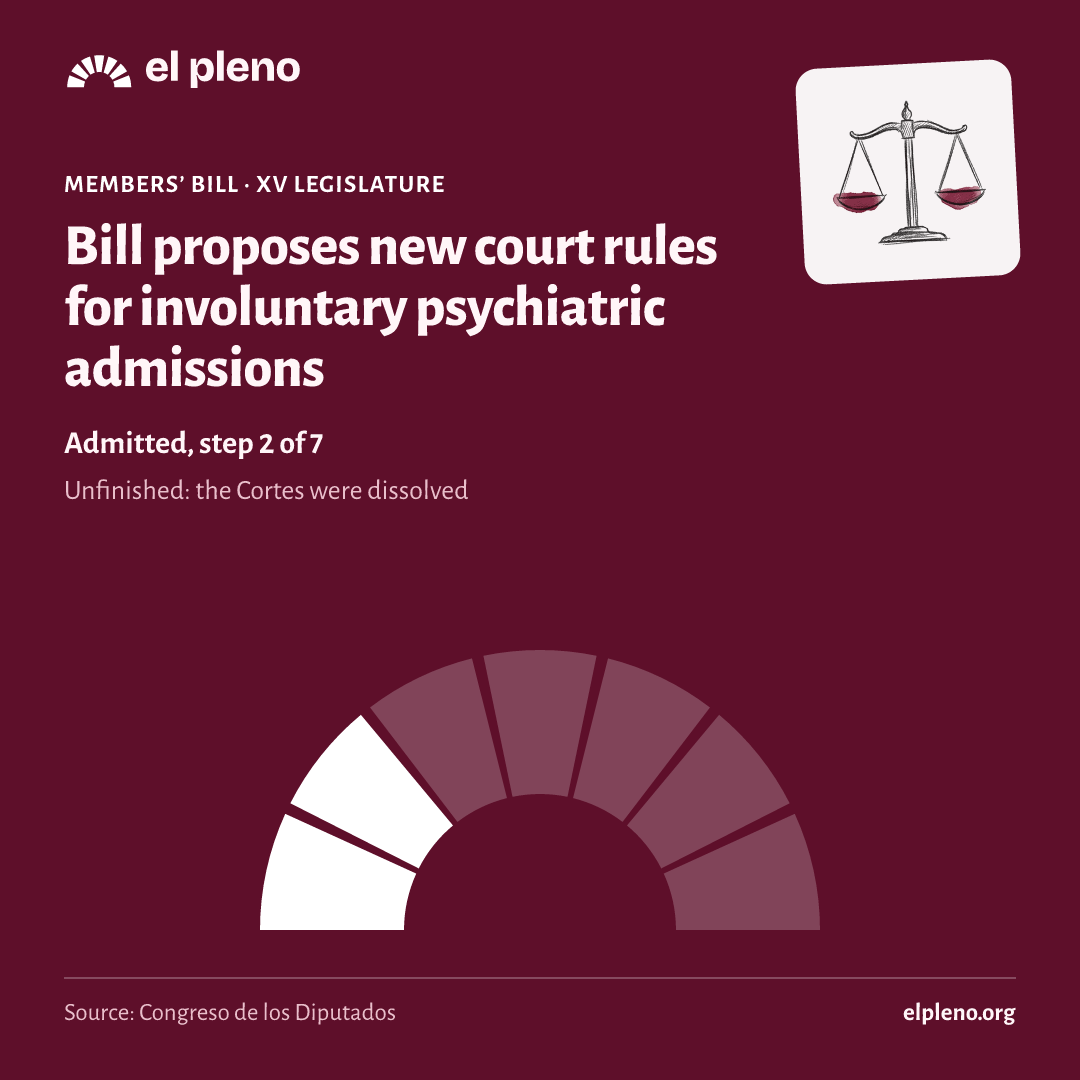
It took 2 of 7 steps. It reached Admitted, and today it is unfinished.
- Introduced24 April 2026Someone registers the text in the Congreso.
- Admitted28 April 2026The Bureau of the Congreso accepts it and, for a members’ bill, the plenary decides whether to consider it.
- Amendmentsnot reachedGroups propose changes.
- Committeenot reachedA committee goes through the text in detail.
- Plenarynot reachedAll 350 deputies vote.
- Senatenot reachedThe Senate can pass it, amend it or veto it.
- BOEnot reachedIt is published in the Official State Gazette (BOE) and comes into force.
See the 6 official steps on a timeline
Was there a plenary vote?
We have no plenary vote linked to this law in the Congreso’s data.
What happens next
What happens now?
The legislature ended before it finished. To go on, someone would have to introduce it again in the new Cortes.
It has not been presented again yet.
Sources
Where does all this come from?
- Congreso de los Diputados, file 122/000279
Official title, type, author, dates and stage.
Retrieved 11 November 2026
- Congreso de los Diputados, procedure
The date of each step, with its official wording.
Retrieved 13 November 2026
- The data comes from the open files of the Congreso, the Senate and the BOE, unaltered.
- Each deputy’s province is the one of their seat on the day of the vote.
- We only say “passed” or “rejected” when the majority needed is certain; otherwise we say which side had more votes.