What it is
Bill to limit store openings on Sundays and holidays
It is a members’ bill. Introduced by parliamentary groups, the Senate, regional governments or citizens. It was introduced on 22 April 2026. Introduced by: Grupo Parlamentario Plurinacional SUMAR.
Official title: Private member's bill amending Law 1/2004, on Commercial Hours, to guarantee the right to Sunday rest and the enjoyment of family life.
Source: Congreso de los Diputados, file 122/000277· updated 11 Nov
Automatic summary, not yet reviewed
- The bill would cap the number of Sundays and holidays per year when stores may open at 8 days. In areas with heavy tourist traffic, that number could rise by at most 50%, and the Autonomous Communities could lower it further.
- Stores such as bakeries, newsstands, gas stations, florists and convenience stores, as well as small stores under 300 square meters, would keep full freedom to set their opening hours, unless they belong to large distribution groups.
- Heavy tourist traffic areas would be declared by the Autonomous Communities at the request of city councils, and the request must be justified; if no decision is made within six months, it is deemed rejected. Cities with over 100,000 residents and many tourist overnight stays or cruise passengers would have to declare at least one such area.
- The explanatory statement defends Sunday rest and family life, criticizes the 24/7 economy and the role of shopping malls, and cites examples from Germany, Switzerland and Austria plus a 2025 Spanish Supreme Court ruling.
Words worth knowing
- Proposición de ley
- A bill introduced by a parliamentary group so it can become law. It is not approved yet.
- Zona de gran afluencia turística
- An area with many tourists, officially declared, where stores may have broader opening hours.
- Tiendas de conveniencia
- Convenience stores of up to 500 square meters that open at least eighteen hours a day and sell a bit of everything.
- Pernoctaciones
- Nights that tourists spend staying overnight in a municipality.
It summarizes the text as it was introduced. It is written by artificial intelligence and may contain mistakes: the official text is what counts. Read the official text · How we make summaries
Where it stands
How far did it get?
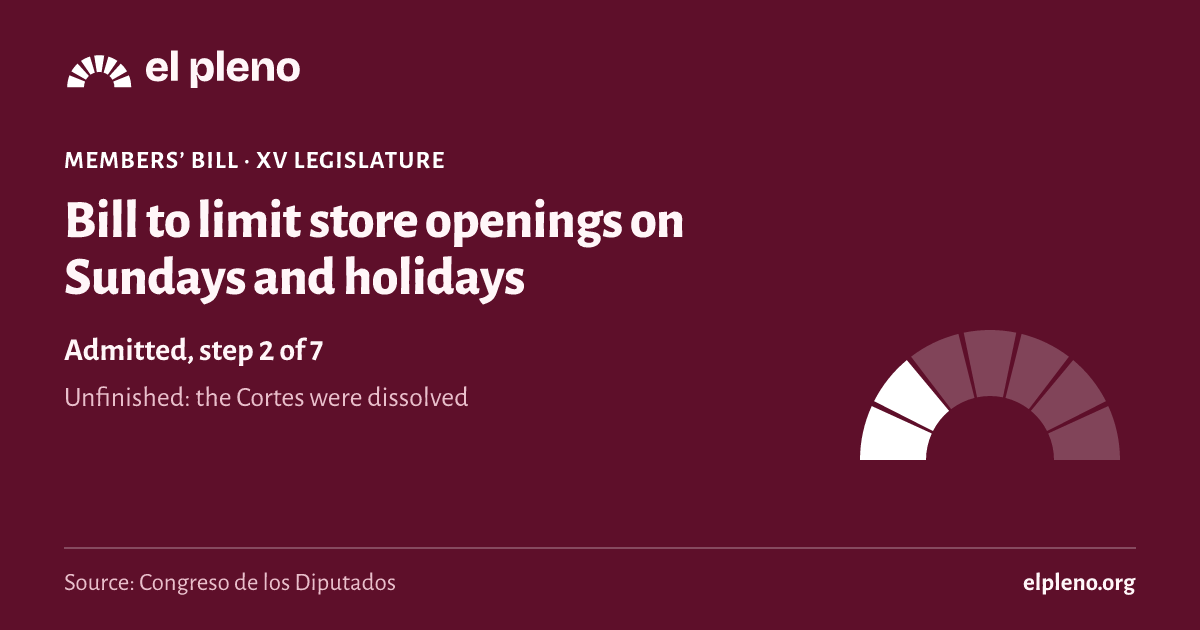
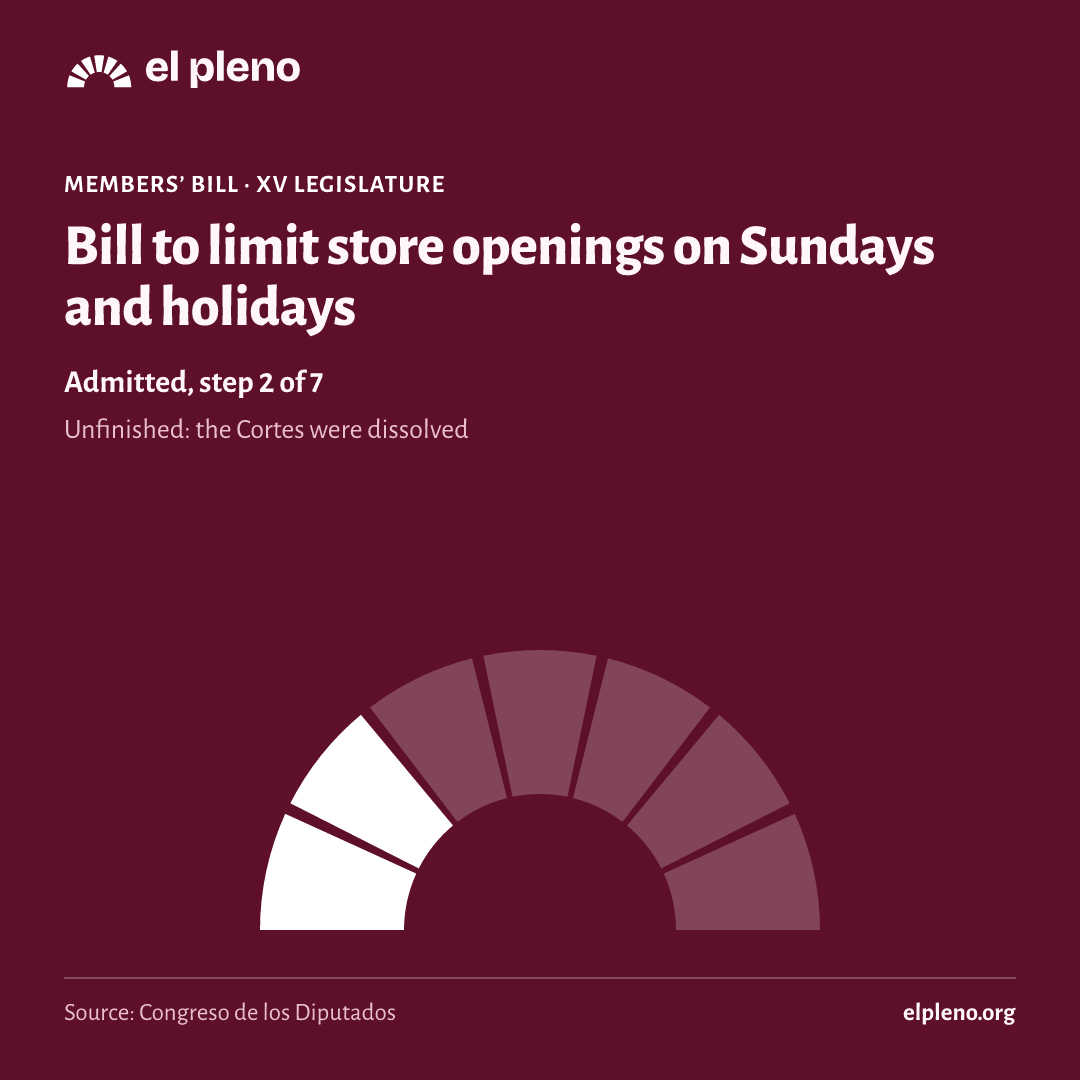
It took 2 of 7 steps. It reached Admitted, and today it is unfinished.
- Introduced22 April 2026Someone registers the text in the Congreso.
- Admitted28 April 2026The Bureau of the Congreso accepts it and, for a members’ bill, the plenary decides whether to consider it.
- Amendmentsnot reachedGroups propose changes.
- Committeenot reachedA committee goes through the text in detail.
- Plenarynot reachedAll 350 deputies vote.
- Senatenot reachedThe Senate can pass it, amend it or veto it.
- BOEnot reachedIt is published in the Official State Gazette (BOE) and comes into force.
See the 6 official steps on a timeline
Was there a plenary vote?
We have no plenary vote linked to this law in the Congreso’s data.
What happens next
What happens now?
The legislature ended before it finished. To go on, someone would have to introduce it again in the new Cortes.
It has not been presented again yet.
Sources
Where does all this come from?
- Congreso de los Diputados, file 122/000277
Official title, type, author, dates and stage.
Retrieved 11 November 2026
- Congreso de los Diputados, procedure
The date of each step, with its official wording.
Retrieved 12 November 2026
- The data comes from the open files of the Congreso, the Senate and the BOE, unaltered.
- Each deputy’s province is the one of their seat on the day of the vote.
- We only say “passed” or “rejected” when the majority needed is certain; otherwise we say which side had more votes.