What it is
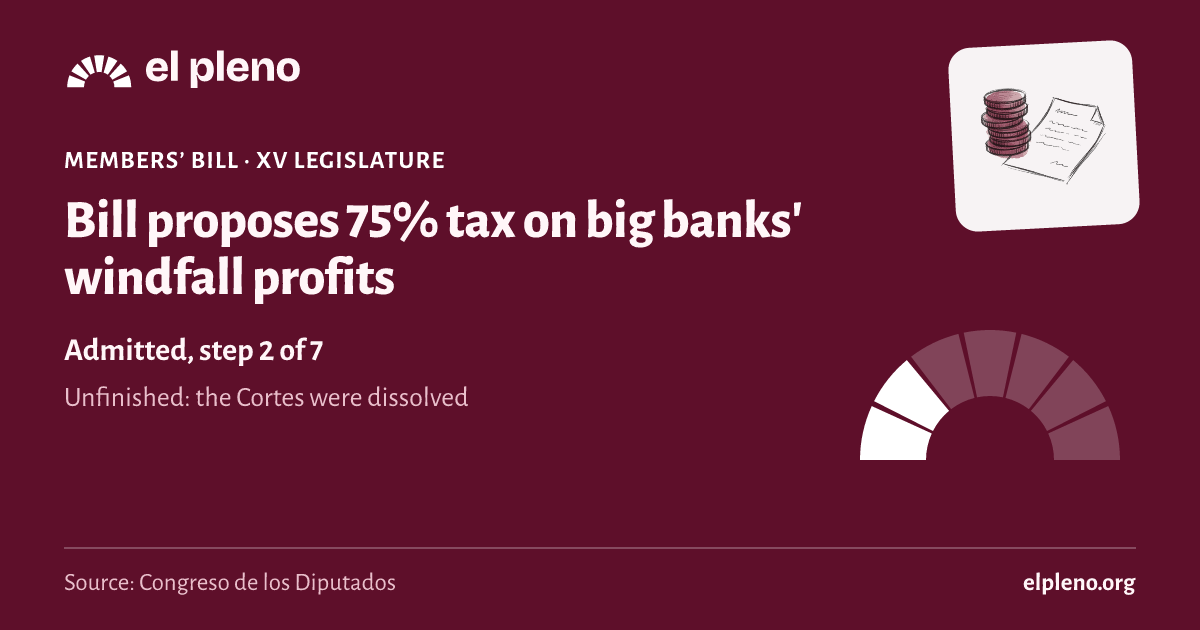
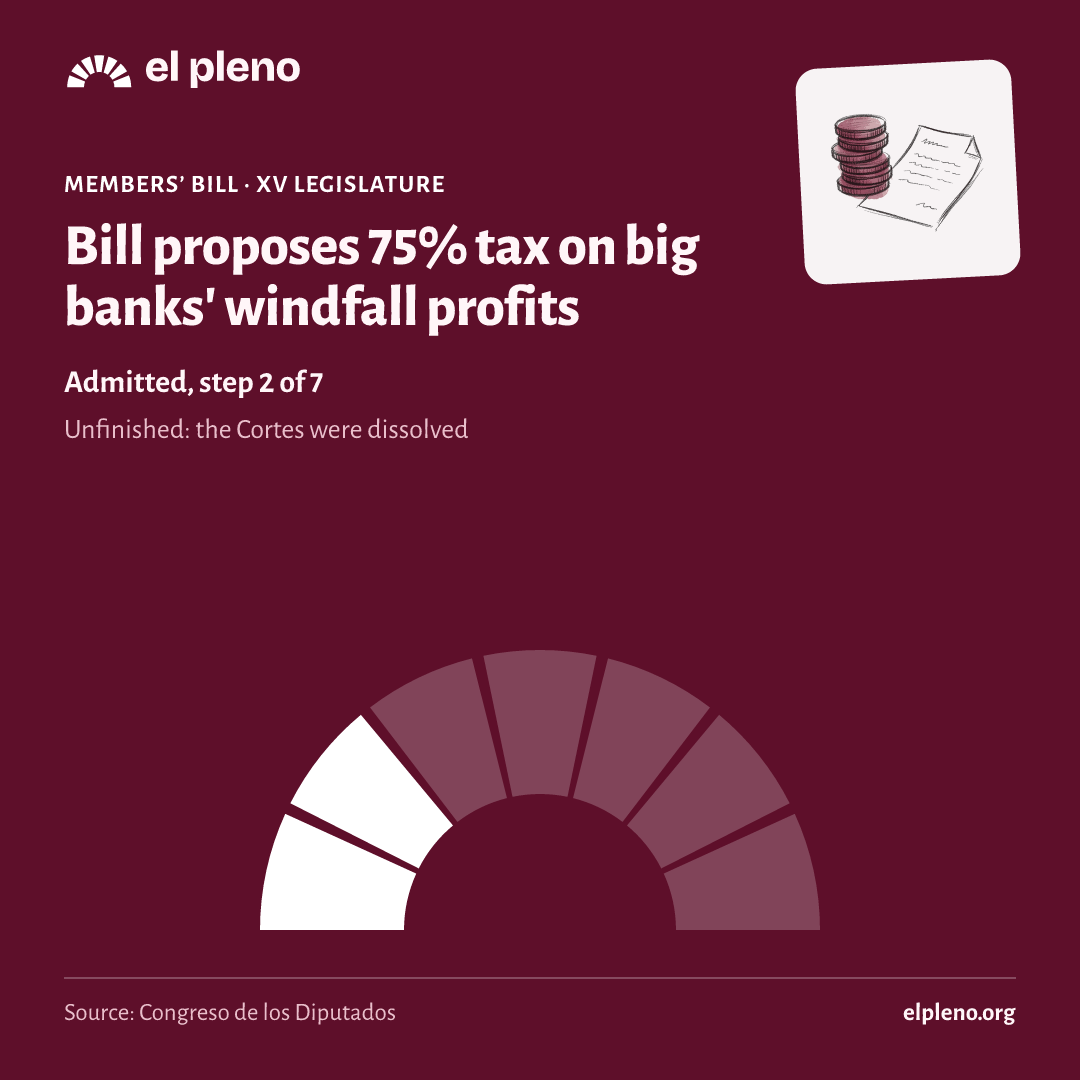
Bill proposes 75% tax on big banks' windfall profits
It is a members’ bill. Introduced by parliamentary groups, the Senate, regional governments or citizens. It was introduced on 4 March 2026. Introduced by: Grupo Parlamentario Mixto.
Official title: Private member's bill for the correct imposition of the benefits fallen from the sky of the big banks.
Source: Congreso de los Diputados, file 122/000264· updated 11 Nov
Automatic summary, not yet reviewed
- The bill would create a temporary levy on big banks' extraordinary margins, payable in 2027, 2028 and 2029. It would only affect credit institutions with interest and commission income of €800 million or more in 2019.
- The standard levy would be 10% of the previous year's interest and commission margin. In addition, 75% would apply to anything more than 5% above the total for the first half of 2022, with an advance payment of 57% in February.
- Banks could not pass the cost of the levy on to their customers. Doing so would be a very serious offense, with a fine of 150% of the amount passed on, and the CNMC (competition watchdog) would monitor compliance.
- The money raised would go to a fund managed by the Ministry of Transport to lend to local governments to build public social rental housing in tight housing markets, for vulnerable people on the waiting list for public housing.
- The explanatory statement justifies the measure by banking concentration, the 2008 bailout with €60 billion unrecoverable, and record bank profits. It considers the current bank tax under Law 38/2022 insufficient.
- The law would take effect on the first day of the fiscal year after its publication in the Official State Gazette.
Who it affects
- Large banks and credit institutions with interest and commission income of €800 million or more (2019).: They would have to pay the new temporary levies in 2027, 2028 and 2029, with an advance payment in February.
- Vulnerable people on the waiting list for public housing.: They would be the intended residents of the public social rental housing built with the fund.
- Municipalities and local entities in tight housing markets.: They could receive credit from the fund to build public rental housing.
- Bank customers.: Banks could not pass the cost of the levy on to them, on pain of a 150% fine.
Words worth knowing
- Gravamen
- A charge or payment obligation imposed on someone, similar to a tax.
- Prestación patrimonial de carácter público no tributario
- A mandatory payment to the State that is not technically a tax, though it works in a similar way.
- Consolidación fiscal
- A regime in which several companies in the same group file taxes together, as if they were one.
- Vivienda de protección oficial
- Public housing with capped prices for people with fewer resources.
- Zonas tensionadas
- Areas where rents have risen sharply and access to housing is difficult.
It summarizes the text as it was introduced. It is written by artificial intelligence and may contain mistakes: the official text is what counts. Read the official text · How we make summaries
Where it stands
How far did it get?
It took 2 of 7 steps. It reached Admitted, and today it is unfinished.
- Introduced4 March 2026Someone registers the text in the Congreso.
- Admitted10 March 2026The Bureau of the Congreso accepts it and, for a members’ bill, the plenary decides whether to consider it.
- Amendmentsnot reachedGroups propose changes.
- Committeenot reachedA committee goes through the text in detail.
- Plenarynot reachedAll 350 deputies vote.
- Senatenot reachedThe Senate can pass it, amend it or veto it.
- BOEnot reachedIt is published in the Official State Gazette (BOE) and comes into force.
See the 6 official steps on a timeline
Was there a plenary vote?
We have no plenary vote linked to this law in the Congreso’s data.
What happens next
What happens now?
The legislature ended before it finished. To go on, someone would have to introduce it again in the new Cortes.
It has not been presented again yet.
Sources
Where does all this come from?
- Congreso de los Diputados, file 122/000264
Official title, type, author, dates and stage.
Retrieved 11 November 2026
- Congreso de los Diputados, procedure
The date of each step, with its official wording.
Retrieved 12 November 2026
- The data comes from the open files of the Congreso, the Senate and the BOE, unaltered.
- Each deputy’s province is the one of their seat on the day of the vote.
- We only say “passed” or “rejected” when the majority needed is certain; otherwise we say which side had more votes.