What it is
Bill would treat victims of State agents as terrorism victims
It is a members’ bill. Introduced by parliamentary groups, the Senate, regional governments or citizens. It was introduced on 2 March 2026. Introduced by: Grupo Parlamentario Plurinacional SUMAR.
Official title: Private member's bill for the recognition and equalization of victims of crimes committed by State agents.
Source: Congreso de los Diputados, file 122/000263· updated 11 Nov
Automatic summary, not yet reviewed
- The bill would amend the 2011 law on victims of terrorism so that victims of crimes committed by State agents while performing official duties before January 1, 1983 would also be recognized as victims. This changes the law's purpose, values, beneficiaries and holders of rights.
- It would add a provision to that same law so the deadline to apply for recognition starts counting from the entry into force of the new rule.
- The bill would add to the Democratic Memory Law compensation of €250,000 for the beneficiaries of people who died between January 1, 1968 and January 1, 1983 defending democratic freedoms and rights. It would only be paid if no equal or larger compensation was already received for the same acts, and there would be one year to apply.
- The explanatory statement justifies the measure as recognition and reparation for victims of police repression, from the Franco dictatorship until the consolidation of democracy, and mentions the case of Manuel José García Caparrós.
Words worth knowing
- Proposición de ley
- A bill introduced by members of Congress. It is not a law until passed.
- Sentencia firme
- A final court ruling that can no longer be appealed.
- Derechohabiente
- A person who inherits or receives another person's rights, such as aid for a deceased victim.
- Disposición derogatoria
- The part of a law that repeals earlier rules that conflict with it.
It summarizes the text as it was introduced. It is written by artificial intelligence and may contain mistakes: the official text is what counts. Read the official text · How we make summaries
Where it stands
How far did it get?
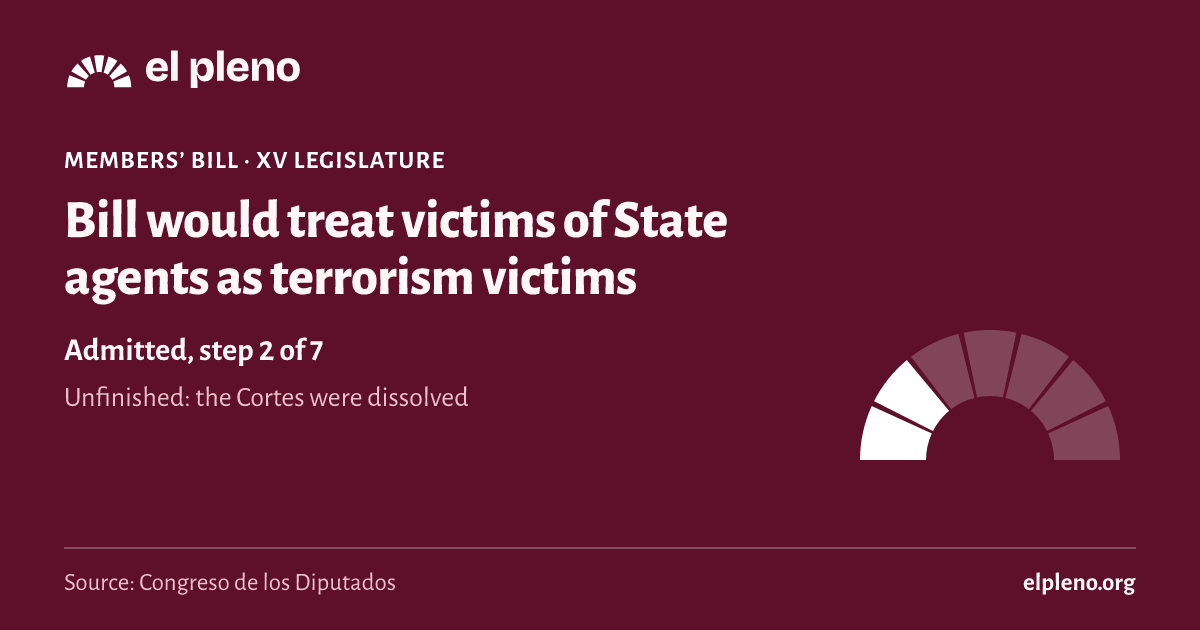
It took 2 of 7 steps. It reached Admitted, and today it is unfinished.
- Introduced2 March 2026Someone registers the text in the Congreso.
- Admitted10 March 2026The Bureau of the Congreso accepts it and, for a members’ bill, the plenary decides whether to consider it.
- Amendmentsnot reachedGroups propose changes.
- Committeenot reachedA committee goes through the text in detail.
- Plenarynot reachedAll 350 deputies vote.
- Senatenot reachedThe Senate can pass it, amend it or veto it.
- BOEnot reachedIt is published in the Official State Gazette (BOE) and comes into force.
See the 6 official steps on a timeline
Was there a plenary vote?
We have no plenary vote linked to this law in the Congreso’s data.
What happens next
What happens now?
The legislature ended before it finished. To go on, someone would have to introduce it again in the new Cortes.
It has not been presented again yet.
Sources
Where does all this come from?
- Congreso de los Diputados, file 122/000263
Official title, type, author, dates and stage.
Retrieved 11 November 2026
- Congreso de los Diputados, procedure
The date of each step, with its official wording.
Retrieved 12 November 2026
- The data comes from the open files of the Congreso, the Senate and the BOE, unaltered.
- Each deputy’s province is the one of their seat on the day of the vote.
- We only say “passed” or “rejected” when the majority needed is certain; otherwise we say which side had more votes.