What it is
Proposal to ban face coverings in public spaces
It is a members’ bill. Introduced by parliamentary groups, the Senate, regional governments or citizens. It was introduced on 19 February 2026. Introduced by: Grupo Parlamentario Popular en el Congreso.
Official title: Private member's Organic bill regulating the use of garments and elements that conceal the face in public spaces.
Source: Congreso de los Diputados, file 122/000259· updated 11 Nov
Automatic summary, not yet reviewed
- The bill would ban wearing clothing or items that fully or partially cover the face and prevent or make it hard to identify a person in public spaces or places open to the public, such as streets, public buildings, schools, health centers and public transport.
- The ban would not apply in specific cases: medical or health reasons, justified work or protection needs, authorized cultural, festive, traditional or sports activities, bad weather declared by the authorities, and anything a law provides for.
- Breaking the rule would be a minor offense with a 100 euro fine, which could rise to 600 euros if repeated. Encouraging others to break it would always carry a 600 euro fine. For minor offenses, the authority could offer to replace the fine with voluntary awareness, training or social integration programs.
- The Government, together with the autonomous communities and local entities, would promote common protocols to apply the law, and religious entities and social organizations could take part. The law would take effect twenty days after publication in the Boletín Oficial del Estado (official state gazette).
Who it affects
- Anyone in public spaces or entering buildings and services open to the public: They could not wear items that cover the face in a way that makes identification hard, except for the exceptions provided.
- People with medical, work or protection reasons: They could keep covering their face if their case fits one of the law's exceptions.
- People who break the ban: They would face 100 euro fines, up to 600 euros if repeated, or the option of joining awareness or training programs.
- Autonomous communities and city councils: They could issue their own rules within their powers, but would have to respect this law, and would help build the application protocols.
Words worth knowing
- Proposición de ley
- A bill introduced by a parliamentary group to become a law. It is not an approved law yet: it is still going through the legislative process.
- Ley orgánica
- A type of Spanish law that requires an absolute majority in Congress and is reserved for major matters, such as fundamental rights.
- Infracción administrativa leve
- A minor offense punished with a fine, not a crime.
- Velo integral
- A garment that covers the whole face, such as the burka or niqab, as the text itself mentions.
It summarizes the text as it was introduced. It is written by artificial intelligence and may contain mistakes: the official text is what counts. Read the official text · How we make summaries
Where it stands
How far did it get?
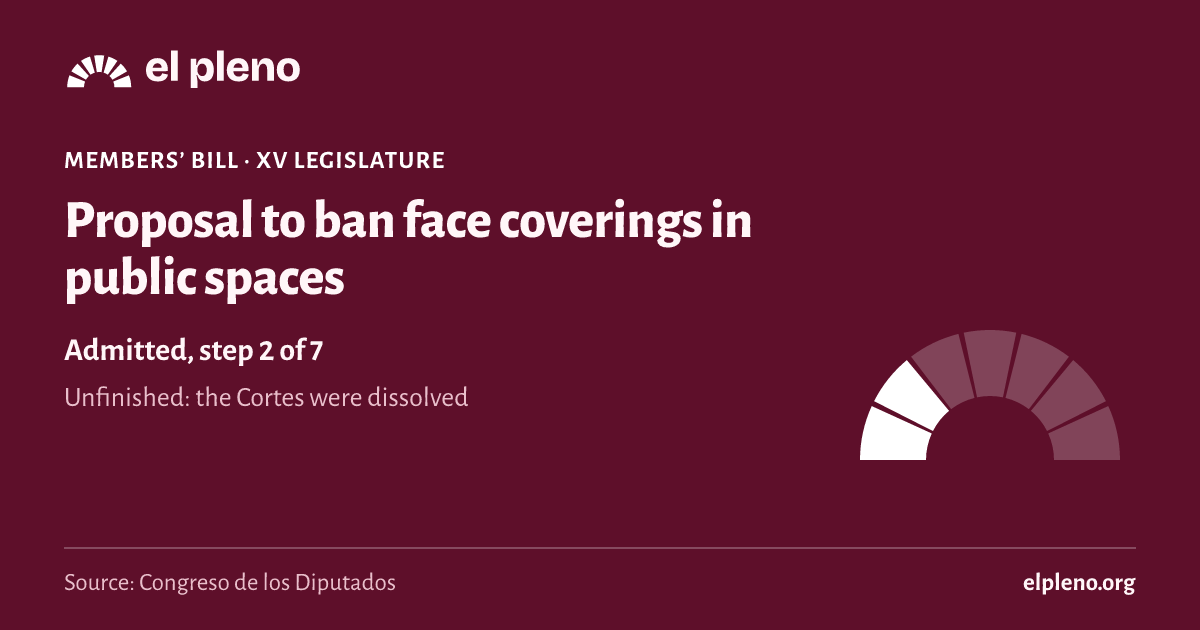
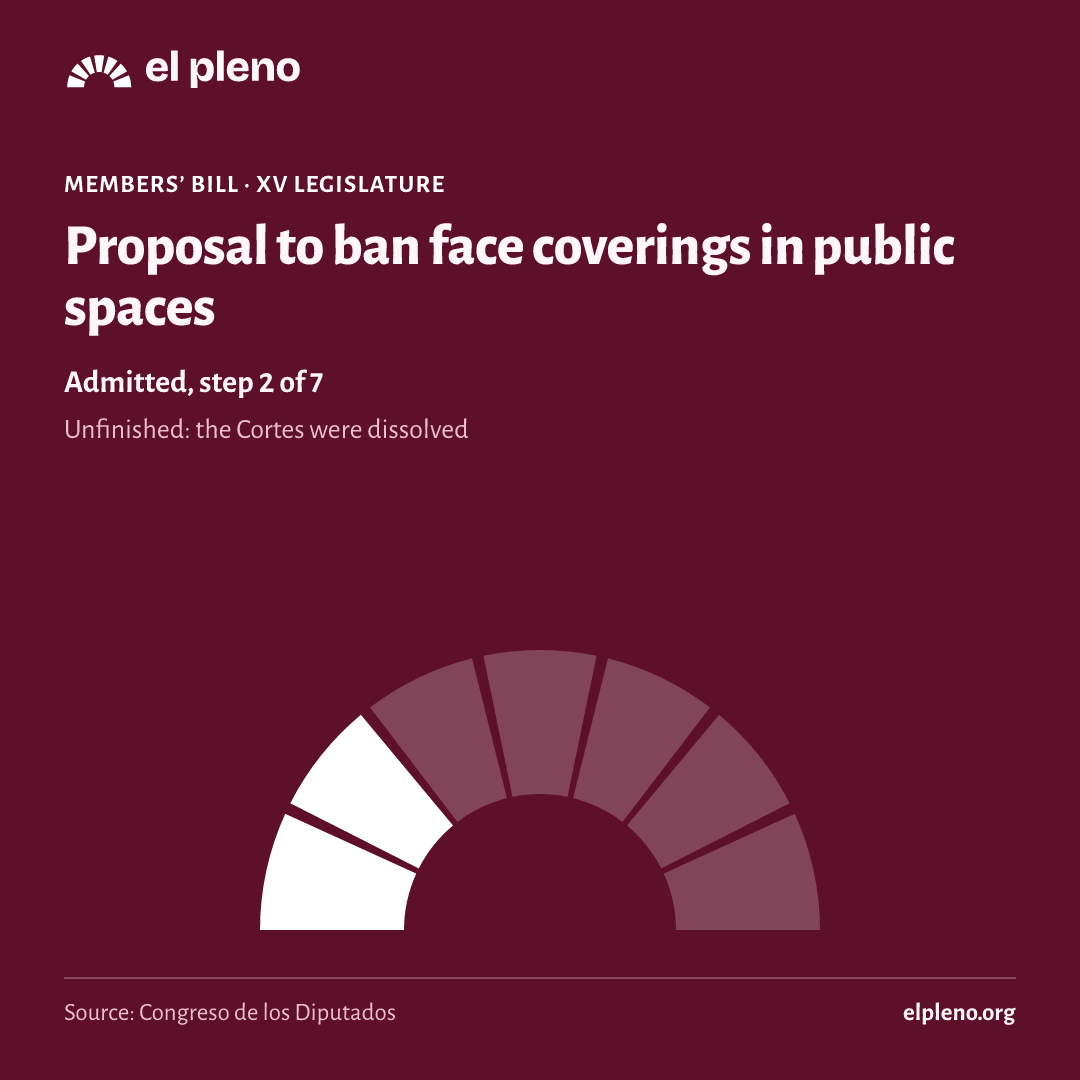
It took 2 of 7 steps. It reached Admitted, and today it is unfinished.
- Introduced19 February 2026Someone registers the text in the Congreso.
- Admitted24 February 2026The Bureau of the Congreso accepts it and, for a members’ bill, the plenary decides whether to consider it.
- Amendmentsnot reachedGroups propose changes.
- Committeenot reachedA committee goes through the text in detail.
- Plenarynot reachedAll 350 deputies vote.
- Senatenot reachedThe Senate can pass it, amend it or veto it.
- BOEnot reachedIt is published in the Official State Gazette (BOE) and comes into force.
See the 6 official steps on a timeline
Was there a plenary vote?
We have no plenary vote linked to this law in the Congreso’s data.
What happens next
What happens now?
The legislature ended before it finished. To go on, someone would have to introduce it again in the new Cortes.
It has not been presented again yet.
The same initiative in the other chamber:
Sources
Where does all this come from?
- Congreso de los Diputados, file 122/000259
Official title, type, author, dates and stage.
Retrieved 11 November 2026
- Congreso de los Diputados, procedure
The date of each step, with its official wording.
Retrieved 12 November 2026
- The data comes from the open files of the Congreso, the Senate and the BOE, unaltered.
- Each deputy’s province is the one of their seat on the day of the vote.
- We only say “passed” or “rejected” when the majority needed is certain; otherwise we say which side had more votes.