What it is
Proposal to nationalize Repsol and turn it into a green public company
It is a members’ bill. Introduced by parliamentary groups, the Senate, regional governments or citizens. It was introduced on 17 February 2026. Introduced by: Grupo Parlamentario Mixto.
Official title: Private member's bill on the nationalization of Repsol and its conversion into a public company serving a green and just energy transition.
Source: Congreso de los Diputados, file 122/000258· updated 11 Nov
Automatic summary, not yet reviewed
- The bill, introduced by the Mixed Group in the Congress of Deputies (Congreso de los Diputados), wants the State to buy Repsol through SEPI Sociedad Española de Participaciones Industriales, the public company that manages the Spanish State's stakes in other companies.: first at least 25% of the shares, and at least 51% before October 29, 2026 to take control of the company.
- It declares the nationalization a decision of public utility, based on the general interest of protecting a safe climate.
- It bans Repsol from exploring or exploiting new fossil fuel deposits until 2030 and forces it to leave major projects such as Marcellus Shale (United States) or El Sharara (Libya).
- It requires a new 2026-2030 strategic plan aligned with the Paris Agreement, with at least a 75% cut in hydrocarbon production and refining before 2030, and a goal of a 100% renewable company by 2050.
- It creates a permanent scientific advisory board, with at least eight experts in climate and green industrial conversion, which must approve the company's plans before they go to the shareholders' meeting.
- From January 1, 2027, Repsol would pay the cost of 100% of its emissions, with no free emission allowances, and its companies in tax havens would have to move to Spain or transparent tax jurisdictions. Current jobs would be guaranteed at least until January 1, 2031.
Who it affects
- Repsol and its shareholders: The State would take control of the company and its fossil fuel activity would be limited.
- Repsol's current workers: Their current contracts would be guaranteed at least until January 1, 2031.
- The Government and SEPI: They would have to buy the shares, appoint the new management and oversee the process.
- Public administrations and technical staff: The Repsol Foundation would be redirected to train them on the climate crisis and energy transition.
Words worth knowing
- Nacionalización (nationalization)
- Transferring a private company to State ownership or control.
- SEPI
- Sociedad Española de Participaciones Industriales, the public company that manages the Spanish State's stakes in other companies.
- Moratoria (moratorium)
- A temporary ban on doing something, here exploring for and extracting fossil fuels.
- Paraíso fiscal (tax haven)
- A country or territory with very low taxes and little transparency, used to pay less tax.
- Presupuesto de carbono (carbon budget)
- The maximum amount of greenhouse gases that can be emitted without exceeding a given temperature rise.
It summarizes the text as it was introduced. It is written by artificial intelligence and may contain mistakes: the official text is what counts. Read the official text · How we make summaries
Where it stands
How far did it get?
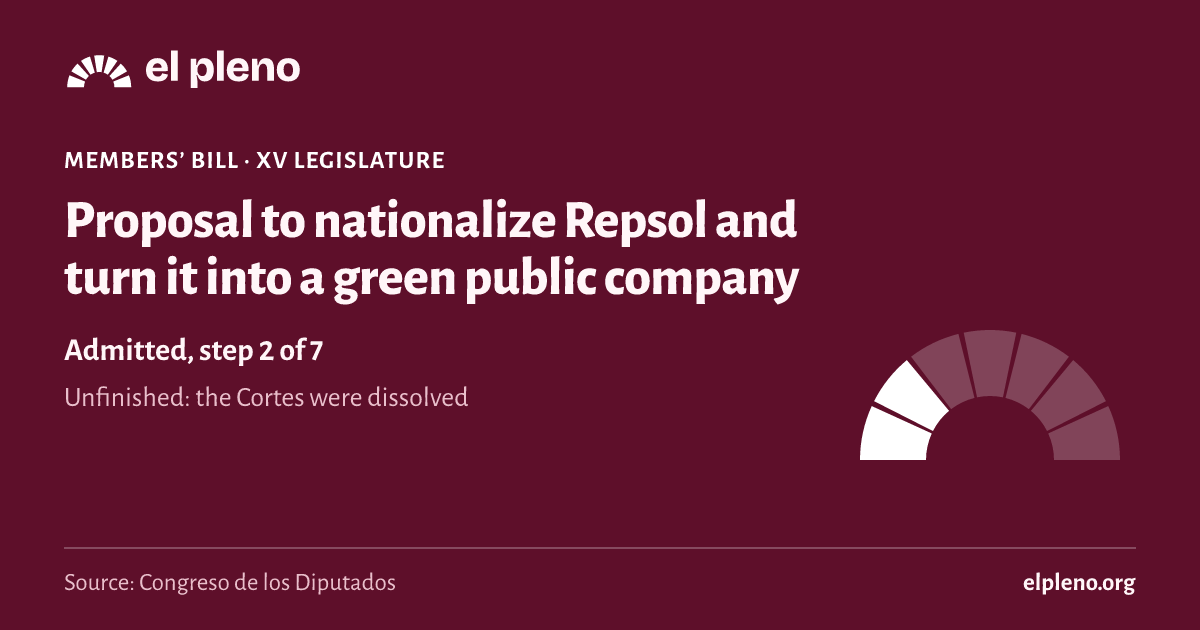
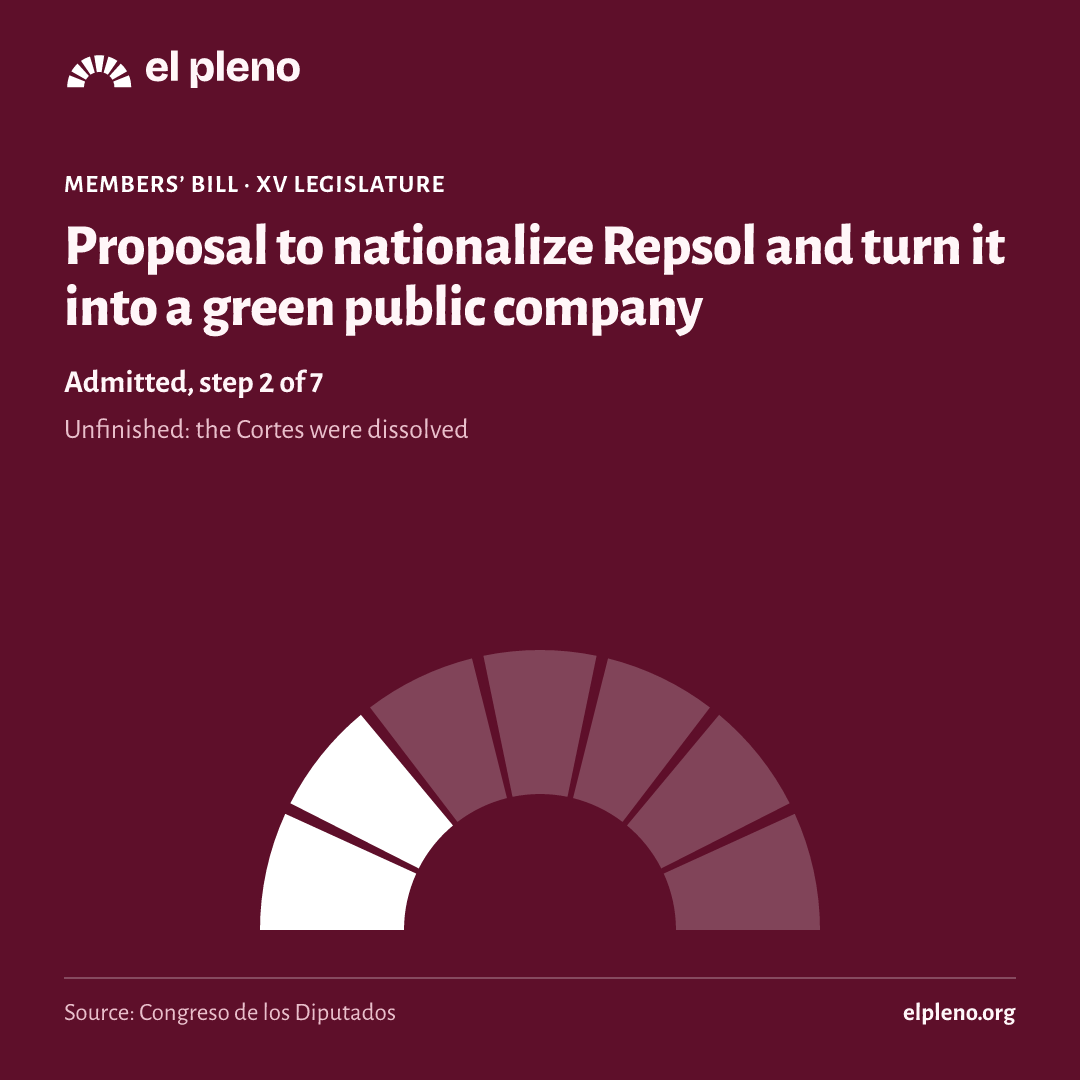
It took 2 of 7 steps. It reached Admitted, and today it is unfinished.
- Introduced17 February 2026Someone registers the text in the Congreso.
- Admitted24 February 2026The Bureau of the Congreso accepts it and, for a members’ bill, the plenary decides whether to consider it.
- Amendmentsnot reachedGroups propose changes.
- Committeenot reachedA committee goes through the text in detail.
- Plenarynot reachedAll 350 deputies vote.
- Senatenot reachedThe Senate can pass it, amend it or veto it.
- BOEnot reachedIt is published in the Official State Gazette (BOE) and comes into force.
See the 6 official steps on a timeline
Was there a plenary vote?
We have no plenary vote linked to this law in the Congreso’s data.
What happens next
What happens now?
The legislature ended before it finished. To go on, someone would have to introduce it again in the new Cortes.
It has not been presented again yet.
Sources
Where does all this come from?
- Congreso de los Diputados, file 122/000258
Official title, type, author, dates and stage.
Retrieved 11 November 2026
- Congreso de los Diputados, procedure
The date of each step, with its official wording.
Retrieved 12 November 2026
- The data comes from the open files of the Congreso, the Senate and the BOE, unaltered.
- Each deputy’s province is the one of their seat on the day of the vote.
- We only say “passed” or “rejected” when the majority needed is certain; otherwise we say which side had more votes.