What it is
Bill proposes jail time and protection zones for harassment outside abortion clinics
It is a members’ bill. Introduced by parliamentary groups, the Senate, regional governments or citizens. It was introduced on 11 February 2026. Introduced by: Grupo Parlamentario Plurinacional SUMAR.
Official title: Private member's Organic bill amending Article 172.quater of the Penal Code, which regulates the right to voluntary interruption of pregnancy.
Source: Congreso de los Diputados, file 122/000255· updated 11 Nov
Automatic summary, not yet reviewed
- The bill would add to the Criminal Code a crime of harassment against anyone who exercises or tries to exercise the right to abortion, with a prison sentence of three months to one year or community service of thirty-one to eighty days. It would also punish harassing healthcare staff who perform abortions.
- It would ban gatherings, vigils or any organized or spontaneous presence within a 200-meter perimeter around the entrances to clinics authorized to perform abortions, even if peaceful or religiously motivated. Within that perimeter, harassment would be presumed, with no need to prove individualized harassment.
- The judge could additionally bar the convicted person from certain places or digital environments for six months to three years. The victim would not need to file a complaint for these acts to be prosecuted.
- The bill is put forward because some court rulings have interpreted the current Article 172 quater of the Criminal Code narrowly, leaving out collective prayers or gatherings outside clinics that create environmental pressure. It cites the recent Constitutional Court ruling upholding that article as constitutional.
Who it affects
- Women who go to or want to go to a clinic to have an abortion, who would be protected from harassment and from gatherings within a 200-meter radius.: protection
- Healthcare and management staff at clinics authorized to perform abortions, who would also be protected from harassment aimed at stopping their work.: protection
- People taking part in gatherings, prayers or vigils outside these clinics, who could face prison sentences or community service.: penalty
Words worth knowing
- Proposición de Ley Orgánica
- A bill to change a law introduced by members of Congress (Congreso de los Diputados). It is not yet an approved law: it must be debated and voted on by Congress and the Senate.
- Código Penal
- The Spanish Criminal Code, the law listing crimes and the penalties for committing them.
- Trabajos en beneficio de la comunidad
- Community service, a penalty alternative to prison consisting of unpaid work for the community for a number of days.
- Artículo 172 quater
- The section of the Criminal Code that punishes harassment of women going to abortion clinics. "Quater" means it was added a fourth time to that article number.
- Perímetro de seguridad
- Security perimeter, a zone around a place where certain conduct is banned, here 200 meters around the entrances to the clinics.
It summarizes the text as it was introduced. It is written by artificial intelligence and may contain mistakes: the official text is what counts. Read the official text · How we make summaries
Where it stands
How far did it get?
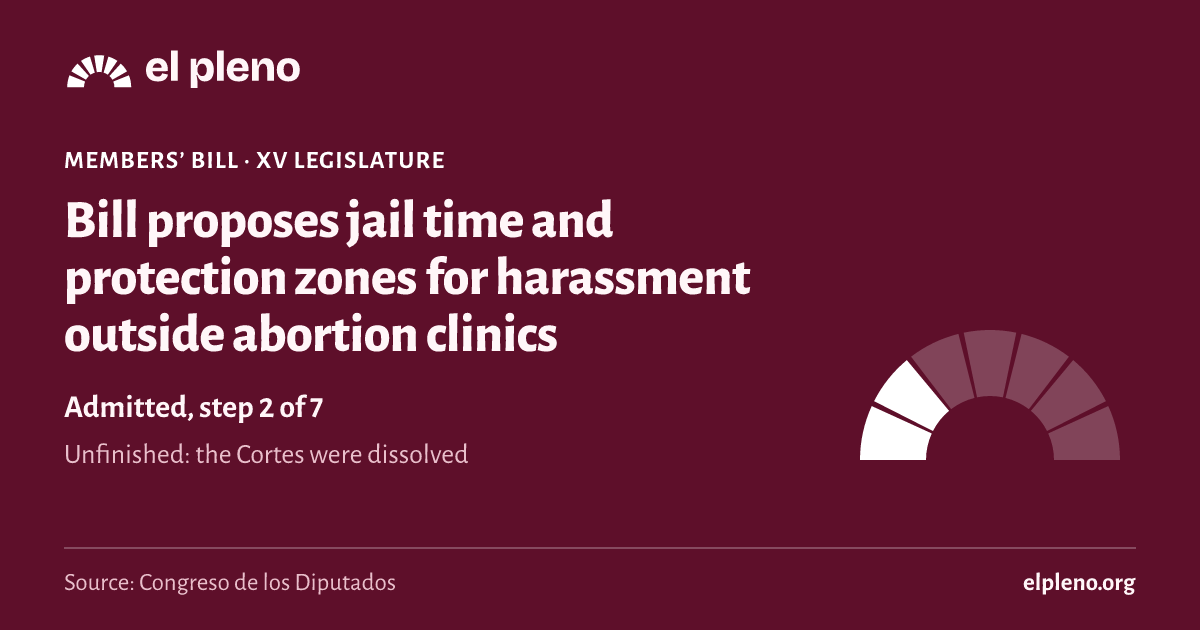
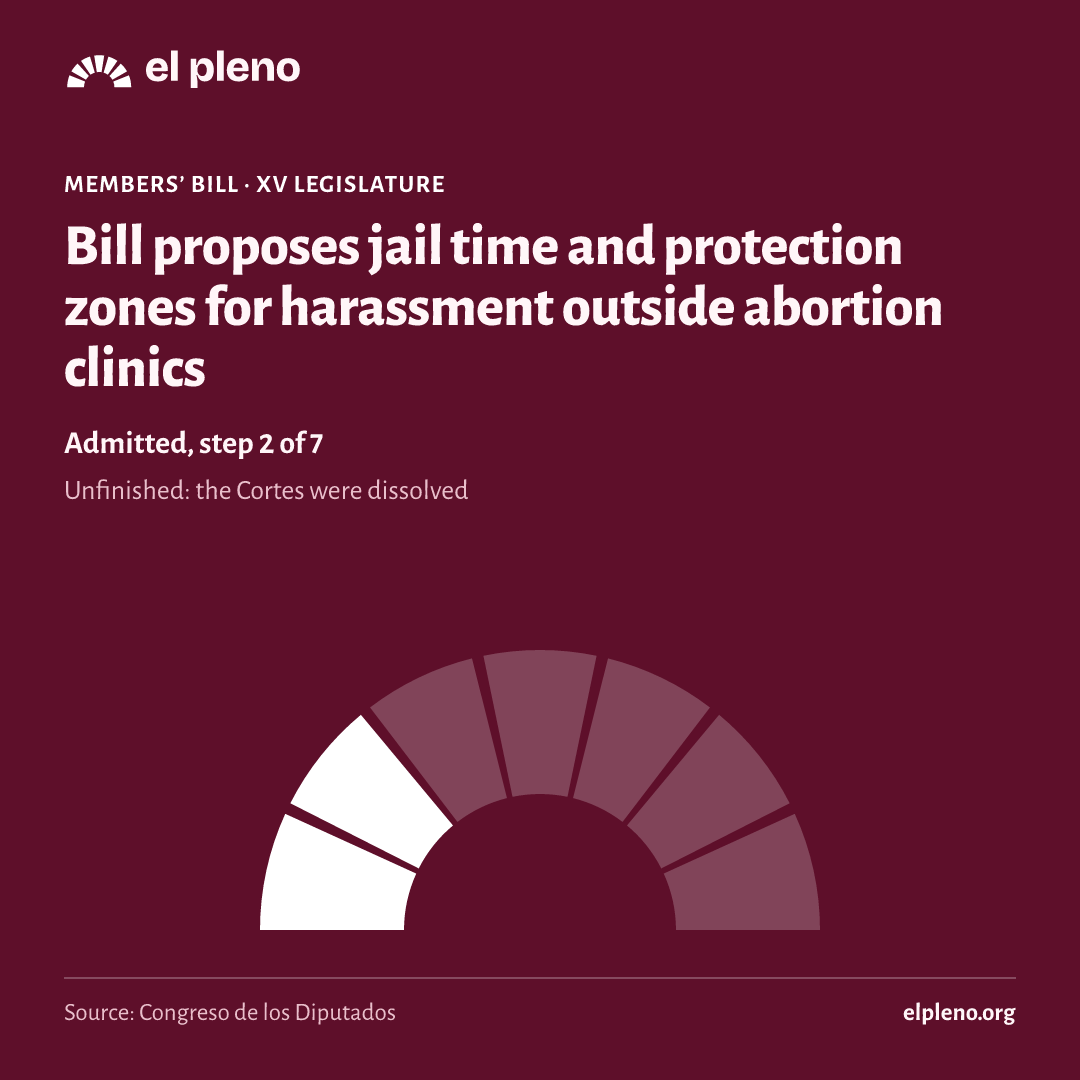
It took 2 of 7 steps. It reached Admitted, and today it is unfinished.
- Introduced11 February 2026Someone registers the text in the Congreso.
- Admitted17 February 2026The Bureau of the Congreso accepts it and, for a members’ bill, the plenary decides whether to consider it.
- Amendmentsnot reachedGroups propose changes.
- Committeenot reachedA committee goes through the text in detail.
- Plenarynot reachedAll 350 deputies vote.
- Senatenot reachedThe Senate can pass it, amend it or veto it.
- BOEnot reachedIt is published in the Official State Gazette (BOE) and comes into force.
See the 6 official steps on a timeline
Was there a plenary vote?
We have no plenary vote linked to this law in the Congreso’s data.
What happens next
What happens now?
The legislature ended before it finished. To go on, someone would have to introduce it again in the new Cortes.
It has not been presented again yet.
Sources
Where does all this come from?
- Congreso de los Diputados, file 122/000255
Official title, type, author, dates and stage.
Retrieved 11 November 2026
- Congreso de los Diputados, procedure
The date of each step, with its official wording.
Retrieved 12 November 2026
- The data comes from the open files of the Congreso, the Senate and the BOE, unaltered.
- Each deputy’s province is the one of their seat on the day of the vote.
- We only say “passed” or “rejected” when the majority needed is certain; otherwise we say which side had more votes.