What it is
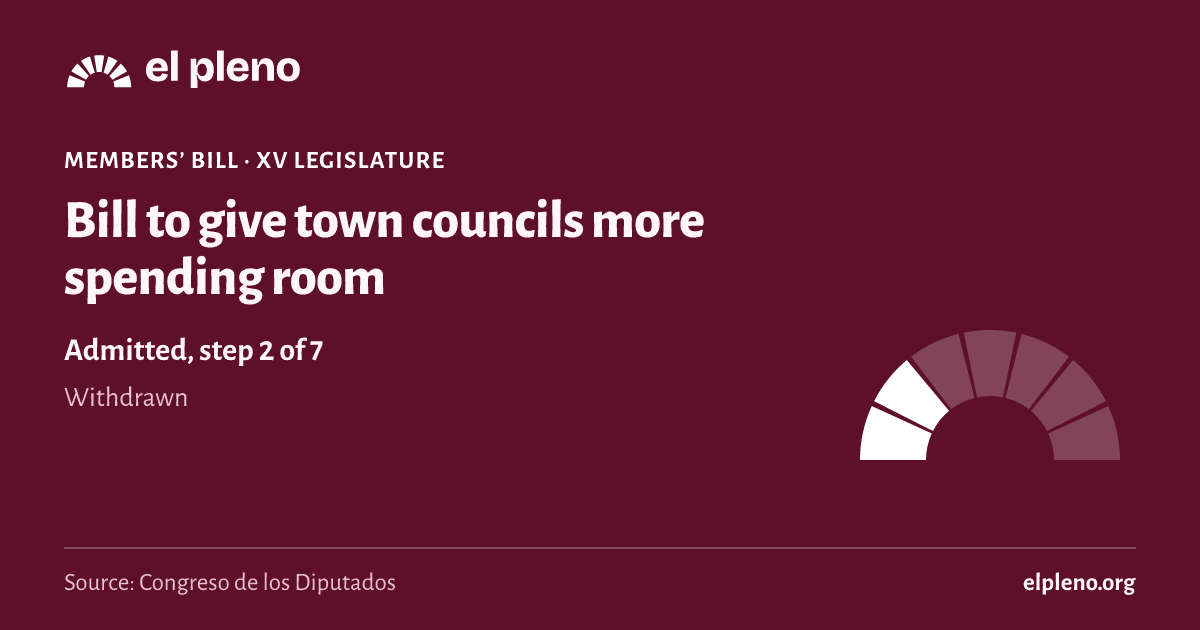
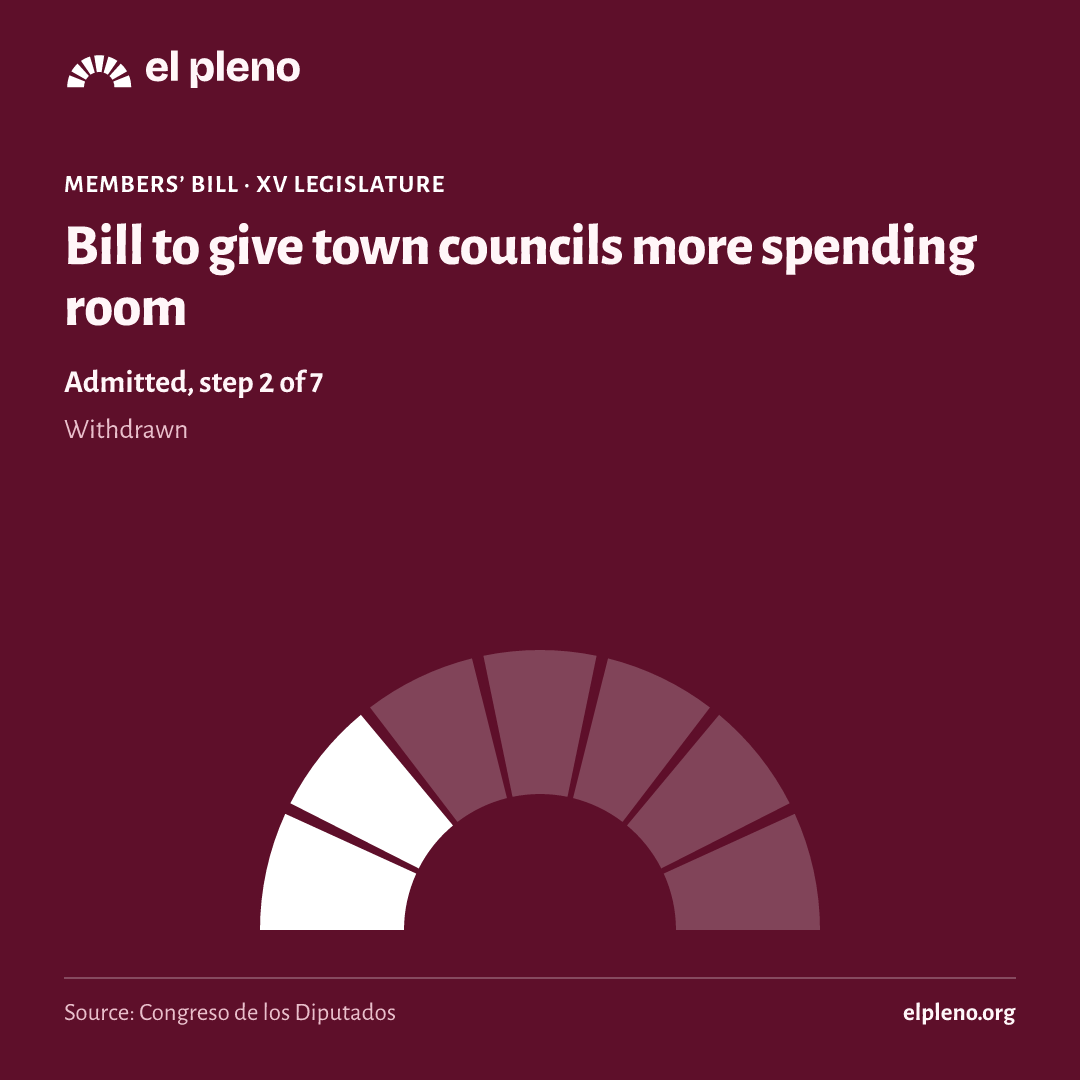
Bill to give town councils more spending room
It is a members’ bill. Introduced by parliamentary groups, the Senate, regional governments or citizens. It was introduced on 4 December 2025. Introduced by: Grupo Parlamentario Republicano.
Official title: Private member's bill on the urgent amendment of Organic Law 2/2012 on Budgetary Stability and Financial Sustainability.
Source: Congreso de los Diputados, file 122/000246· updated 11 Nov
Automatic summary, not yet reviewed
- The bill, introduced by the Republican Parliamentary Group and admitted for processing, would amend the 2012 organic law A law on fundamental rights, the electoral system or other matters the Constitution reserves. It needs an absolute majority in the Congreso: 176 votes. on Budgetary Stability and Financial Sustainability so that town councils can spend their savings and better plan their investments.
- It would repeal Law 27/2013 on Rationalization and Sustainability of Local Administration (LRSAL A 2013 law that reduced town councils' powers and limited their spending, which the bill would repeal.), which the text says limited local autonomy, and add a provision to guarantee the financial sufficiency of town councils.
- It would allow town councils to run a Déficit A situation where an administration spends more than it takes in. in emergencies such as natural disasters or health emergencies, provided they approve a rebalancing plan and keep debt below 110% of current revenues.
- It would exclude financially sustainable town councils from the spending rule and allow those with a surplus and positive treasury balance to spend above that limit. It would also stop requiring councils below the legal debt limit to use all their surpluses to pay down debt.
- It would distribute the 60% of GDP debt limit among the central state (34.8%), the autonomous communities (18.6%) and local corporations (6.6%), and require deficit targets to be debated and approved with representatives of the communities and town councils.
- It would create a new Article 24 bis exempting town councils from corrective measures when they exceed fiscal rules due to investment in building, renovating or acquiring public housing.
Who it affects
- Town councils: They could spend their surpluses on services and investments, opt out of the spending rule if they are sustainable, and avoid penalties for investing in public housing.
- Autonomous communities: They would take part in debating and approving deficit targets and would have a set share of the debt limit.
- The Government: It would have to approve, within six months, a bill to improve the funding of local administrations.
- Citizens: The text argues that public services such as education, health, housing and social services would improve.
Words worth knowing
- Regla de gasto (spending rule)
- A legal limit on how much public spending can grow each year.
- Superávit (surplus)
- A situation where an administration takes in more than it spends.
- Déficit
- A situation where an administration spends more than it takes in.
- Remanente de tesorería (treasury balance)
- Leftover money remaining in an administration's accounts at the end of the fiscal year.
- LRSAL
- A 2013 law that reduced town councils' powers and limited their spending, which the bill would repeal.
- organic law
- A law on fundamental rights, the electoral system or other matters the Constitution reserves. It needs an absolute majority in the Congreso: 176 votes.
It summarizes the text as it was introduced. It is written by artificial intelligence and may contain mistakes: the official text is what counts. Read the official text · How we make summaries
Where it stands
How far did it get?
It took 2 of 7 steps. It reached Admitted, and today it is withdrawn.
- Introduced4 December 2025Someone registers the text in the Congreso.
- Admitted9 December 2025The Bureau of the Congreso accepts it and, for a members’ bill, the plenary decides whether to consider it.
- Amendmentsnot reachedGroups propose changes.
- Committeenot reachedA committee goes through the text in detail.
- Plenarynot reachedAll 350 deputies vote.
- Senatenot reachedThe Senate can pass it, amend it or veto it.
- BOEnot reachedIt is published in the Official State Gazette (BOE) and comes into force.
See the 6 official steps on a timeline
Was there a plenary vote?
We have no plenary vote linked to this law in the Congreso’s data.
What happens next
What happens now?
Whoever introduced it withdrew it, or it was merged into another one. It goes no further.
Sources
Where does all this come from?
- Congreso de los Diputados, file 122/000246
Official title, type, author, dates and stage.
Retrieved 11 November 2026
- Congreso de los Diputados, procedure
The date of each step, with its official wording.
Retrieved 12 November 2026
- The data comes from the open files of the Congreso, the Senate and the BOE, unaltered.
- Each deputy’s province is the one of their seat on the day of the vote.
- We only say “passed” or “rejected” when the majority needed is certain; otherwise we say which side had more votes.