What it is
Bill would recognize Patronato detainees as Franco dictatorship victims
It is a members’ bill. Introduced by parliamentary groups, the Senate, regional governments or citizens. It was introduced on 25 November 2025. Introduced by: Grupo Parlamentario Republicano.
Official title: Private member's bill on the recognition as victims of the Franco dictatorship of the women interned in the 'Patronato de Protección a la Mujer'.
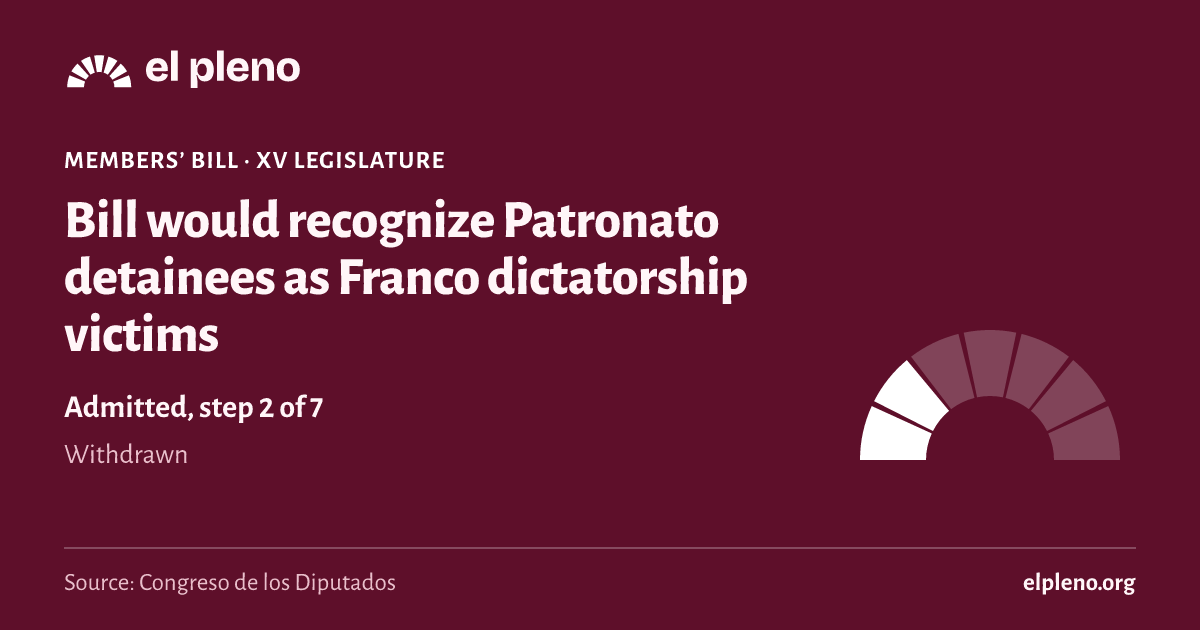
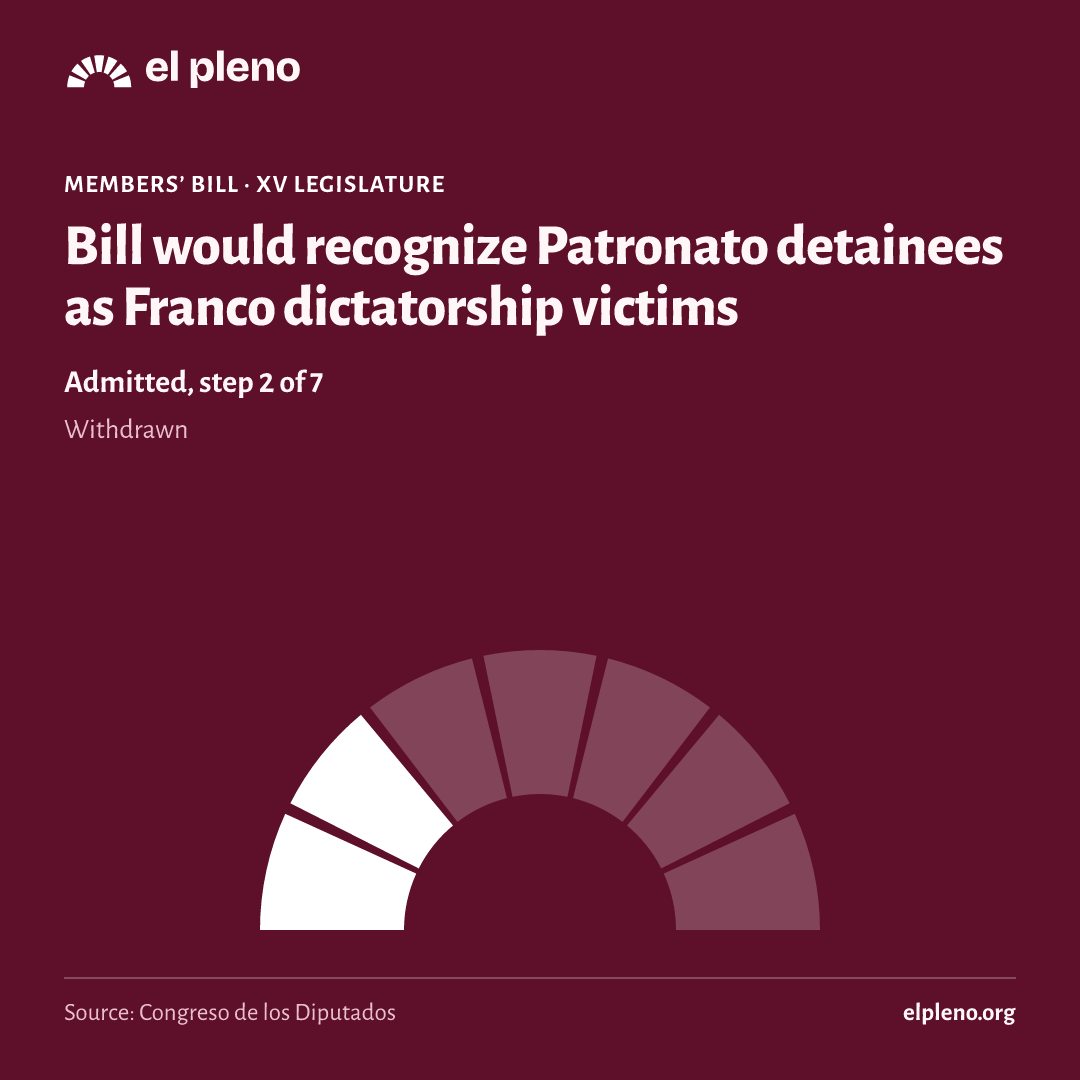
Source: Congreso de los Diputados, file 122/000243· updated 11 Nov
Automatic summary, not yet reviewed
- The proposal explains that the Patronato de Protección a la Mujer, created in 1941 and dissolved in 1985, interned thousands of women without trial, with abuse, forced labor and cases of stolen babies. No one responsible has been tried, and the Democratic Memory Law does not recognize these women as victims.
- The bill would amend the Democratic Memory Law of October 19, 2022 so that women interned in the Patronato between November 6, 1941 and August 1, 1985 are considered victims.
- It would also require the Government to prepare, within one year of the law's publication, an inventory of all documents and records on the Patronato held in public archives, with guaranteed public access.
Who it affects
- Women interned in the Patronato de Protección a la Mujer between 1941 and 1985: They would be officially recognized as victims of the Franco dictatorship.
- The Government: It would have to prepare and publish the documentary inventory on the Patronato.
- Ministries, public bodies, regional and local administrations and other institutions with archives: They would have to locate and preserve documents and records on the Patronato.
Words worth knowing
- Proposición de ley
- A bill introduced by a parliamentary group; it is not yet an approved law.
- Ley de Memoria Democrática (Democratic Memory Law)
- A 2022 Spanish law that recognizes and provides redress for victims of the Franco dictatorship.
- Disposición adicional (additional provision)
- A section at the end of a law that adds specific rules or mandates.
It summarizes the text as it was introduced. It is written by artificial intelligence and may contain mistakes: the official text is what counts. Read the official text · How we make summaries
Where it stands
How far did it get?
It took 2 of 7 steps. It reached Admitted, and today it is withdrawn.
- Introduced25 November 2025Someone registers the text in the Congreso.
- Admitted9 December 2025The Bureau of the Congreso accepts it and, for a members’ bill, the plenary decides whether to consider it.
- Amendmentsnot reachedGroups propose changes.
- Committeenot reachedA committee goes through the text in detail.
- Plenarynot reachedAll 350 deputies vote.
- Senatenot reachedThe Senate can pass it, amend it or veto it.
- BOEnot reachedIt is published in the Official State Gazette (BOE) and comes into force.
See the 6 official steps on a timeline
Was there a plenary vote?
We have no plenary vote linked to this law in the Congreso’s data.
What happens next
What happens now?
Whoever introduced it withdrew it, or it was merged into another one. It goes no further.
Sources
Where does all this come from?
- Congreso de los Diputados, file 122/000243
Official title, type, author, dates and stage.
Retrieved 11 November 2026
- Congreso de los Diputados, procedure
The date of each step, with its official wording.
Retrieved 12 November 2026
- The data comes from the open files of the Congreso, the Senate and the BOE, unaltered.
- Each deputy’s province is the one of their seat on the day of the vote.
- We only say “passed” or “rejected” when the majority needed is certain; otherwise we say which side had more votes.