What it is
What the bill proposes for regulating criminology practice
It is a members’ bill. Introduced by parliamentary groups, the Senate, regional governments or citizens. It was introduced on 19 November 2025. Introduced by: Grupo Parlamentario Plurinacional SUMAR.
Official title: Private member's bill regulating the professional practice of criminology.
Source: Congreso de los Diputados, file 122/000242· updated 11 Nov
Automatic summary, not yet reviewed
- The bill would regulate the professional practice of criminology in Spain, setting the requirements to practice and defining the profession's functions.
- Only people holding an official licentiate degree or bachelor's degree in Criminology, or homologated foreign degrees, could practice. This requirement would also bind public and private sector employers.
- The bill lists criminologists' competencies, such as preparing criminological reports, assessing recidivism risk, supporting victims, managing whistleblower channels, and preventing crime in policing, prisons, education, and digital settings.
- Practitioners in territories with a professional association would have to join it. These associations would enforce ethical rules, represent the profession, and could impose disciplinary sanctions.
- The bill creates a sanctions regime with minor, serious, and very serious offenses. Penalties range from written warnings to suspension from practice or expulsion from the professional association.
- Within one year, the Government would have to propose adding criminologists to the state civil service, and universities and ministries would have to recognize criminology as a science independent from criminal law, psychology, or sociology.
Who it affects
- People with a Criminology degree: They would gain a legal framework to practice, with clear requirements, rights, duties, and mandatory membership of a professional association where one exists.
- Public administrations: They would have to include the criminologist role in their staffing lists and public employment offers.
- Companies and private entities: They could hire criminologists for prevention, Compliance Programs companies use to follow the law and prevent internal wrongdoing., whistleblower channels, or victim support, always requiring the official degree.
- Criminology professional associations: They would oversee the profession, promote ongoing training, hold sanctioning powers, and have a deadline to adapt their bylaws.
- Universities: They would have to ensure suitable study programs and recognize criminology as an independent field of knowledge.
Words worth knowing
- Colegiación
- The requirement to register with the profession's official association in order to practice.
- Código deontológico
- A code of ethics: the rules of good conduct professionals in a field must follow.
- Homologación
- Official recognition of a foreign degree so it counts as equivalent in Spain.
- Compliance
- Programs companies use to follow the law and prevent internal wrongdoing.
- Victimología
- The branch of criminology that studies crime victims and how to protect and repair them.
It summarizes the text as it was introduced. It is written by artificial intelligence and may contain mistakes: the official text is what counts. Read the official text · How we make summaries
Where it stands
How far did it get?
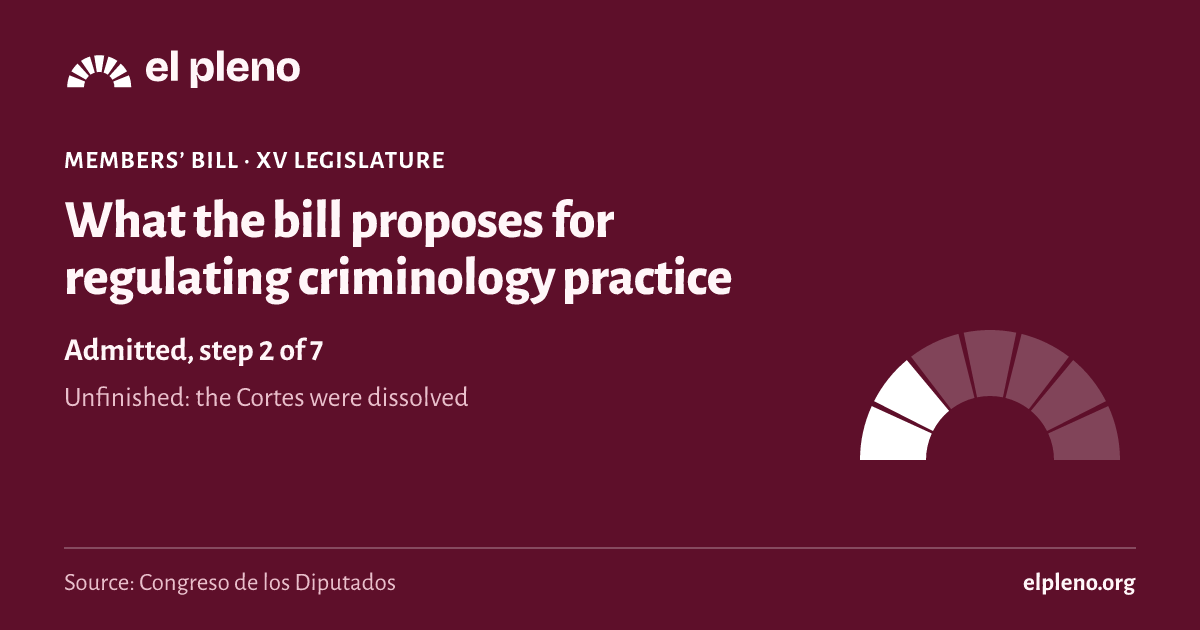
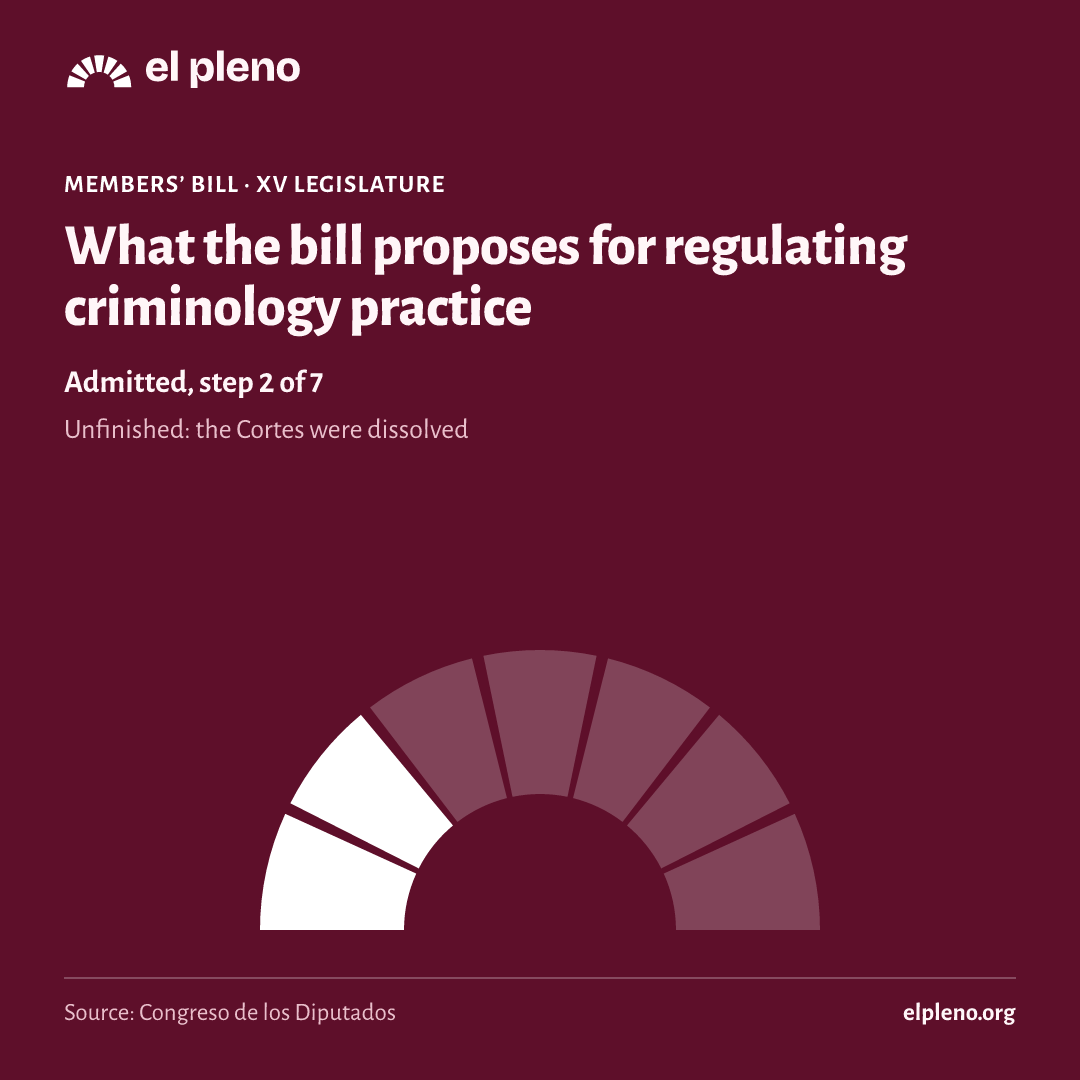
It took 2 of 7 steps. It reached Admitted, and today it is unfinished.
- Introduced19 November 2025Someone registers the text in the Congreso.
- Admitted25 November 2025The Bureau of the Congreso accepts it and, for a members’ bill, the plenary decides whether to consider it.
- Amendmentsnot reachedGroups propose changes.
- Committeenot reachedA committee goes through the text in detail.
- Plenarynot reachedAll 350 deputies vote.
- Senatenot reachedThe Senate can pass it, amend it or veto it.
- BOEnot reachedIt is published in the Official State Gazette (BOE) and comes into force.
See the 6 official steps on a timeline
Was there a plenary vote?
We have no plenary vote linked to this law in the Congreso’s data.
What happens next
What happens now?
The legislature ended before it finished. To go on, someone would have to introduce it again in the new Cortes.
It has not been presented again yet.
Sources
Where does all this come from?
- Congreso de los Diputados, file 122/000242
Official title, type, author, dates and stage.
Retrieved 11 November 2026
- Congreso de los Diputados, procedure
The date of each step, with its official wording.
Retrieved 13 November 2026
- The data comes from the open files of the Congreso, the Senate and the BOE, unaltered.
- Each deputy’s province is the one of their seat on the day of the vote.
- We only say “passed” or “rejected” when the majority needed is certain; otherwise we say which side had more votes.