What it is
VOX bill would end mandatory low-emission zones and the waste fee
It is a members’ bill. Introduced by parliamentary groups, the Senate, regional governments or citizens. It was introduced on 28 October 2025. Introduced by: Grupo Parlamentario VOX.
Official title: Private member's bill regarding the revocation of the mandatory implementation of Low Emission Zones and the repeal of the waste tax.
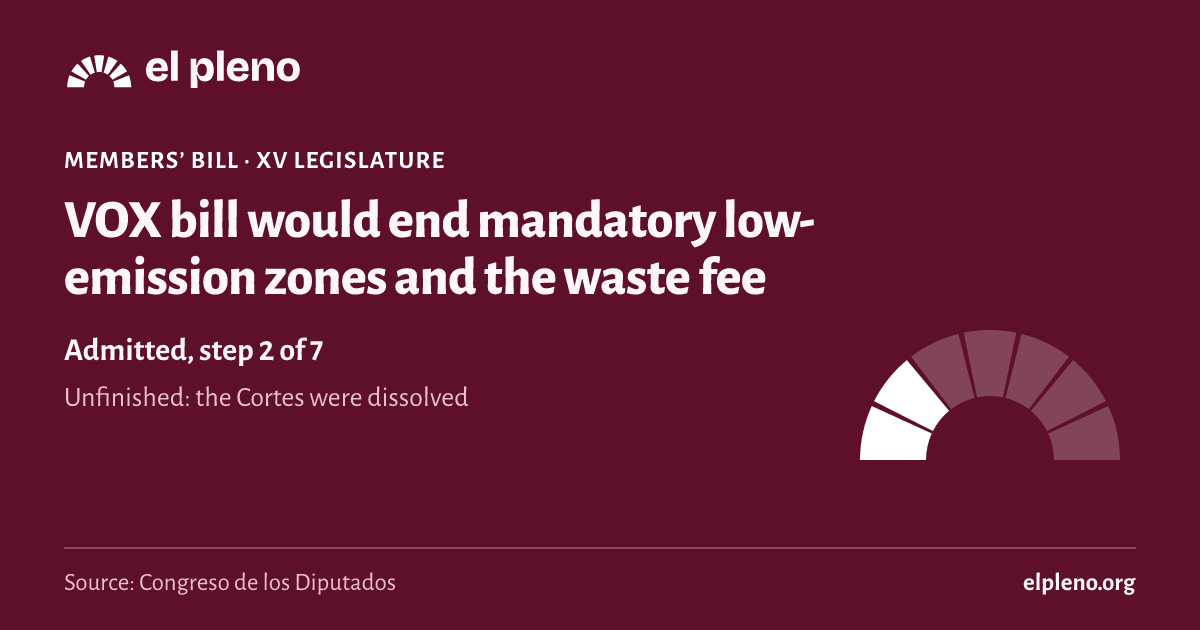
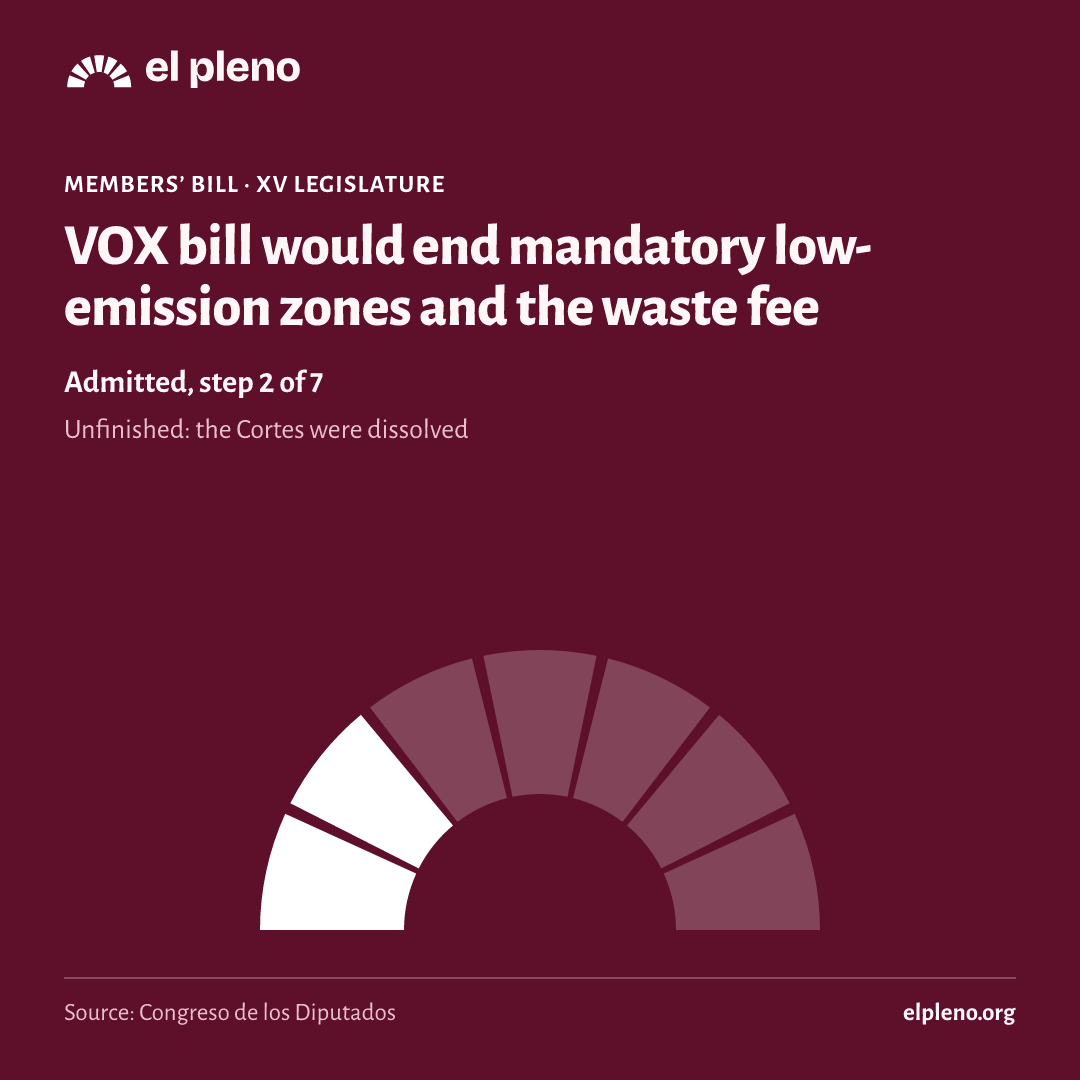
Source: Congreso de los Diputados, file 122/000232· updated 11 Nov
Automatic summary, not yet reviewed
- The bill would remove the obligation for municipalities with over 50,000 residents and other territories to create low-emission zones, by deleting Article 14 of the Climate Change Law. It would also stop local governments from restricting traffic for environmental reasons.
- It would amend the traffic law so that traffic restrictions can only be imposed for safety or traffic flow reasons, and it would prevent the Government from making public aid to regional and local authorities conditional on environmental goals or low-emission zones.
- The bill would delete the article of the Waste Law that requires municipalities to charge the waste fee, a tax that the text says averages 116.32 euros per household in 2025.
- It would also repeal the regulation governing low-emission zones, and the law would take effect on January 1 of the year after its approval.
Who it affects
- Municipalities and other local authorities: They would no longer be required to create low-emission zones or charge the waste fee.
- Drivers and vehicle owners: They could no longer face traffic limits based on their car's environmental label for environmental reasons.
- Households: They would stop paying the waste fee charged through municipalities.
- Self-employed workers and small businesses: The text says they are among those most harmed by low-emission zone restrictions.
Words worth knowing
- Zona de bajas emisiones (ZBE)
- Low-emission zone: an urban area where access or circulation of the most polluting vehicles is restricted.
- Tasa de residuos
- Waste fee: a tax municipalities charge residents to fund trash collection and treatment.
- Proposición de ley
- A bill introduced by a parliamentary group that still needs to be debated and passed; it is not a law in force.
- Distintivo ambiental
- Environmental label that classifies vehicles by their pollution level.
It summarizes the text as it was introduced. It is written by artificial intelligence and may contain mistakes: the official text is what counts. Read the official text · How we make summaries
Where it stands
How far did it get?
It took 2 of 7 steps. It reached Admitted, and today it is unfinished.
- Introduced28 October 2025Someone registers the text in the Congreso.
- Admitted11 November 2025The Bureau of the Congreso accepts it and, for a members’ bill, the plenary decides whether to consider it.
- Amendmentsnot reachedGroups propose changes.
- Committeenot reachedA committee goes through the text in detail.
- Plenarynot reachedAll 350 deputies vote.
- Senatenot reachedThe Senate can pass it, amend it or veto it.
- BOEnot reachedIt is published in the Official State Gazette (BOE) and comes into force.
See the 6 official steps on a timeline
Was there a plenary vote?
We have no plenary vote linked to this law in the Congreso’s data.
What happens next
What happens now?
The legislature ended before it finished. To go on, someone would have to introduce it again in the new Cortes.
It has not been presented again yet.
Sources
Where does all this come from?
- Congreso de los Diputados, file 122/000232
Official title, type, author, dates and stage.
Retrieved 11 November 2026
- Congreso de los Diputados, procedure
The date of each step, with its official wording.
Retrieved 12 November 2026
- The data comes from the open files of the Congreso, the Senate and the BOE, unaltered.
- Each deputy’s province is the one of their seat on the day of the vote.
- We only say “passed” or “rejected” when the majority needed is certain; otherwise we say which side had more votes.