What it is
Bill to count study time for Spanish nationality and allow dual citizenship
It is a members’ bill. Introduced by parliamentary groups, the Senate, regional governments or citizens. It was introduced on 27 October 2025. Introduced by: Grupo Parlamentario Plurinacional SUMAR.
Official title: Private member's bill regarding the acquisition of Spanish nationality by residence and the retention of the nationality of origin.
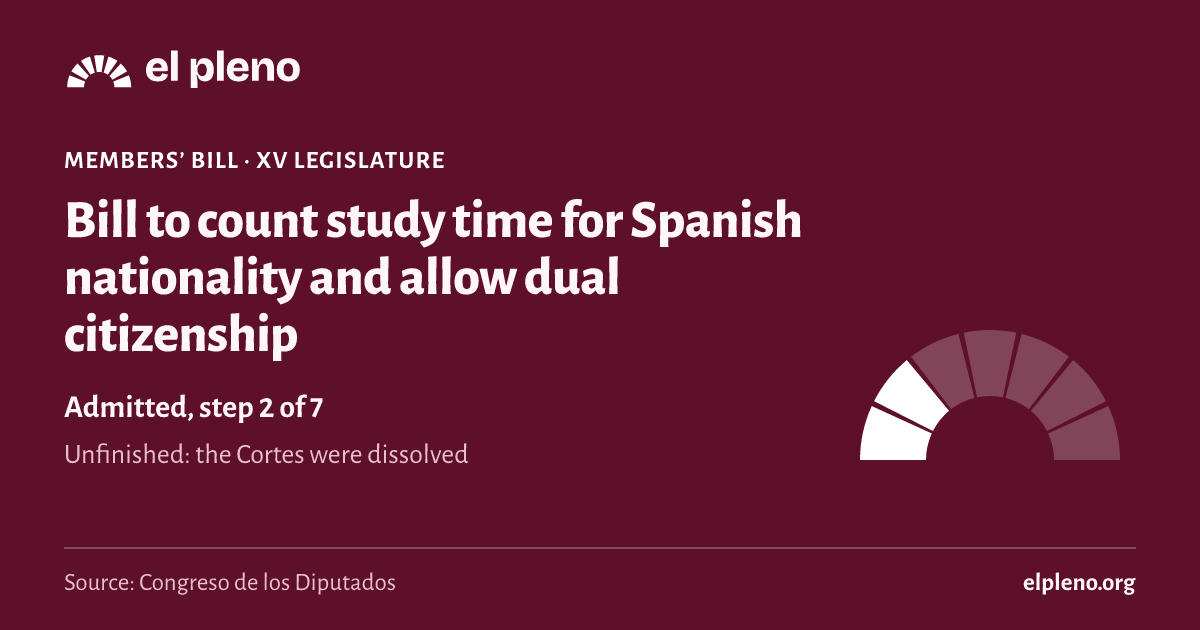
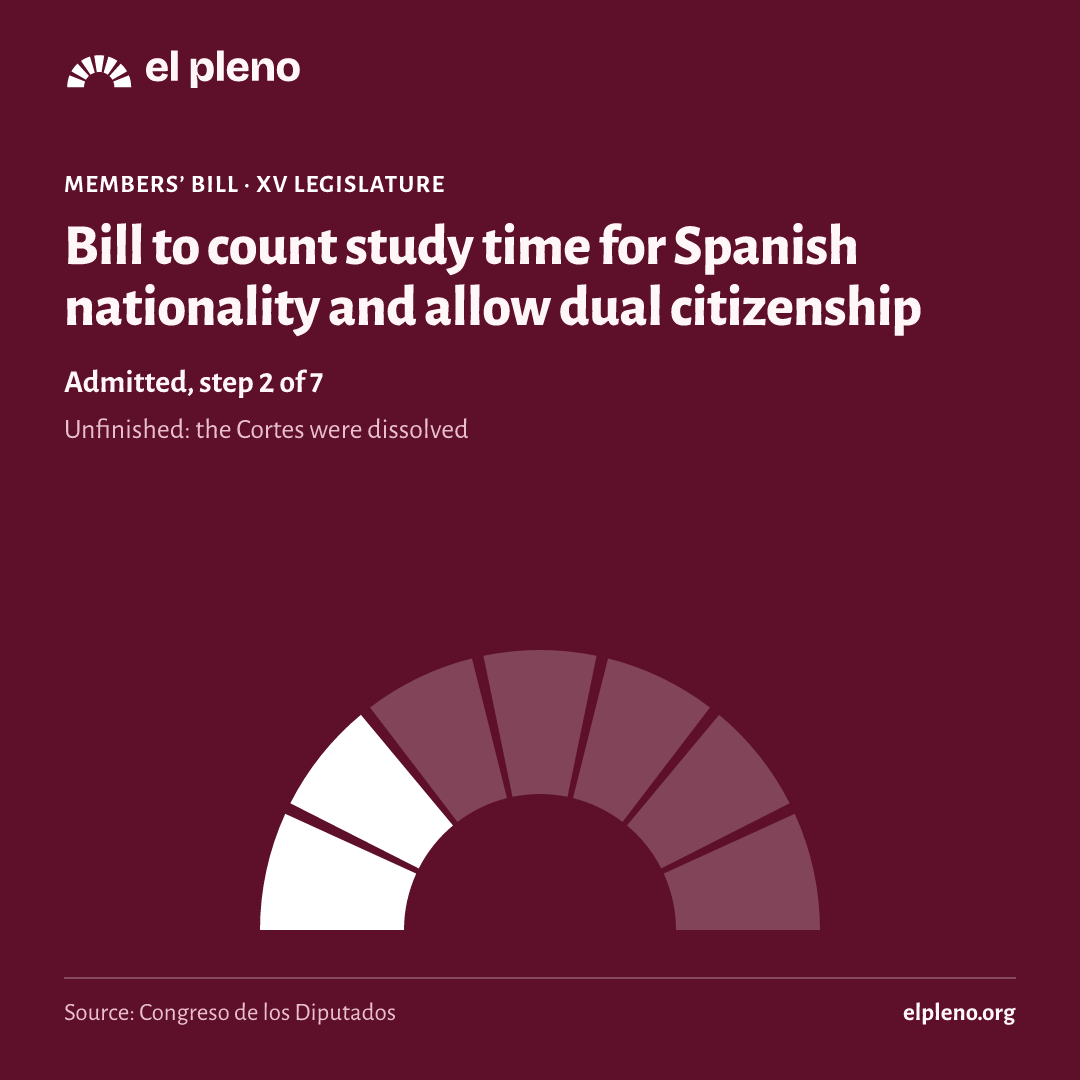
Source: Congreso de los Diputados, file 122/000230· updated 11 Nov
Automatic summary, not yet reviewed
- The bill would allow years spent in Spain under either residence or stay (estancia) status to count toward Spanish nationality by residence, as long as the stay is legal, continuous and immediately before the application. Reduced periods remain: five years for refugees and two for nationals of Ibero-American countries, Andorra, the Philippines, Equatorial Guinea, Portugal, and Sephardic Jews.
- The bill would remove the requirement to renounce one's previous nationality to acquire Spanish nationality through option, Carta de naturaleza An exceptional grant of Spanish nationality made by the Government for special reasons., or residence. The remaining requirements would be swearing loyalty to the King and obedience to the Constitution and laws, and registering the acquisition in the Civil Registry.
- Article 24 of the Civil Code would be amended so that Spaniards who are not Spanish by origin and live abroad would lose their Spanish nationality only if they voluntarily acquire another one and expressly declare they renounce the Spanish one.
- The bill would eliminate the loss of nationality for Spaniards who are not Spanish by origin due to using only the nationality they had renounced to obtain the Spanish one.
- Civil Registry entries resulting from the granting of Spanish nationality would be handled by the registrar who recorded the person's birth.
- The law would take effect twenty days after its publication in the Official State Gazette (Boletín Oficial del Estado).
Who it affects
- Foreigners in Spain on stay (estancia) status, such as students: Years on study, internship, or research stay permits could count toward applying for nationality, instead of starting the count from zero.
- People applying for nationality by residence, option, or carta de naturaleza: They would no longer have to give up their original nationality to obtain the Spanish one.
- Spaniards who are not Spanish by origin and live abroad: They would stop losing Spanish nationality for using only the other nationality they had renounced.
Words worth knowing
- Estancia (stay)
- A permit to be in Spain for a limited time, for example for studies, without being residence.
- Carta de naturaleza
- An exceptional grant of Spanish nationality made by the Government for special reasons.
- Registro Civil (Civil Registry)
- The public registry where events such as births, marriages, and nationality acquisitions are recorded.
- Proposición de ley
- A bill introduced by a parliamentary group; it is not a law until it is passed.
It summarizes the text as it was introduced. It is written by artificial intelligence and may contain mistakes: the official text is what counts. Read the official text · How we make summaries
Where it stands
How far did it get?
It took 2 of 7 steps. It reached Admitted, and today it is unfinished.
- Introduced27 October 2025Someone registers the text in the Congreso.
- Admitted11 November 2025The Bureau of the Congreso accepts it and, for a members’ bill, the plenary decides whether to consider it.
- Amendmentsnot reachedGroups propose changes.
- Committeenot reachedA committee goes through the text in detail.
- Plenarynot reachedAll 350 deputies vote.
- Senatenot reachedThe Senate can pass it, amend it or veto it.
- BOEnot reachedIt is published in the Official State Gazette (BOE) and comes into force.
See the 6 official steps on a timeline
Was there a plenary vote?
We have no plenary vote linked to this law in the Congreso’s data.
What happens next
What happens now?
The legislature ended before it finished. To go on, someone would have to introduce it again in the new Cortes.
It has not been presented again yet.
Sources
Where does all this come from?
- Congreso de los Diputados, file 122/000230
Official title, type, author, dates and stage.
Retrieved 11 November 2026
- Congreso de los Diputados, procedure
The date of each step, with its official wording.
Retrieved 13 November 2026
- The data comes from the open files of the Congreso, the Senate and the BOE, unaltered.
- Each deputy’s province is the one of their seat on the day of the vote.
- We only say “passed” or “rejected” when the majority needed is certain; otherwise we say which side had more votes.