What it is
Bill proposes using culture as a public health tool
It is a members’ bill. Introduced by parliamentary groups, the Senate, regional governments or citizens. It was introduced on 15 July 2025. Introduced by: Grupo Parlamentario Plurinacional SUMAR.
Official title: Private member's bill for a Caring Culture.
Source: Congreso de los Diputados, file 122/000213· updated 11 Nov
Automatic summary, not yet reviewed
- The bill would recognize culture as an essential factor for physical, mental and social health, and would integrate the cultural approach into public health policies and the health approach into cultural policies.
- It would guarantee unrestricted access to public cultural spaces, removing physical, economic, social, knowledge and cultural barriers, with special attention to the most vulnerable groups.
- It would transform cultural spaces, especially museums, into open, natural environments that encourage walking and meeting, with gardens, trails and accessible areas.
- It would create a public catalog of cultural and health assets, which could rely on the Localiza Salud repository run by the Ministry of Health, to connect cultural spaces with care and health promotion systems.
- It would promote social prescribing, meaning health and social professionals could recommend cultural activities as a resource to improve health, plus interdisciplinary training and integrated culture and health programs.
- It would create an Interministerial Commission and a Sectoral Council for Health and Culture Coordination, which would draft a five-year State Health and Culture Strategy and its action plans. The bodies must be set up within three months and the Strategy approved within one year of the law taking effect.
Who it affects
- Public administrations and publicly owned or managed cultural spaces, which would have to guarantee universal access and transform into open environments.: New obligations on access and transformation of spaces
- Health, culture and education professionals, who could recommend cultural assets and receive interdisciplinary training.: New tools and training
- People in economic, personal or social vulnerability, and people with disabilities, priority recipients of the access measures.: Better access to culture
- The ministries of Health and Culture and the autonomous communities, which would coordinate their policies through the new bodies and the State Strategy.: New coordination bodies
Words worth knowing
- Prescripción social (social prescribing)
- When a health or social professional recommends non-drug resources, such as cultural activities, to improve health, the way a medication is prescribed.
- Activos para la salud (health assets)
- Factors that help people and communities maintain health and well-being and reduce inequalities, such as green or cultural spaces.
- Atención Primaria (primary care)
- The first level of care in the health system, the one people go to first, such as health centers.
- Proposición de ley (bill)
- A text in the form of a law introduced by members of Congress, which still must be debated and approved by the Congress and the Senate to become law.
It summarizes the text as it was introduced. It is written by artificial intelligence and may contain mistakes: the official text is what counts. Read the official text · How we make summaries
Where it stands
How far did it get?
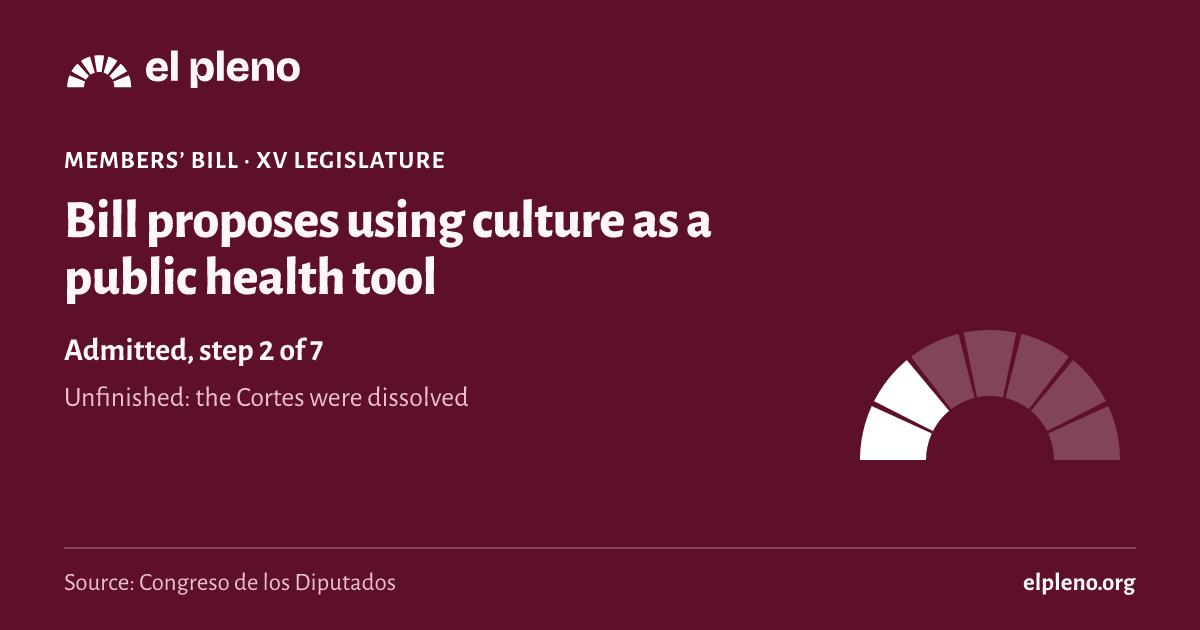
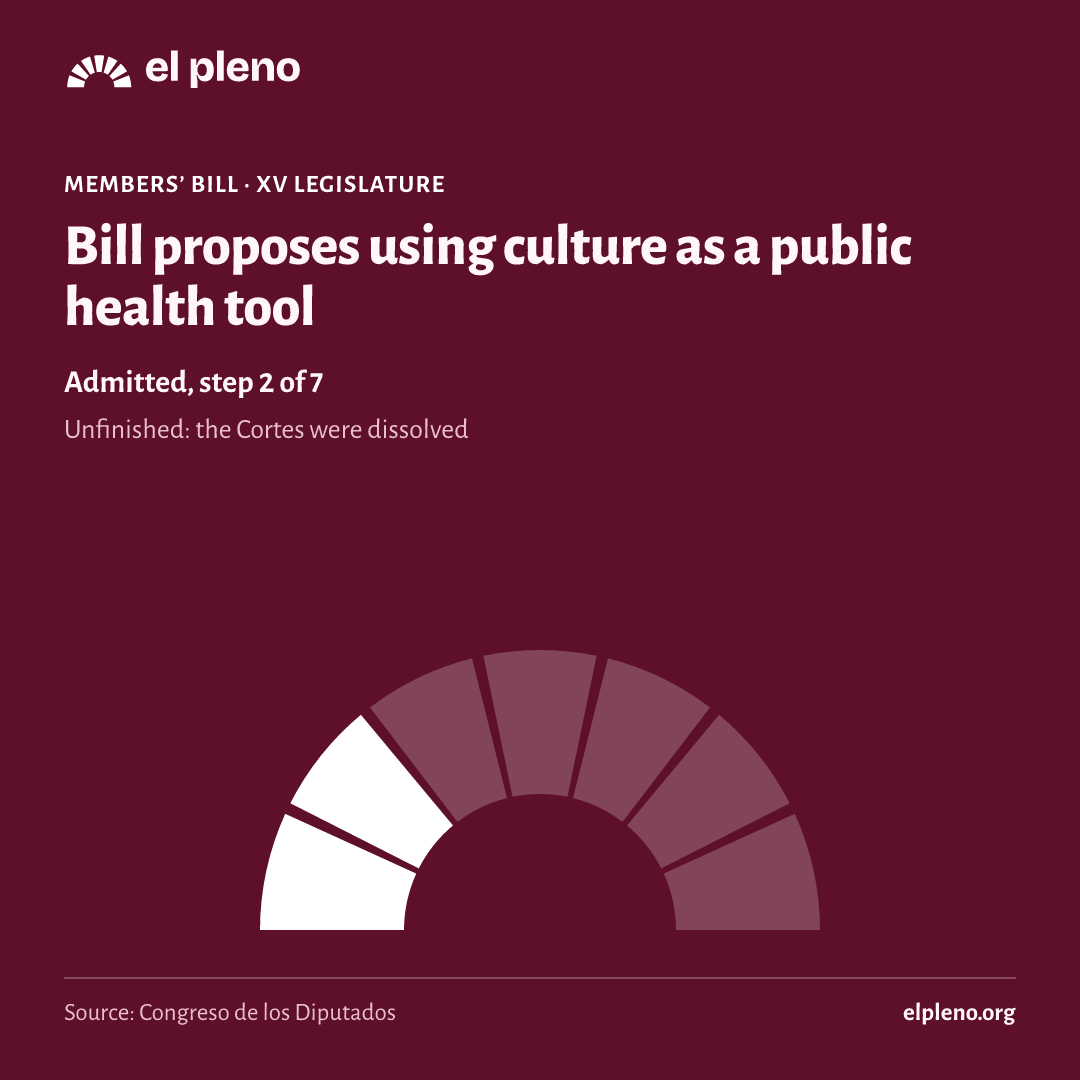
It took 2 of 7 steps. It reached Admitted, and today it is unfinished.
- Introduced15 July 2025Someone registers the text in the Congreso.
- Admitted22 July 2025The Bureau of the Congreso accepts it and, for a members’ bill, the plenary decides whether to consider it.
- Amendmentsnot reachedGroups propose changes.
- Committeenot reachedA committee goes through the text in detail.
- Plenarynot reachedAll 350 deputies vote.
- Senatenot reachedThe Senate can pass it, amend it or veto it.
- BOEnot reachedIt is published in the Official State Gazette (BOE) and comes into force.
See the 6 official steps on a timeline
Was there a plenary vote?
We have no plenary vote linked to this law in the Congreso’s data.
What happens next
What happens now?
The legislature ended before it finished. To go on, someone would have to introduce it again in the new Cortes.
It has not been presented again yet.
Sources
Where does all this come from?
- Congreso de los Diputados, file 122/000213
Official title, type, author, dates and stage.
Retrieved 11 November 2026
- Congreso de los Diputados, procedure
The date of each step, with its official wording.
Retrieved 13 November 2026
- The data comes from the open files of the Congreso, the Senate and the BOE, unaltered.
- Each deputy’s province is the one of their seat on the day of the vote.
- We only say “passed” or “rejected” when the majority needed is certain; otherwise we say which side had more votes.