What it is
Bill would ban public contracts for corruption-convicted companies for good
It is a members’ bill. Introduced by parliamentary groups, the Senate, regional governments or citizens. It was introduced on 17 June 2025. Introduced by: Grupo Parlamentario Mixto.
Official title: Private member's bill prohibiting public contracting with companies involved in corruption.
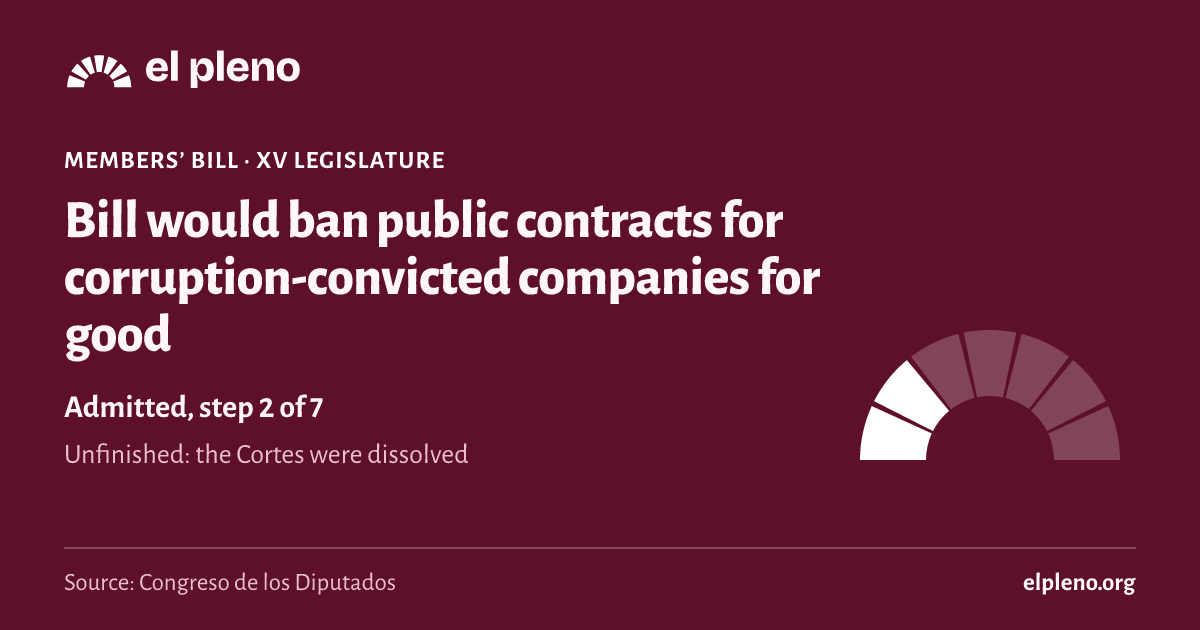
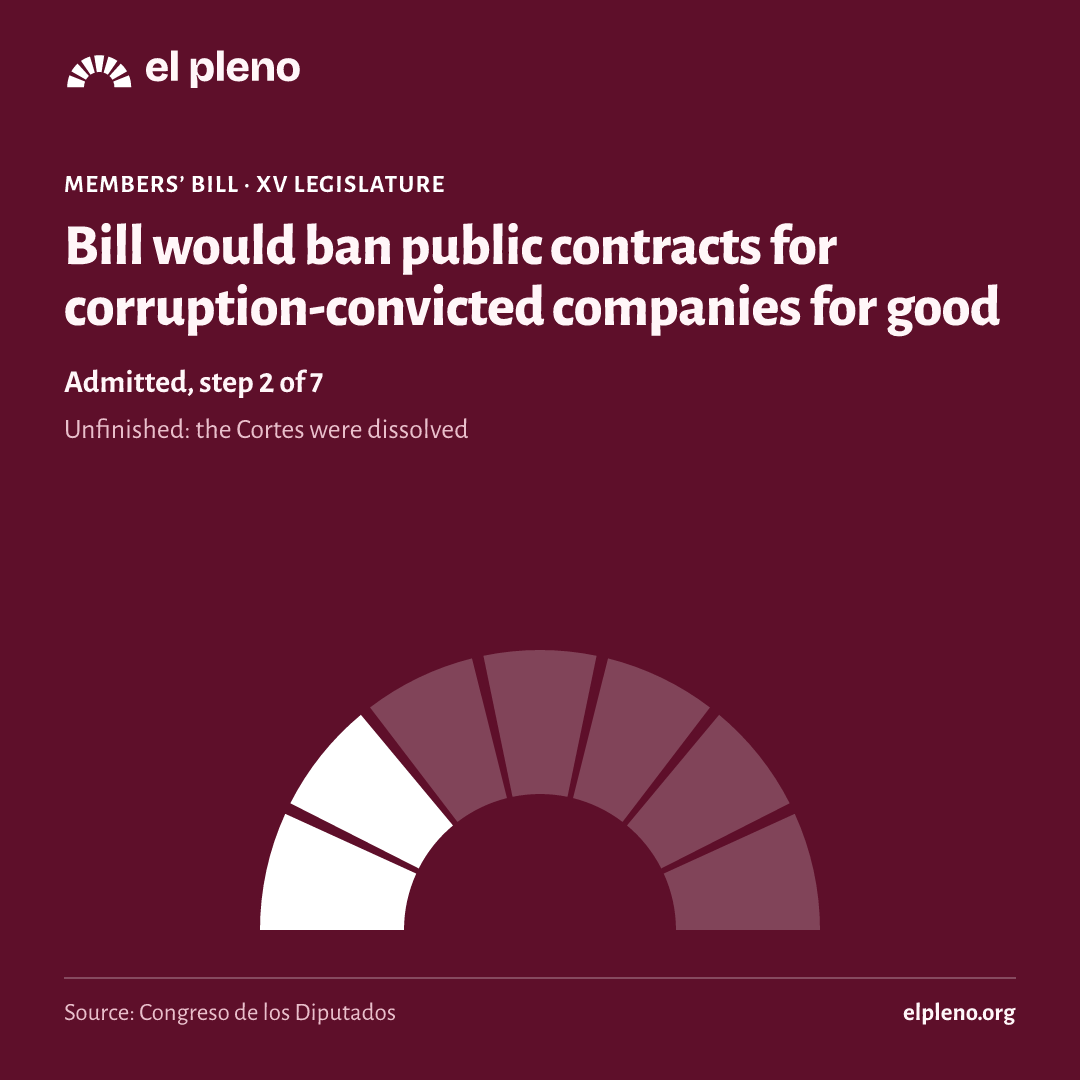
Source: Congreso de los Diputados, file 122/000207· updated 11 Nov
Automatic summary, not yet reviewed
- The bill would bar any person or company convicted of corruption crimes from contracting with the government, even if the conviction is not final, and the ban would be permanent as long as the conviction stands.
- The ban would also cover companies that benefited from the illegal activity and all companies in the same group as the convicted one, so the ban cannot be dodged by switching companies.
- If an investigation finds signs that a company with public contracts took part in these crimes, the State Attorney (Ministerio Fiscal The Spanish public prosecutor's office.) could request a precautionary contracting ban of up to four years.
- The rule would take effect the day after its publication in the Official State Gazette (Boletín Oficial del Estado).
Who it affects
- Companies and individuals convicted of crimes such as bribery, fraud, embezzlement or money laundering: They could not contract with the government, permanently, unless the conviction is overturned.
- Companies in the same group as a convicted company: They would also be covered by the contracting ban.
- Companies under investigation for these crimes that hold public contracts: They could face a precautionary contracting ban of up to four years during the process.
- Government bodies: They could not award contracts to the affected companies and individuals.
Words worth knowing
- Sentencia firme
- A court ruling that can no longer be appealed or changed.
- Medida cautelar
- A temporary measure applied while a court case is ongoing to prevent harm.
- Ministerio Fiscal
- The Spanish public prosecutor's office.
- Revocar
- To overturn or reverse a previous court decision.
It summarizes the text as it was introduced. It is written by artificial intelligence and may contain mistakes: the official text is what counts. Read the official text · How we make summaries
Where it stands
How far did it get?
It took 2 of 7 steps. It reached Admitted, and today it is unfinished.
- Introduced17 June 2025Someone registers the text in the Congreso.
- Admitted24 June 2025The Bureau of the Congreso accepts it and, for a members’ bill, the plenary decides whether to consider it.
- Amendmentsnot reachedGroups propose changes.
- Committeenot reachedA committee goes through the text in detail.
- Plenarynot reachedAll 350 deputies vote.
- Senatenot reachedThe Senate can pass it, amend it or veto it.
- BOEnot reachedIt is published in the Official State Gazette (BOE) and comes into force.
See the 6 official steps on a timeline
Was there a plenary vote?
We have no plenary vote linked to this law in the Congreso’s data.
What happens next
What happens now?
The legislature ended before it finished. To go on, someone would have to introduce it again in the new Cortes.
It has not been presented again yet.
Sources
Where does all this come from?
- Congreso de los Diputados, file 122/000207
Official title, type, author, dates and stage.
Retrieved 11 November 2026
- Congreso de los Diputados, procedure
The date of each step, with its official wording.
Retrieved 12 November 2026
- The data comes from the open files of the Congreso, the Senate and the BOE, unaltered.
- Each deputy’s province is the one of their seat on the day of the vote.
- We only say “passed” or “rejected” when the majority needed is certain; otherwise we say which side had more votes.