What it is
Bill would ban octopus farming in Spain
It is a members’ bill. Introduced by parliamentary groups, the Senate, regional governments or citizens. It was introduced on 11 June 2025. Introduced by: Grupo Parlamentario Plurinacional SUMAR Grupo Parlamentario Mixto.
Official title: Private member's bill on the prohibition of octopus aquaculture in Spain.
Source: Congreso de los Diputados, file 122/000202· updated 11 Nov
Automatic summary, not yet reviewed
- The bill would ban keeping and farming octopuses in captivity for consumption or any other productive purpose.
- It would also ban selling farmed octopuses, or their parts and derivatives, including keeping, transporting, storing, processing and selling them.
- Violations of this ban would be punished as serious offenses under the State Marine Fishing Law, with fines of up to 35% of the value of the farming facility.
- The ban would apply across the whole country, while the Autonomous Communities could still pass additional protection rules.
- The proposal is based on the idea that octopuses can suffer, on the harm these farms would cause to the marine environment, and on the precautionary principle, since this activity does not currently exist in Spain.
- The law would take effect the day after its publication in the Official State Gazette and would repeal any conflicting provisions.
Who it affects
- Companies or people who might want to farm octopuses: they could not do it in Spain.: ban
- Retailers and distributors: they could not sell or transport farmed octopuses.: ban
- The Autonomous Communities: they could add protection rules, but not allow this activity.: limits
Words worth knowing
- Acuicultura (aquaculture)
- Raising aquatic animals or plants, such as fish or shellfish, in controlled facilities, like a sea farm.
- Principio de precaución (precautionary principle)
- The idea that if an activity may cause serious harm, even without full scientific certainty, it is wise to avoid or prevent it.
- Seres sintientes (sentient beings)
- Animals able to feel pain, pleasure or suffering, recognized as such by the Spanish Civil Code since 2021.
- Proposición de ley (bill)
- A text introduced by members of Congress to become a law. It is not approved yet.
It summarizes the text as it was introduced. It is written by artificial intelligence and may contain mistakes: the official text is what counts. Read the official text · How we make summaries
Where it stands
How far did it get?
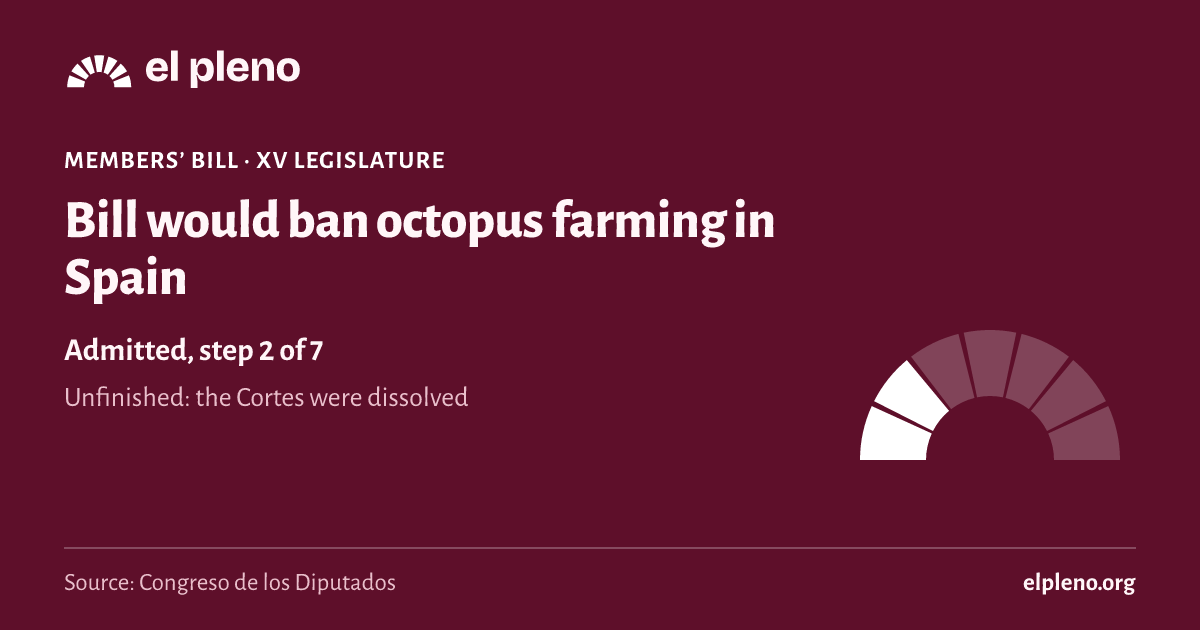
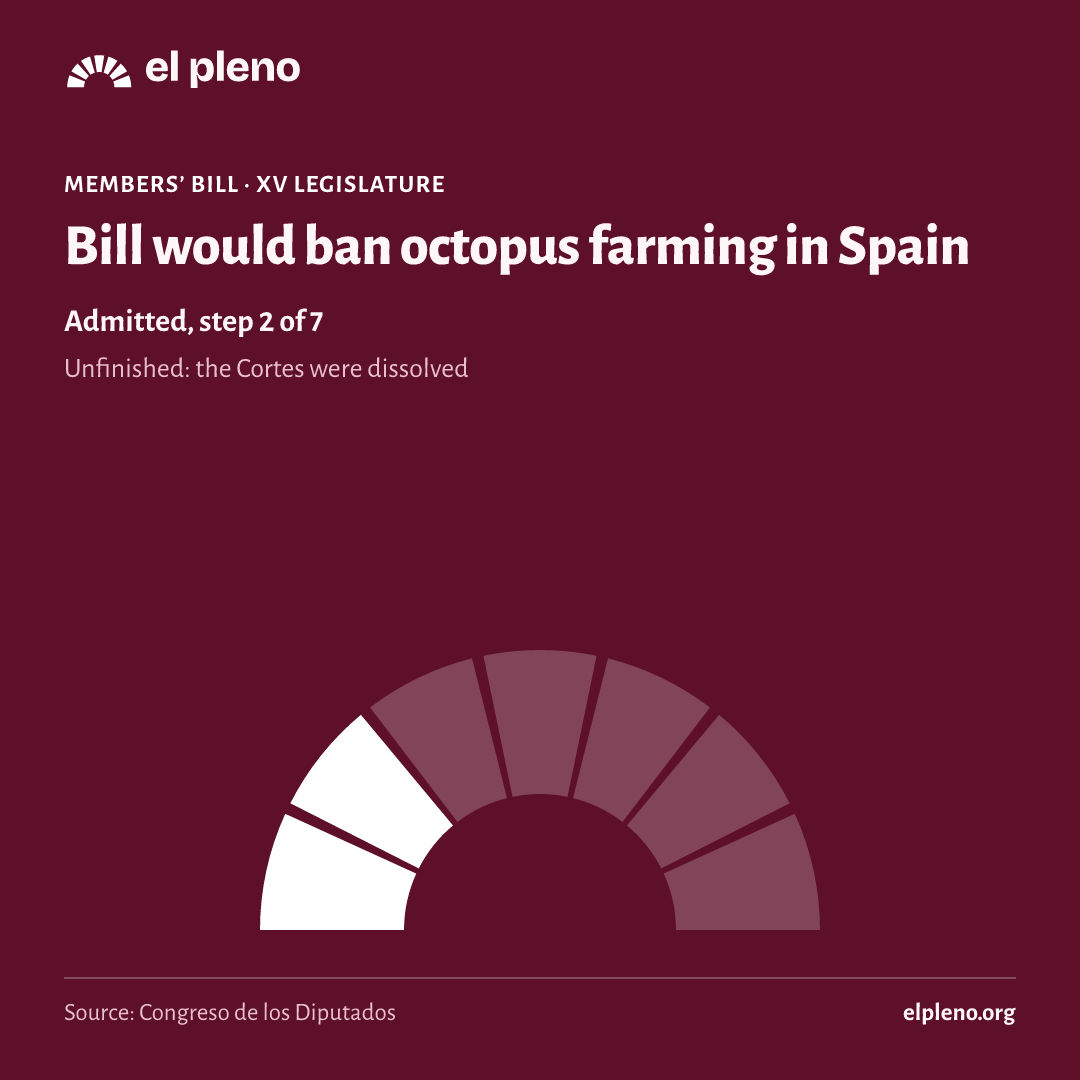
It took 2 of 7 steps. It reached Admitted, and today it is unfinished.
- Introduced11 June 2025Someone registers the text in the Congreso.
- Admitted17 June 2025The Bureau of the Congreso accepts it and, for a members’ bill, the plenary decides whether to consider it.
- Amendmentsnot reachedGroups propose changes.
- Committeenot reachedA committee goes through the text in detail.
- Plenarynot reachedAll 350 deputies vote.
- Senatenot reachedThe Senate can pass it, amend it or veto it.
- BOEnot reachedIt is published in the Official State Gazette (BOE) and comes into force.
See the 6 official steps on a timeline
Was there a plenary vote?
We have no plenary vote linked to this law in the Congreso’s data.
What happens next
What happens now?
The legislature ended before it finished. To go on, someone would have to introduce it again in the new Cortes.
It has not been presented again yet.
Sources
Where does all this come from?
- Congreso de los Diputados, file 122/000202
Official title, type, author, dates and stage.
Retrieved 11 November 2026
- Congreso de los Diputados, procedure
The date of each step, with its official wording.
Retrieved 12 November 2026
- The data comes from the open files of the Congreso, the Senate and the BOE, unaltered.
- Each deputy’s province is the one of their seat on the day of the vote.
- We only say “passed” or “rejected” when the majority needed is certain; otherwise we say which side had more votes.