What it is
Bill would ban undercover police infiltration in most cases
It is a members’ bill. Introduced by parliamentary groups, the Senate, regional governments or citizens. It was introduced on 19 March 2025. Introduced by: Grupo Parlamentario Plurinacional SUMAR.
Official title: Organic Private member's bill amending the Criminal Procedure Law to strengthen procedural guarantees in the figure of the Undercover Agent.
Source: Congreso de los Diputados, file 122/000174· updated 11 Nov
Automatic summary, not yet reviewed
- The bill, introduced by the SUMAR parliamentary group and admitted for processing in Congress, proposes amending the Criminal Procedure Act to strengthen safeguards around undercover agents.
- The bill would ban all police infiltration using a false identity aimed at gathering information, discovering suspected crimes or analyzing data, except as provided for undercover agents in the previous article (282 bis).
- The explanatory statement says police infiltration has also been used in social movements and activist groups, and that the reform seeks to set clear limits with judicial control to avoid violating rights such as freedom of expression, association and peaceful protest.
- The proposed law would be an organic law A law on fundamental rights, the electoral system or other matters the Constitution reserves. It needs an absolute majority in the Congreso: 176 votes., issued under the State's jurisdiction over justice and public security, would allow the Ministry of Justice to issue implementing rules, and would take effect twenty days after publication in the official state gazette.
Who it affects
- Members of the State security forces: They could not infiltrate groups under a false identity except in the cases allowed for undercover agents.
- People under criminal investigation: They would have stronger safeguards against police infiltration.
- Social movements and activist groups: They would be out of reach of police infiltration under a false identity.
- Ministry of Justice: It could issue the rules needed to apply the law if it is passed.
Words worth knowing
- Agente encubierto (undercover agent)
- A police officer who joins a group under a false identity to gather information and prevent crimes.
- Ley orgánica (organic law)
- A type of Spanish law that requires special majorities in Congress and is reserved for important matters.
- Ley de Enjuiciamiento Criminal (LECrim)
- The Spanish law governing criminal court proceedings.
- Acciones prospectivas (prospective actions)
- Information-gathering activities aimed at anticipating or detecting possible crimes before a specific one exists.
- organic law
- A law on fundamental rights, the electoral system or other matters the Constitution reserves. It needs an absolute majority in the Congreso: 176 votes.
It summarizes the text as it was introduced. It is written by artificial intelligence and may contain mistakes: the official text is what counts. Read the official text · How we make summaries
Where it stands
How far did it get?
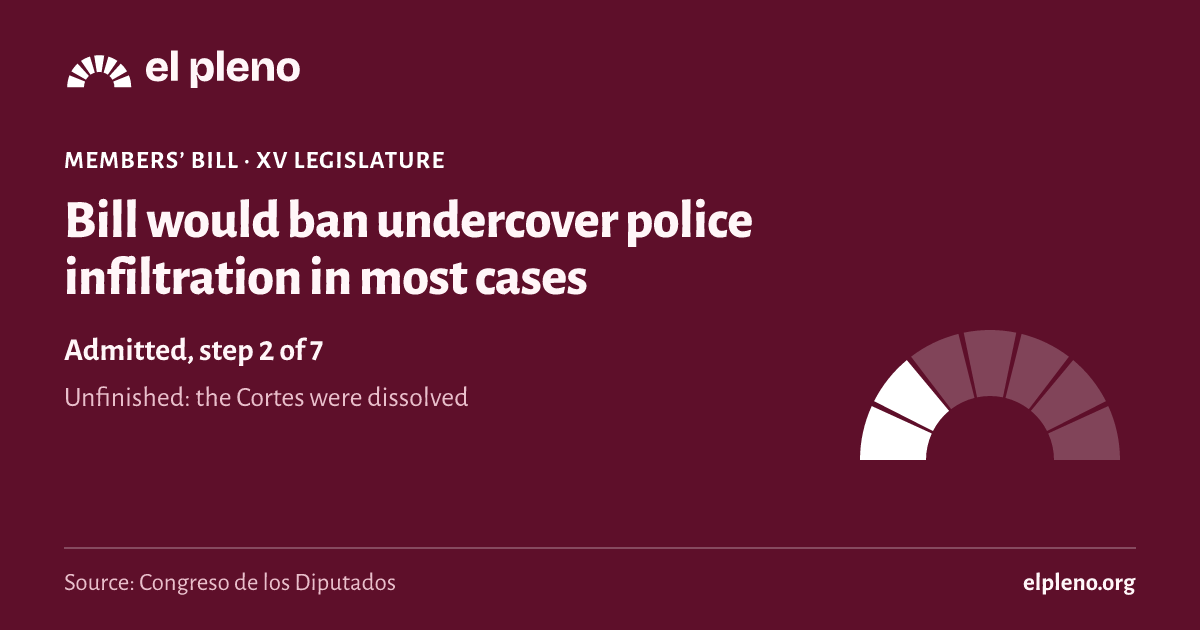
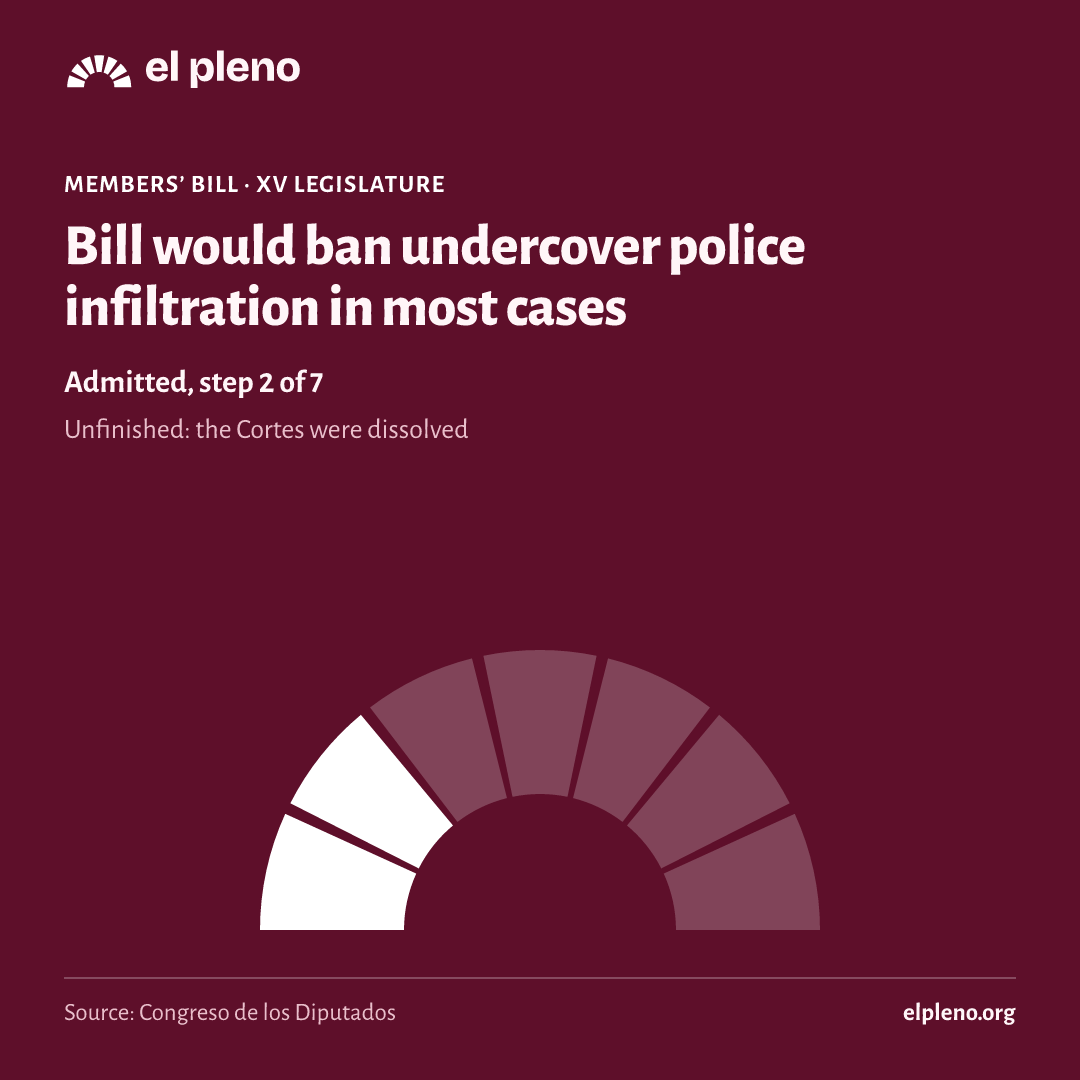
It took 2 of 7 steps. It reached Admitted, and today it is unfinished.
- Introduced19 March 2025Someone registers the text in the Congreso.
- Admitted25 March 2025The Bureau of the Congreso accepts it and, for a members’ bill, the plenary decides whether to consider it.
- Amendmentsnot reachedGroups propose changes.
- Committeenot reachedA committee goes through the text in detail.
- Plenarynot reachedAll 350 deputies vote.
- Senatenot reachedThe Senate can pass it, amend it or veto it.
- BOEnot reachedIt is published in the Official State Gazette (BOE) and comes into force.
See the 7 official steps on a timeline
Was there a plenary vote?
We have no plenary vote linked to this law in the Congreso’s data.
What happens next
What happens now?
The legislature ended before it finished. To go on, someone would have to introduce it again in the new Cortes.
It has not been presented again yet.
Sources
Where does all this come from?
- Congreso de los Diputados, file 122/000174
Official title, type, author, dates and stage.
Retrieved 11 November 2026
- Congreso de los Diputados, procedure
The date of each step, with its official wording.
Retrieved 12 November 2026
- The data comes from the open files of the Congreso, the Senate and the BOE, unaltered.
- Each deputy’s province is the one of their seat on the day of the vote.
- We only say “passed” or “rejected” when the majority needed is certain; otherwise we say which side had more votes.