What it is
Bill to raise or lower traffic fines based on income
It is a members’ bill. Introduced by parliamentary groups, the Senate, regional governments or citizens. It was introduced on 7 March 2025. Introduced by: Grupo Parlamentario Plurinacional SUMAR.
Official title: Private member's bill for the progressive and equitable imposition of traffic fine amounts.
Source: Congreso de los Diputados, file 122/000173· updated 11 Nov
Automatic summary, not yet reviewed
- The bill would raise traffic fines by 150%, 300% or 500% depending on the offender's gross annual income: between €70,000 and €85,000, between €85,000 and €100,000, or above €100,000, respectively.
- It would also reduce serious and very serious fines by 30% for people earning up to 1.5 times the minimum wage, and by 15% for those earning between 1.5 and 2.5 times that wage.
- To apply these increases and reductions, the Tax Agency, Social Security and the National Statistics Institute would give access to the necessary data without the person's consent. The Government would also have 6 months to produce a report on extending this progressive approach to sanctions outside traffic law.
- Proceedings already underway when the law takes effect would be governed by it if that is more favorable to the offender, unless they are in the enforcement stage. The law would take effect six months after publication in the Official State Gazette.
Who it affects
- Drivers with gross annual income above €70,000: Would pay notably higher traffic fines, up to 500% of the current amount.
- Low-income drivers (up to 2.5 times the minimum wage): Would get reductions of 15% or 30% on serious and very serious fines.
- Public administrations (Tax Agency, Social Security, National Statistics Institute): Would have to provide income and census data to calculate fines, without prior consent.
- The Government: Would have to produce a report within 6 months on extending progressivity to other sanction areas.
Words worth knowing
- Proposición de ley
- A bill: a text through which a parliamentary group proposes a new law. It is not a law until approved by the Congress and the Senate.
- Infractor reincidente
- A repeat offender: someone who commits the same violation again after being sanctioned.
- Fase ejecutiva
- The final stage of the sanction procedure, when the fine is final and is being collected.
- Salario Mínimo Interprofesional
- The minimum wage: the lowest pay allowed by law for a full working day.
It summarizes the text as it was introduced. It is written by artificial intelligence and may contain mistakes: the official text is what counts. Read the official text · How we make summaries
Where it stands
How far did it get?
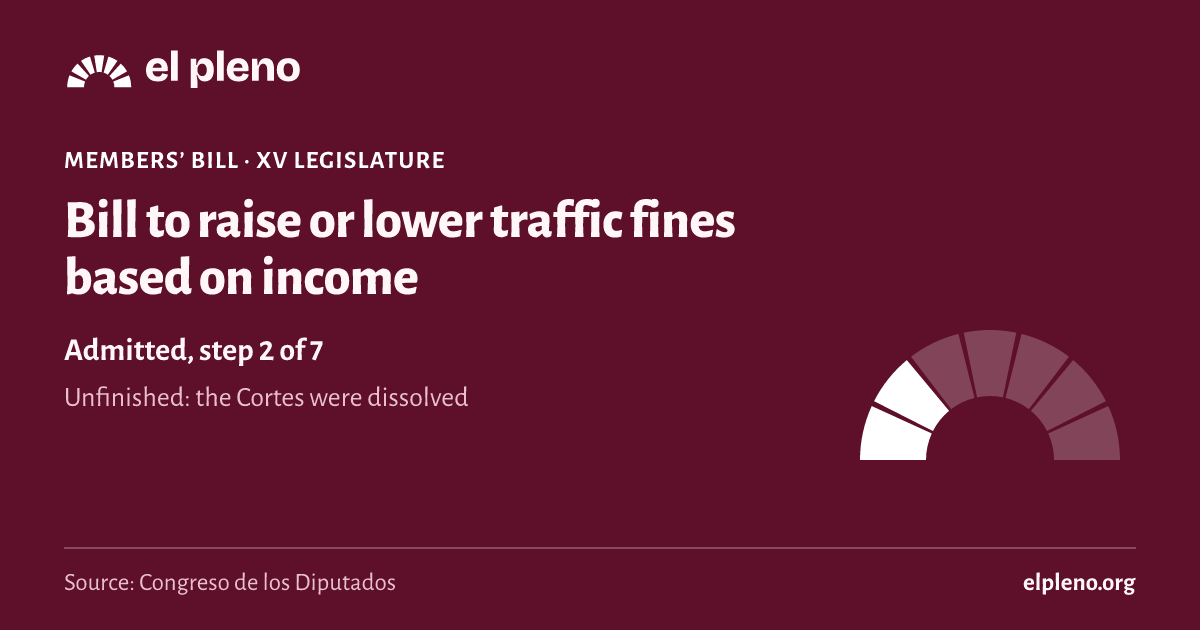
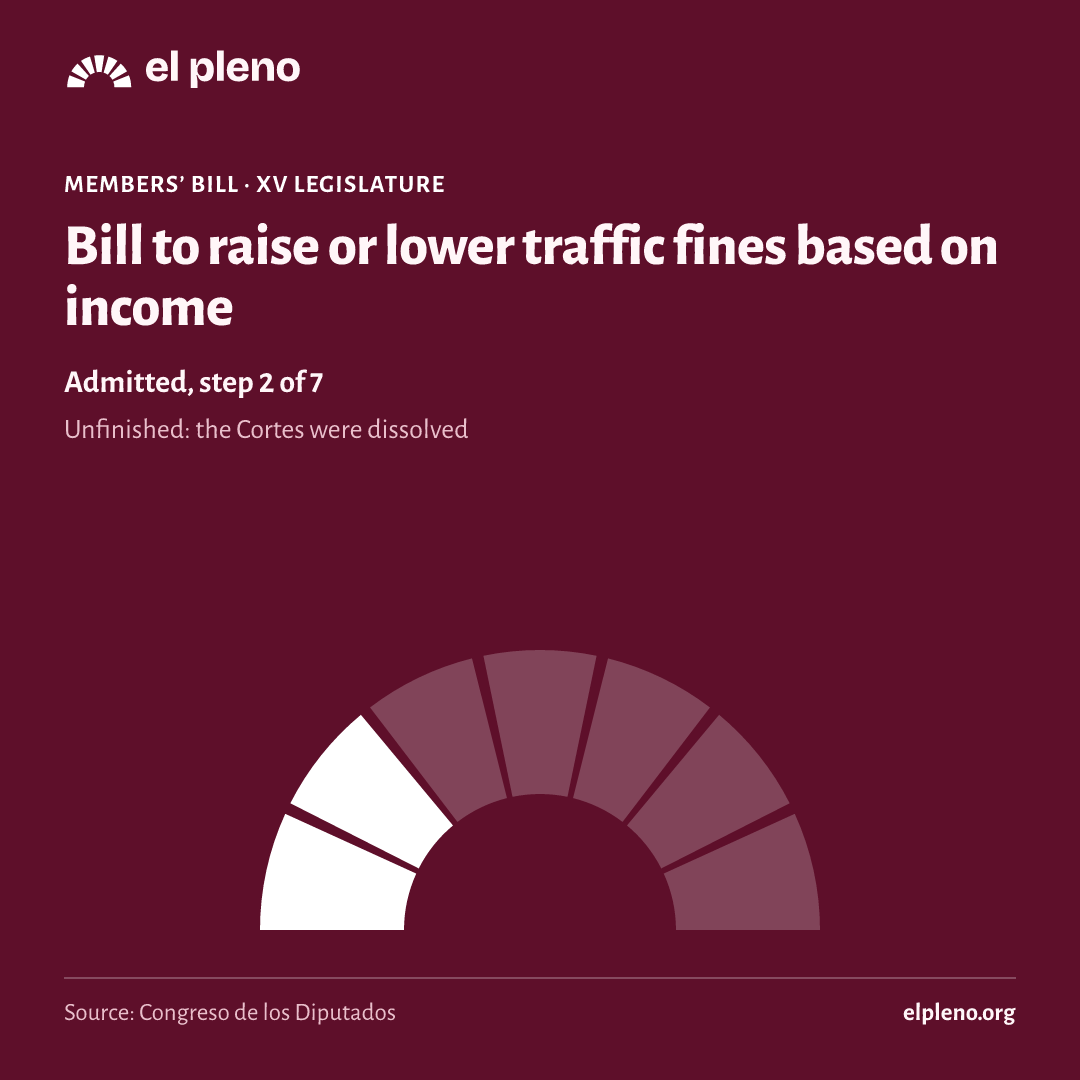
It took 2 of 7 steps. It reached Admitted, and today it is unfinished.
- Introduced7 March 2025Someone registers the text in the Congreso.
- Admitted11 March 2025The Bureau of the Congreso accepts it and, for a members’ bill, the plenary decides whether to consider it.
- Amendmentsnot reachedGroups propose changes.
- Committeenot reachedA committee goes through the text in detail.
- Plenarynot reachedAll 350 deputies vote.
- Senatenot reachedThe Senate can pass it, amend it or veto it.
- BOEnot reachedIt is published in the Official State Gazette (BOE) and comes into force.
See the 6 official steps on a timeline
Was there a plenary vote?
We have no plenary vote linked to this law in the Congreso’s data.
What happens next
What happens now?
The legislature ended before it finished. To go on, someone would have to introduce it again in the new Cortes.
It has not been presented again yet.
Sources
Where does all this come from?
- Congreso de los Diputados, file 122/000173
Official title, type, author, dates and stage.
Retrieved 11 November 2026
- Congreso de los Diputados, procedure
The date of each step, with its official wording.
Retrieved 12 November 2026
- The data comes from the open files of the Congreso, the Senate and the BOE, unaltered.
- Each deputy’s province is the one of their seat on the day of the vote.
- We only say “passed” or “rejected” when the majority needed is certain; otherwise we say which side had more votes.