What it is
Bill would make conversion therapies a crime punishable by prison
It is a members’ bill. Introduced by parliamentary groups, the Senate, regional governments or citizens. It was introduced on 18 February 2025. Introduced by: Grupo Parlamentario Mixto Grupo Parlamentario Plurinacional SUMAR.
Official title: Organic Private member's bill amending Organic Law 10/1995, of November 23, on the Penal Code, to punish the practice of conversion therapies and guarantee the protection of victims.
Source: Congreso de los Diputados, file 122/000167· updated 11 Nov
Automatic summary, not yet reviewed
- The bill would create a new crime in the Criminal Code for anyone who performs, forces or allows conversion therapies, with prison sentences of one to four years and a fine. The penalty would increase if the victim is a minor or especially vulnerable. The victim's consent would not remove criminal liability, and no complaint from the victim would be needed to start proceedings.
- It would provide financial aid for victims with low income, equal to six months of unemployment subsidy, which could reach eighteen or twenty-four months if they have dependents or a recognized disability. It could be paid as a single payment or in six monthly installments.
- It would require public authorities to give victims priority access to public housing and housing programs, with an immediate housing alternative when those responsible for the crime are the people holding parental authority, custody or legal representation and live with the victim.
- It would require prior authorization from a judge to take down websites with discriminatory content or content promoting conversion therapies, after a hearing where all parties are heard.
- It would amend the LGTBI law: banning the practice, dissemination and promotion of conversion therapies in any setting, creating early identification protocols for victims, ensuring international cooperation funds do not finance these practices, and raising fines for very serious violations to up to €150,000.
- The law would be enacted under the State's exclusive powers and would take effect the day after its publication in the Official State Gazette (Boletín Oficial del Estado).
Who it affects
- LGBT people, especially minors and vulnerable people, who could be subjected to conversion therapies.: They would have criminal protection, financial aid and priority access to housing.
- Those who practice, promote or disseminate conversion therapies.: They could face prison, fines of up to €150,000 and other sanctions.
- Health and psychology professionals.: They would have to follow good practice guides and protocols to identify and prevent these practices.
- Schools and teachers.: They would have to provide training on the risks of these practices and detect potential victims.
- Victims who depend financially on those subjecting them to these practices.: They could receive financial aid and an immediate housing alternative.
Words worth knowing
- Terapias de conversión (ECOSIEG)
- Conversion therapies: practices or treatments that seek to modify, repress or suppress a person's sexual orientation, gender identity or gender expression.
- Proposición de Ley Orgánica
- An organic bill: a text proposed by parliamentary groups to change a law. It is not an approved law; it is still being processed.
- Acción popular
- Popular action: the ability of any citizen or association to go to court over a crime, even if they are not the victim.
- Patria potestad
- Parental authority: the set of rights and duties parents have over their minor children.
- Subsidio por desempleo
- Unemployment subsidy: a public payment for people who are out of work and do not qualify for regular unemployment benefits.
It summarizes the text as it was introduced. It is written by artificial intelligence and may contain mistakes: the official text is what counts. Read the official text · How we make summaries
Where it stands
How far did it get?
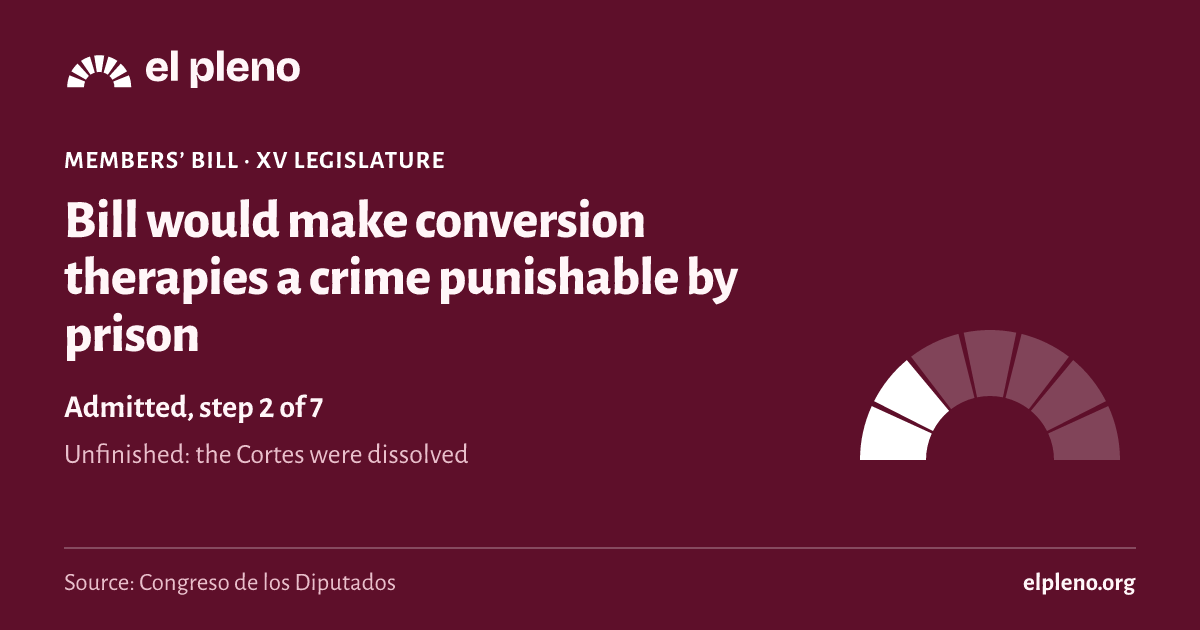
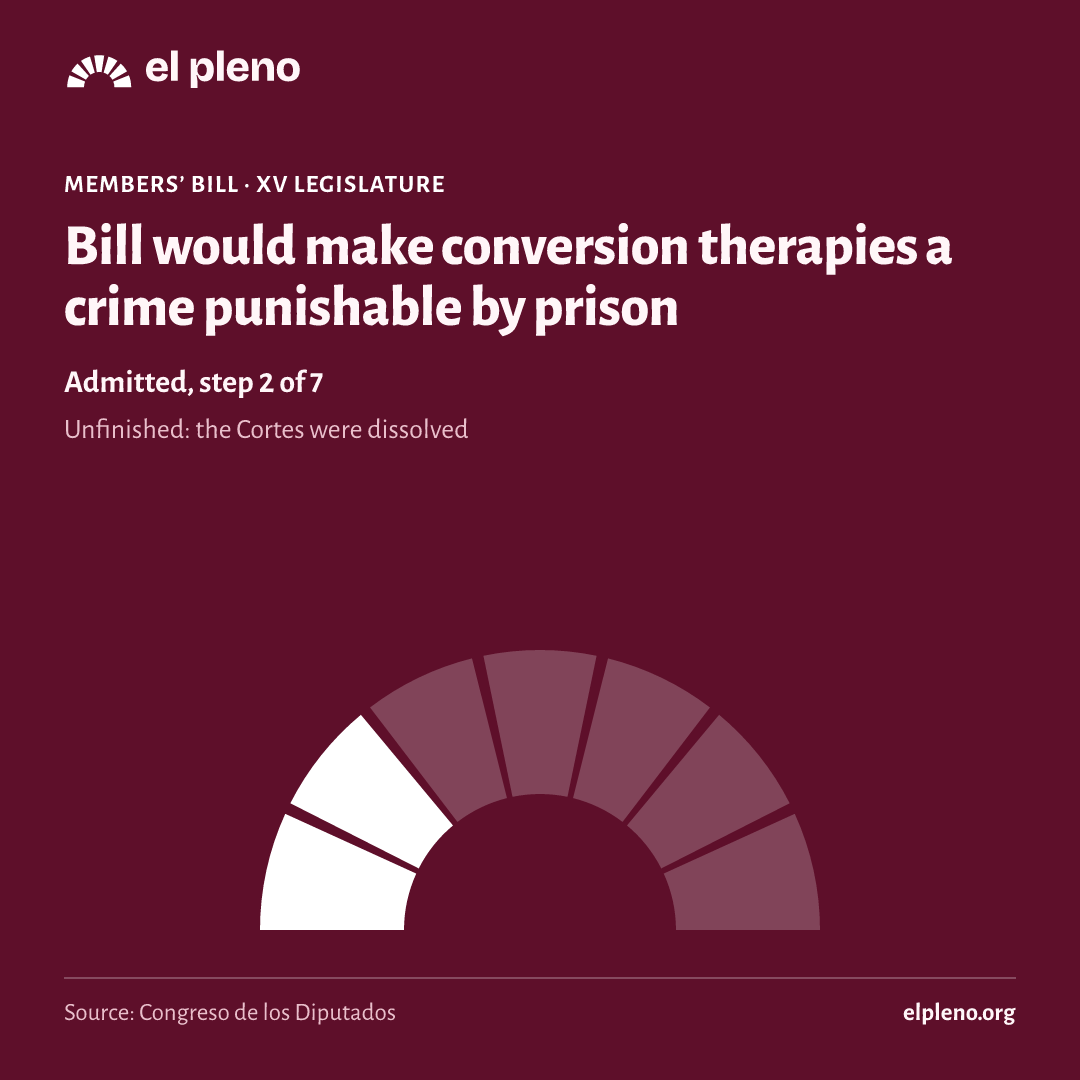
It took 2 of 7 steps. It reached Admitted, and today it is unfinished.
- Introduced18 February 2025Someone registers the text in the Congreso.
- Admitted25 February 2025The Bureau of the Congreso accepts it and, for a members’ bill, the plenary decides whether to consider it.
- Amendmentsnot reachedGroups propose changes.
- Committeenot reachedA committee goes through the text in detail.
- Plenarynot reachedAll 350 deputies vote.
- Senatenot reachedThe Senate can pass it, amend it or veto it.
- BOEnot reachedIt is published in the Official State Gazette (BOE) and comes into force.
See the 6 official steps on a timeline
Was there a plenary vote?
We have no plenary vote linked to this law in the Congreso’s data.
What happens next
What happens now?
The legislature ended before it finished. To go on, someone would have to introduce it again in the new Cortes.
It has not been presented again yet.
Sources
Where does all this come from?
- Congreso de los Diputados, file 122/000167
Official title, type, author, dates and stage.
Retrieved 11 November 2026
- Congreso de los Diputados, procedure
The date of each step, with its official wording.
Retrieved 12 November 2026
- The data comes from the open files of the Congreso, the Senate and the BOE, unaltered.
- Each deputy’s province is the one of their seat on the day of the vote.
- We only say “passed” or “rejected” when the majority needed is certain; otherwise we say which side had more votes.