What it is
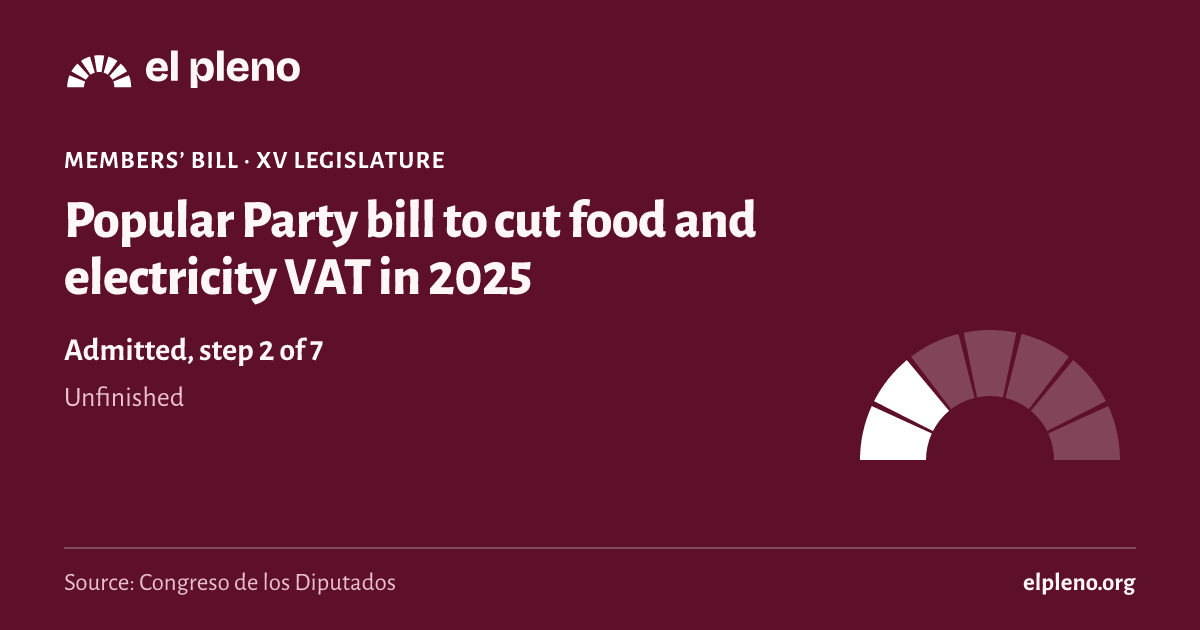
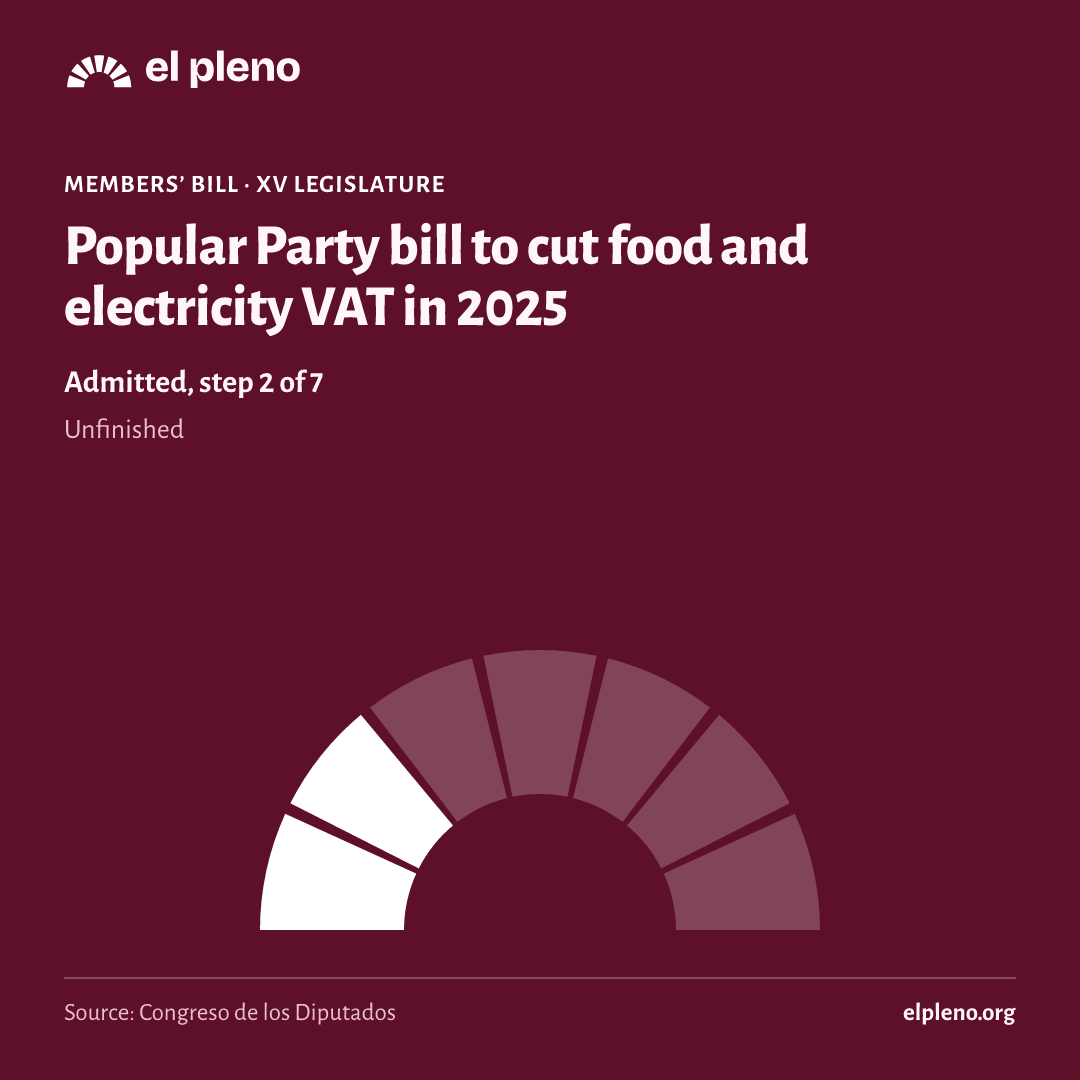
Popular Party bill to cut food and electricity VAT in 2025
It is a members’ bill. Introduced by parliamentary groups, the Senate, regional governments or citizens. It was introduced on 14 February 2025. Introduced by: Grupo Parlamentario Popular en el Congreso.
Official title: Private member's bill on tax, financing, and family support measures in the absence of General State Budgets for 2025.
Source: Congreso de los Diputados, file 122/000161· updated 11 Nov
Automatic summary, not yet reviewed
- The bill would cut VAT on basic foods (bread, milk, cheese, eggs, fruit, vegetables and olive oil) to 2% for all of 2025. Pasta and seed oils would pay 7.5%.
- It would lower electricity bills: the VAT on electricity would drop to 10% until June 30, 2025 for most households, and the same for natural gas, briquettes and pellets. The special tax on power generation would go to 0%.
- The income tax The personal income tax (IRPF in Spain): what people pay on what they earn from work, business or savings. filing thresholds would rise and the tax would be adjusted for inflation, so that higher salaries and pensions do not pay more tax just for moving into a higher bracket.
- The limits would rise so that self-employed people and farmers can stay in their simplified tax schemes. It would also settle the 2023 accounts and update 2025 payments to autonomous communities and local governments.
Who it affects
- Consumers: Would pay less VAT on basic foods and less on electricity and gas bills.
- Workers and pensioners: Would pay less income tax as the tax is adjusted for inflation.
- Self-employed people and farmers: Could earn more without leaving their simplified tax schemes.
- Autonomous communities and local governments: Would receive updated payments from the State to fund health care, education and social services.
Words worth knowing
- IVA
- VAT, the tax paid when buying goods or services in Spain.
- IRPF
- Spanish personal income tax, paid on wages, pensions and other income.
- Progresividad en frío
- Literally 'cold progressivity': when income tax brackets are not adjusted for inflation, so people pay more tax even if their pay only rose to match prices.
- Estimación objetiva
- A simplified tax method used by some self-employed people, based on estimated modules rather than actual income and expenses.
- income tax
- The personal income tax (IRPF in Spain): what people pay on what they earn from work, business or savings.
It summarizes the text as it was introduced. It is written by artificial intelligence and may contain mistakes: the official text is what counts. Read the official text · How we make summaries
Where it stands
How far did it get?
It took 2 of 7 steps. It reached Admitted, and today it is unfinished.
- Introduced14 February 2025Someone registers the text in the Congreso.
- Admitted18 February 2025The Bureau of the Congreso accepts it and, for a members’ bill, the plenary decides whether to consider it.
- Amendmentsnot reachedGroups propose changes.
- Committeenot reachedA committee goes through the text in detail.
- Plenarynot reachedAll 350 deputies vote.
- Senatenot reachedThe Senate can pass it, amend it or veto it.
- BOEnot reachedIt is published in the Official State Gazette (BOE) and comes into force.
See the 5 official steps on a timeline
Was there a plenary vote?
We have no plenary vote linked to this law in the Congreso’s data.
What happens next
What happens now?
The legislature ended before it finished. To go on, someone would have to introduce it again in the new Cortes.
It has not been presented again yet.
Sources
Where does all this come from?
- Congreso de los Diputados, file 122/000161
Official title, type, author, dates and stage.
Retrieved 11 November 2026
- Congreso de los Diputados, procedure
The date of each step, with its official wording.
Retrieved 13 November 2026
- The data comes from the open files of the Congreso, the Senate and the BOE, unaltered.
- Each deputy’s province is the one of their seat on the day of the vote.
- We only say “passed” or “rejected” when the majority needed is certain; otherwise we say which side had more votes.