What it is
Bill to make the minimum vital income easier to get and regulate emergency aid
It is a members’ bill. Introduced by parliamentary groups, the Senate, regional governments or citizens. It was introduced on 13 February 2025. Introduced by: Grupo Parlamentario Plurinacional SUMAR.
Official title: Private member's bill amending Law 19/2021, of December 20, establishing the minimum vital income, and establishing a specific legal regime for emergency aid.
Source: Congreso de los Diputados, file 122/000160· updated 11 Nov
Automatic summary, not yet reviewed
- The bill would reform the minimum vital income because, according to AIReF, only 36% of households that could receive it actually do. It also notes that many families end up owing repayments when their income is reviewed.
- The bill would change several requirements for the minimum vital income: simplify how income and assets are counted, remove certain requirements and paperwork, and allow the benefit to be reviewed automatically using data the government already has. It would also mean that if a review lowers the payment, no money would have to be paid back.
- The bill would regulate the child allowance supplement as a monthly payment for each minor in the household, without needing to have applied for the minimum vital income first.
- The bill would give their own legal framework to emergency cash benefits managed by social services, so they can be granted quickly. Regional governments would have twelve months to adapt their rules, and these benefits would fall outside the general subsidies law.
Who it affects
- Low-income households: Lone adults aged 18 or over and low-income, low-asset families could qualify for the minimum vital income more easily.
- Families with children: Households with minors could receive the child allowance supplement without having applied for the minimum vital income first.
- People in vulnerable situations: They would no longer have to repay money when a review lowers the benefit, and emergency aid would involve less paperwork.
- Autonomous communities (regional governments): They would have to adapt the legal framework for emergency benefits within twelve months and define how they are granted.
- Foreign nationals and people affected by emergencies: They could qualify for the minimum vital income with fewer proof requirements, and compensation for emergency damage would not count as income.
Words worth knowing
- Ingreso mínimo vital (IMV)
- A monthly government benefit for households with very low income in Spain.
- Unidad de convivencia
- The group of people living in the same home who are linked by marriage, registered partnership, family ties or other relationships covered by the law.
- Complemento de ayuda para la infancia (CAPI)
- An extra monthly payment for families with children under their care.
- Patrimonio neto
- Net worth: the value of everything a person or family owns (homes, bank accounts, investments) minus their debts.
- Declaración responsable
- A written statement in which someone declares they meet a condition, knowing it can be checked later.
It summarizes the text as it was introduced. It is written by artificial intelligence and may contain mistakes: the official text is what counts. Read the official text · How we make summaries
Where it stands
How far did it get?
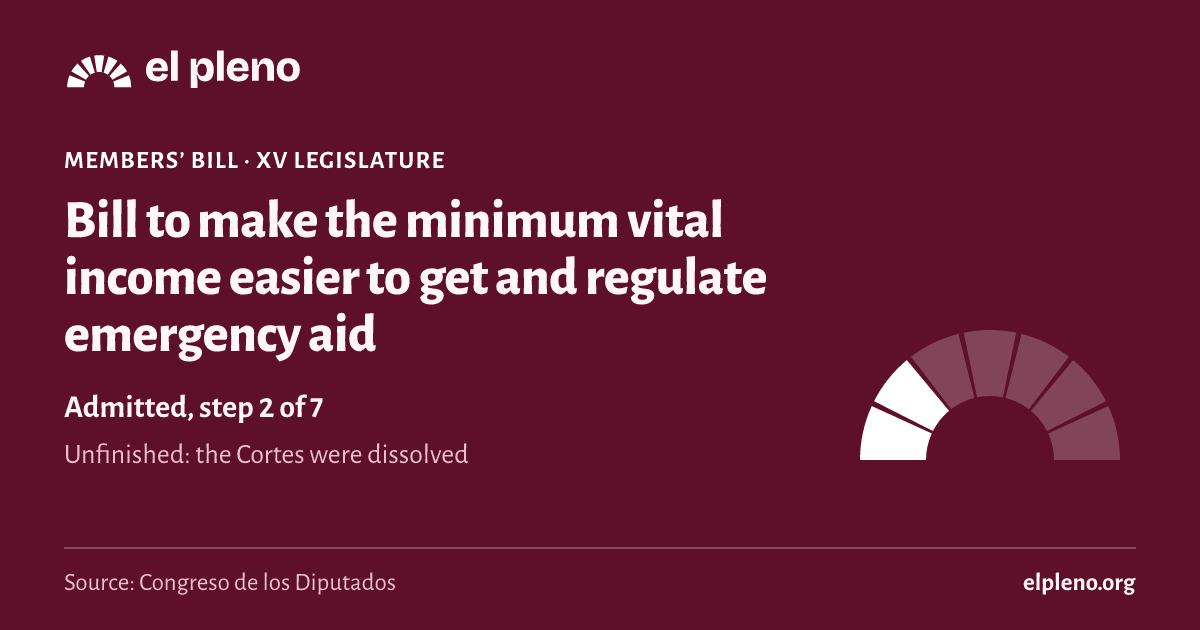
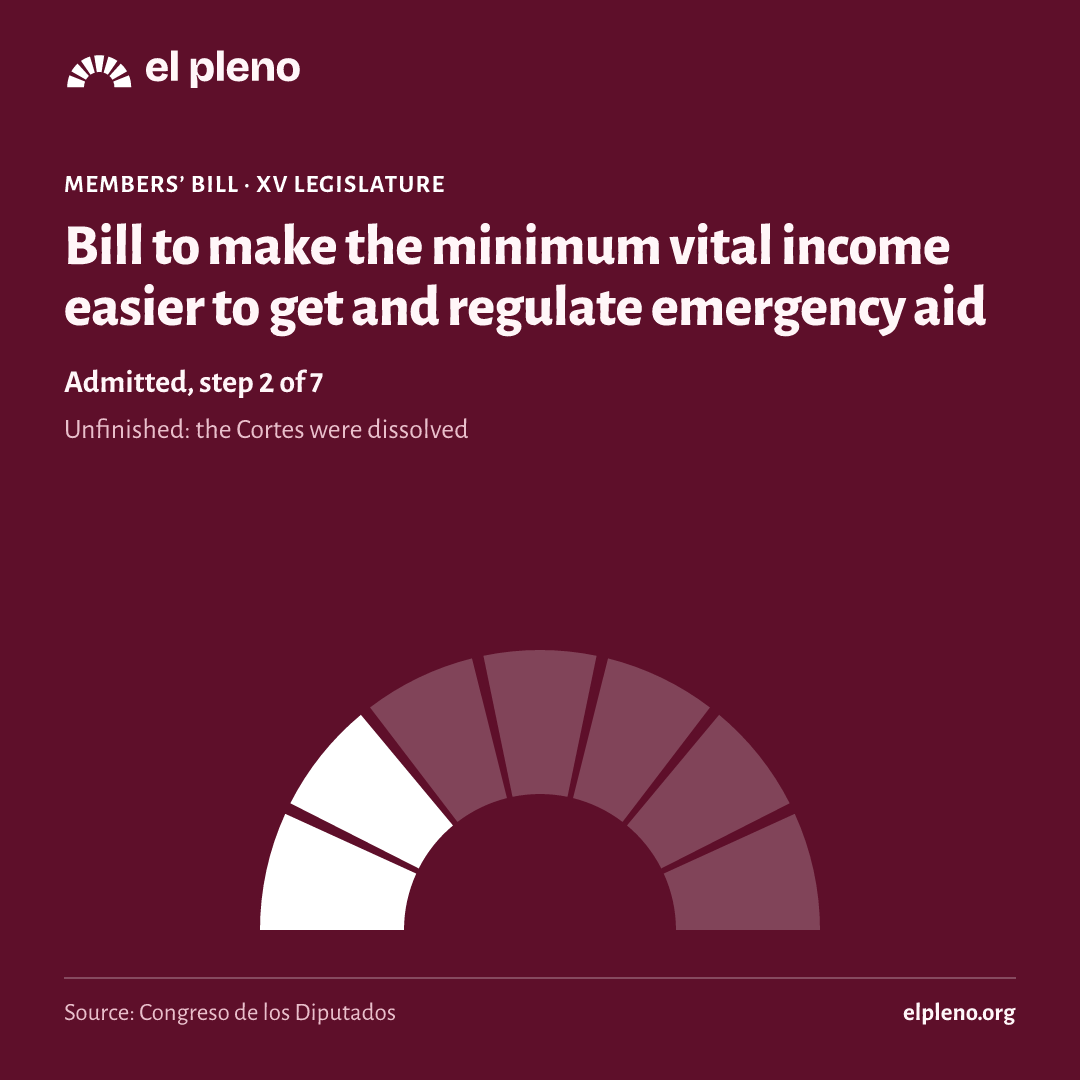
It took 2 of 7 steps. It reached Admitted, and today it is unfinished.
- Introduced13 February 2025Someone registers the text in the Congreso.
- Admitted18 February 2025The Bureau of the Congreso accepts it and, for a members’ bill, the plenary decides whether to consider it.
- Amendmentsnot reachedGroups propose changes.
- Committeenot reachedA committee goes through the text in detail.
- Plenarynot reachedAll 350 deputies vote.
- Senatenot reachedThe Senate can pass it, amend it or veto it.
- BOEnot reachedIt is published in the Official State Gazette (BOE) and comes into force.
See the 6 official steps on a timeline
Was there a plenary vote?
We have no plenary vote linked to this law in the Congreso’s data.
What happens next
What happens now?
The legislature ended before it finished. To go on, someone would have to introduce it again in the new Cortes.
It has not been presented again yet.
Sources
Where does all this come from?
- Congreso de los Diputados, file 122/000160
Official title, type, author, dates and stage.
Retrieved 11 November 2026
- Congreso de los Diputados, procedure
The date of each step, with its official wording.
Retrieved 13 November 2026
- The data comes from the open files of the Congreso, the Senate and the BOE, unaltered.
- Each deputy’s province is the one of their seat on the day of the vote.
- We only say “passed” or “rejected” when the majority needed is certain; otherwise we say which side had more votes.