What it is
Bill would limit the Military Criminal Code's application to the Civil Guard
It is a members’ bill. Introduced by parliamentary groups, the Senate, regional governments or citizens. It was introduced on 30 January 2025. Introduced by: Grupo Parlamentario Plurinacional SUMAR.
Official title: Private member's bill on the amendment of Organic Law 14/2025, of October 14, on the Military Penal Code (Organic).
Source: Congreso de los Diputados, file 122/000154· updated 11 Nov
Automatic summary, not yet reviewed
- The bill, introduced by the Plurinational Parliamentary Group SUMAR, proposes deleting section 5 of Article 1 of the Military Criminal Code, so that the code would apply to Civil Guard members only in the cases listed in section 4 of that article, and never for acts committed off duty.
- The explanatory statement says that, under the current wording, Civil Guard officers can be criminally convicted and sent to military prison for acts committed while performing police duties, even though many of those acts are already punished under the Civil Guard's disciplinary rules.
- Acts committed before the law takes effect would be punished under the previous code, unless the new rules are more favorable, in which case the new rules would apply.
- Final judgments not yet carried out would be reviewed on the court's own initiative if the new law would mean an acquittal or a more beneficial sentence. Judgments under appeal could also apply the more favorable rules.
- The law is enacted under the State's powers over criminal legislation, defense, the Armed Forces and public security, and would take effect the day after its publication in the Official State Gazette.
Who it affects
- Civil Guard members: They could no longer be convicted under the Military Criminal Code for acts committed off duty.
- Convicted or charged Civil Guard officers: Their sentences could be reviewed or the more favorable rules applied to them.
- Judges and courts: They would have to review final, unexecuted judgments on their own initiative and apply the more favorable law.
Words worth knowing
- Código Penal Militar
- The law listing crimes and penalties that apply to members of the military.
- Sentencia firme
- A final judgment that can no longer be appealed.
- Revisión de oficio
- A review the court starts on its own, without anyone asking for it.
- Reo
- A person convicted of a crime.
- Ley orgánica
- A type of Spanish law reserved for major matters, such as criminal law, requiring a stricter approval process.
It summarizes the text as it was introduced. It is written by artificial intelligence and may contain mistakes: the official text is what counts. Read the official text · How we make summaries
Where it stands
How far did it get?
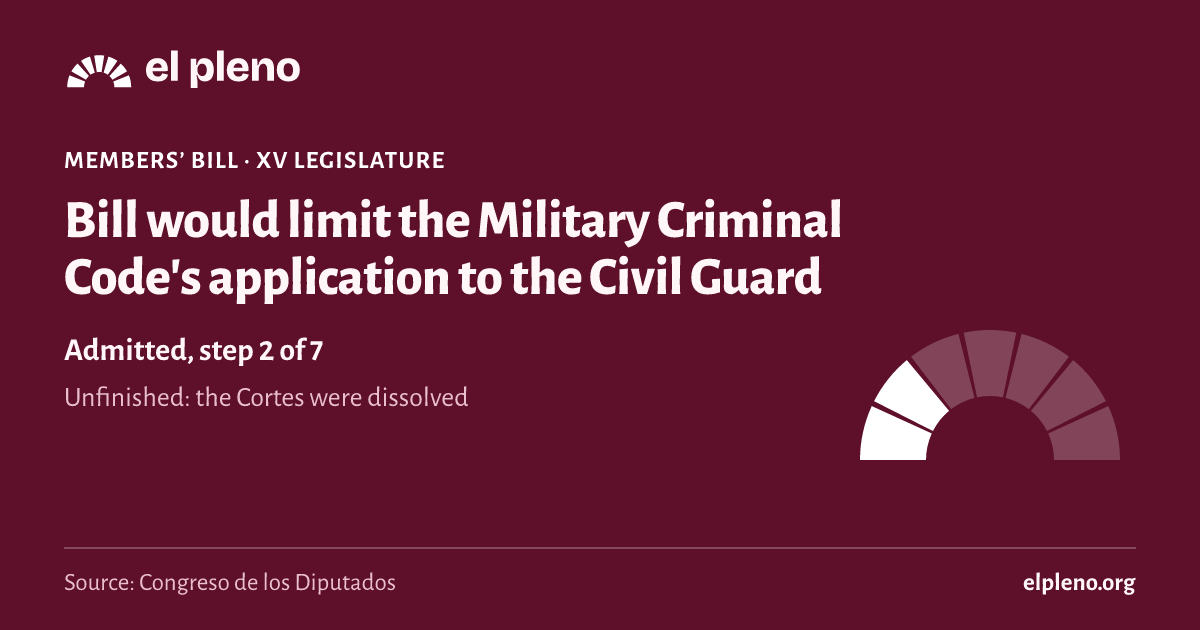
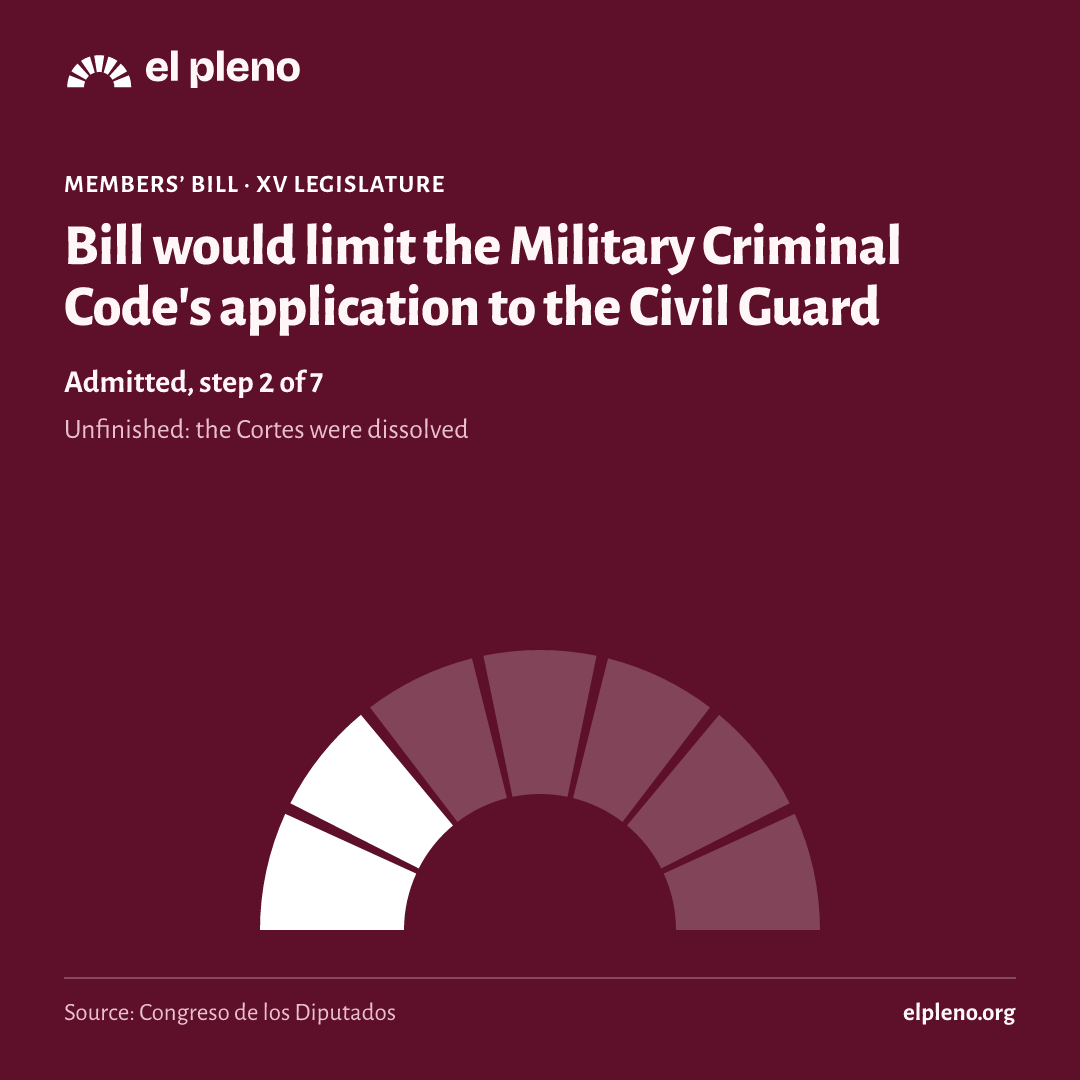
It took 2 of 7 steps. It reached Admitted, and today it is unfinished.
- Introduced30 January 2025Someone registers the text in the Congreso.
- Admitted4 February 2025The Bureau of the Congreso accepts it and, for a members’ bill, the plenary decides whether to consider it.
- Amendmentsnot reachedGroups propose changes.
- Committeenot reachedA committee goes through the text in detail.
- Plenarynot reachedAll 350 deputies vote.
- Senatenot reachedThe Senate can pass it, amend it or veto it.
- BOEnot reachedIt is published in the Official State Gazette (BOE) and comes into force.
See the 6 official steps on a timeline
Was there a plenary vote?
We have no plenary vote linked to this law in the Congreso’s data.
What happens next
What happens now?
The legislature ended before it finished. To go on, someone would have to introduce it again in the new Cortes.
It has not been presented again yet.
Sources
Where does all this come from?
- Congreso de los Diputados, file 122/000154
Official title, type, author, dates and stage.
Retrieved 11 November 2026
- Congreso de los Diputados, procedure
The date of each step, with its official wording.
Retrieved 13 November 2026
- The data comes from the open files of the Congreso, the Senate and the BOE, unaltered.
- Each deputy’s province is the one of their seat on the day of the vote.
- We only say “passed” or “rejected” when the majority needed is certain; otherwise we say which side had more votes.