What it is
Bill proposes fast, paperwork-free aid after disasters
It is a members’ bill. Introduced by parliamentary groups, the Senate, regional governments or citizens. It was introduced on 11 January 2025. Introduced by: Grupo Parlamentario Popular en el Congreso.
Official title: Private member's bill regarding the establishment of new mechanisms to urgently and efficiently address emergency situations, such as that resulting from the DANA of October 2024.
Source: Congreso de los Diputados, file 122/000148· updated 11 Nov
Automatic summary, not yet reviewed
- The bill would allow the Tax Agency to handle economic aid for individuals and businesses, and even pay it without anyone applying, using data the Administration already has.
- It creates a Reconstruction Fund under the Ministry of Finance to finance recovery in affected areas, with State money and private donations, subject to regular audits.
- The Government would have to report to the Spanish Parliament every three months on how the Fund is working: contributions, aid granted and results.
- Regional governments and municipalities could receive aid covering one hundred percent of emergency costs, and up to one hundred percent of the cost of repairing public infrastructure and services.
- Affected self-employed workers would get a specific plan with benefits for business closure, reduced Social Security contributions, tax deferrals and direct aid. In addition, company donations to affected employees would be exempt from personal income tax The personal income tax (IRPF in Spain): what people pay on what they earn from work, business or savings..
- For those hit by the October 2024 DANA Spanish acronym for a high-altitude isolated depression, a weather event that caused severe flooding in eastern and southern Spain in October 2024. floods, the bill proposes tax breaks (exemptions from property tax, VAT on car purchases or home repairs, deferrals), 250 public homes, the transfer of 1,056 SAREB Spanish public company that manages real estate from bailed-out banks; its apartments would be transferred to house affected families. apartments, and a 0% interest rate on loans under the ICO DANA line.
Who it affects
- Families and businesses affected by disasters: They would receive direct, automatic aid with no paperwork.
- Regional governments and municipalities: They could recover up to one hundred percent of emergency costs and reconstruction works.
- Self-employed workers: They would get closure benefits, reduced contributions and deferrals of taxes and Social Security payments.
- People hit by the October 2024 DANA floods: They would get tax exemptions, temporary housing and interest-free loans.
- Employees receiving donations from their employer: Those amounts would not be taxed as income up to the certified damage.
Words worth knowing
- DANA
- Spanish acronym for a high-altitude isolated depression, a weather event that caused severe flooding in eastern and southern Spain in October 2024.
- AEAT
- Spanish Tax Agency, the public body that manages taxes and holds citizens' tax data.
- IRPF
- Spanish personal income tax, paid on earnings from work and other income.
- IBI
- Spanish local property tax, paid for owning a home, premises or land.
- SAREB
- Spanish public company that manages real estate from bailed-out banks; its apartments would be transferred to house affected families.
- income tax
- The personal income tax (IRPF in Spain): what people pay on what they earn from work, business or savings.
It summarizes the text as it was introduced. It is written by artificial intelligence and may contain mistakes: the official text is what counts. Read the official text · How we make summaries
Where it stands
How far did it get?
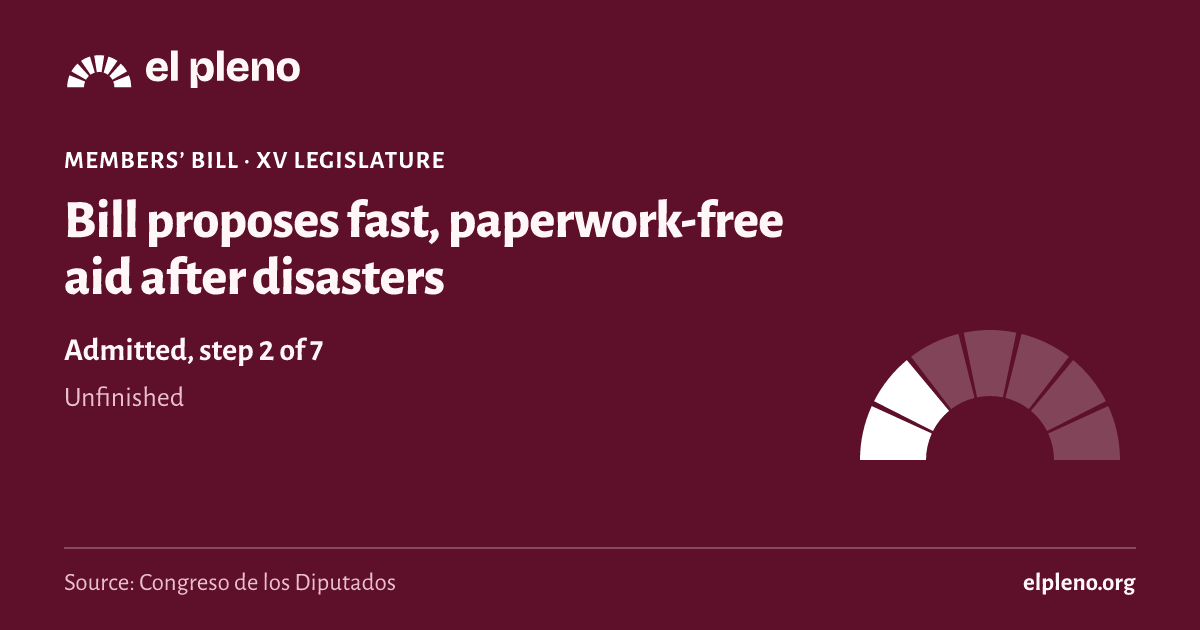
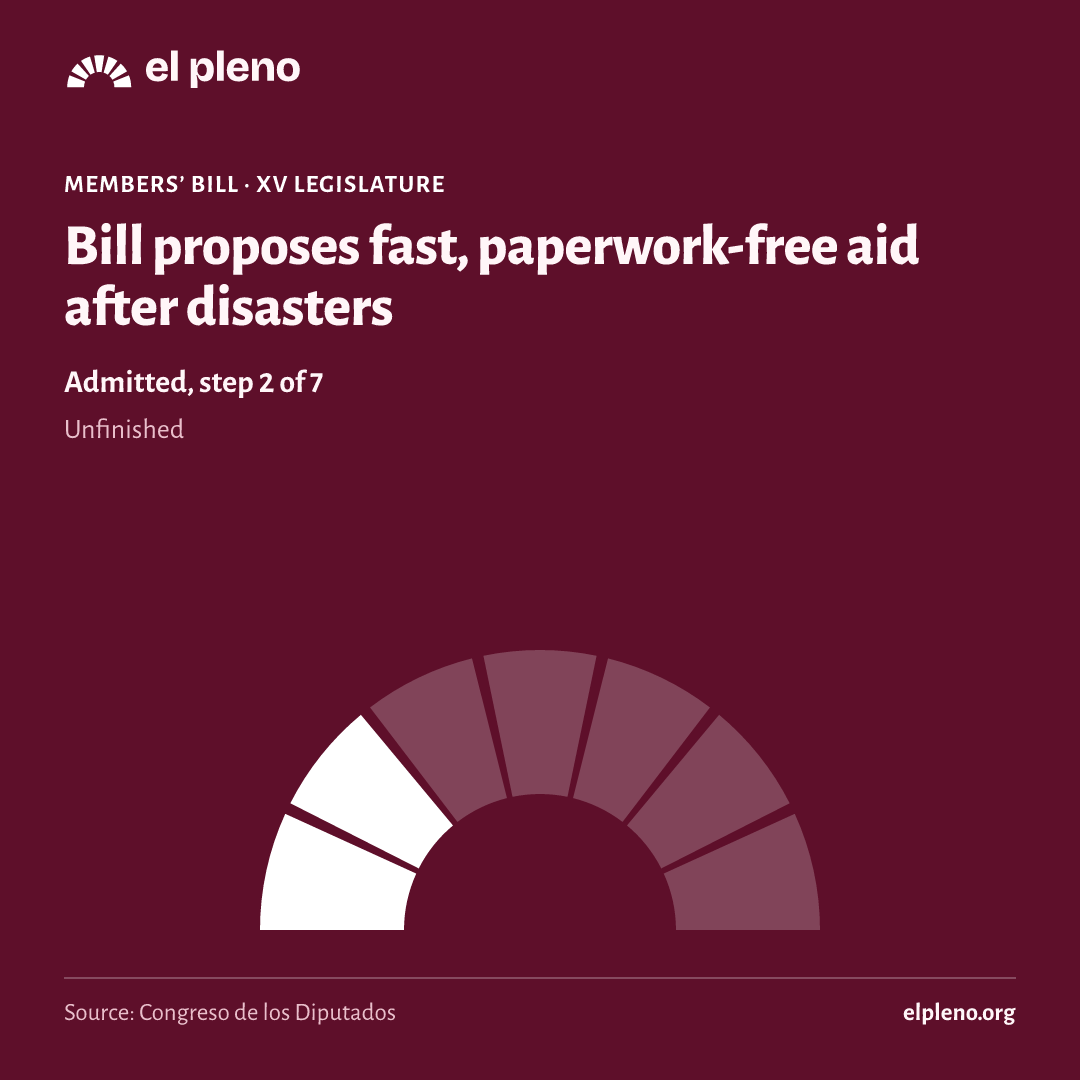
It took 2 of 7 steps. It reached Admitted, and today it is unfinished.
- Introduced11 January 2025Someone registers the text in the Congreso.
- Admitted16 January 2025The Bureau of the Congreso accepts it and, for a members’ bill, the plenary decides whether to consider it.
- Amendmentsnot reachedGroups propose changes.
- Committeenot reachedA committee goes through the text in detail.
- Plenarynot reachedAll 350 deputies vote.
- Senatenot reachedThe Senate can pass it, amend it or veto it.
- BOEnot reachedIt is published in the Official State Gazette (BOE) and comes into force.
See the 5 official steps on a timeline
Was there a plenary vote?
We have no plenary vote linked to this law in the Congreso’s data.
What happens next
What happens now?
The legislature ended before it finished. To go on, someone would have to introduce it again in the new Cortes.
It has not been presented again yet.
The same initiative in the other chamber:
- XV Legislature, Senate Private member's bill regarding the establishment of new mechanisms to address emergency situations urgently and efficiently, such as that resulting from the October 2024 flash flood.
- XV Legislature, Senate Private member's bill regarding the establishment of new mechanisms to address emergency situations urgently and efficiently, such as that resulting from the October 2024 flash flood.
Sources
Where does all this come from?
- Congreso de los Diputados, file 122/000148
Official title, type, author, dates and stage.
Retrieved 11 November 2026
- Congreso de los Diputados, procedure
The date of each step, with its official wording.
Retrieved 12 November 2026
- The data comes from the open files of the Congreso, the Senate and the BOE, unaltered.
- Each deputy’s province is the one of their seat on the day of the vote.
- We only say “passed” or “rejected” when the majority needed is certain; otherwise we say which side had more votes.