What it is
Bill to ban minors from attending or taking part in bullfighting events
It is a members’ bill. Introduced by parliamentary groups, the Senate, regional governments or citizens. It was introduced on 20 December 2024. Introduced by: Grupo Parlamentario Plurinacional SUMAR.
Official title: Private member's bill for the protection of childhood and adolescence against the violence of bullfighting.
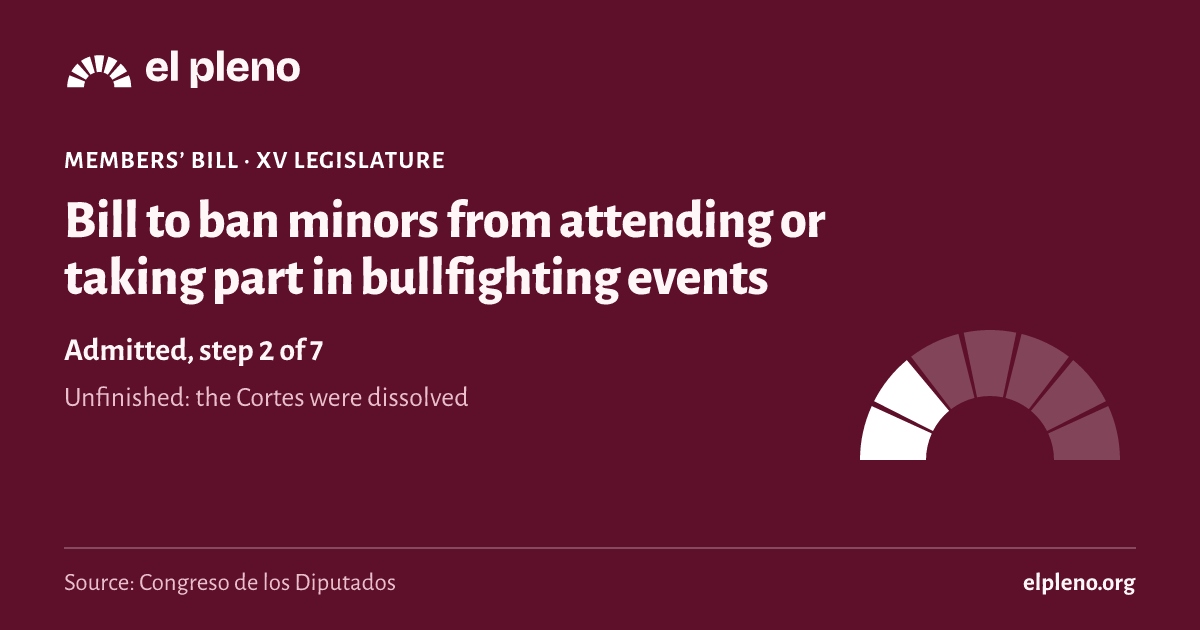
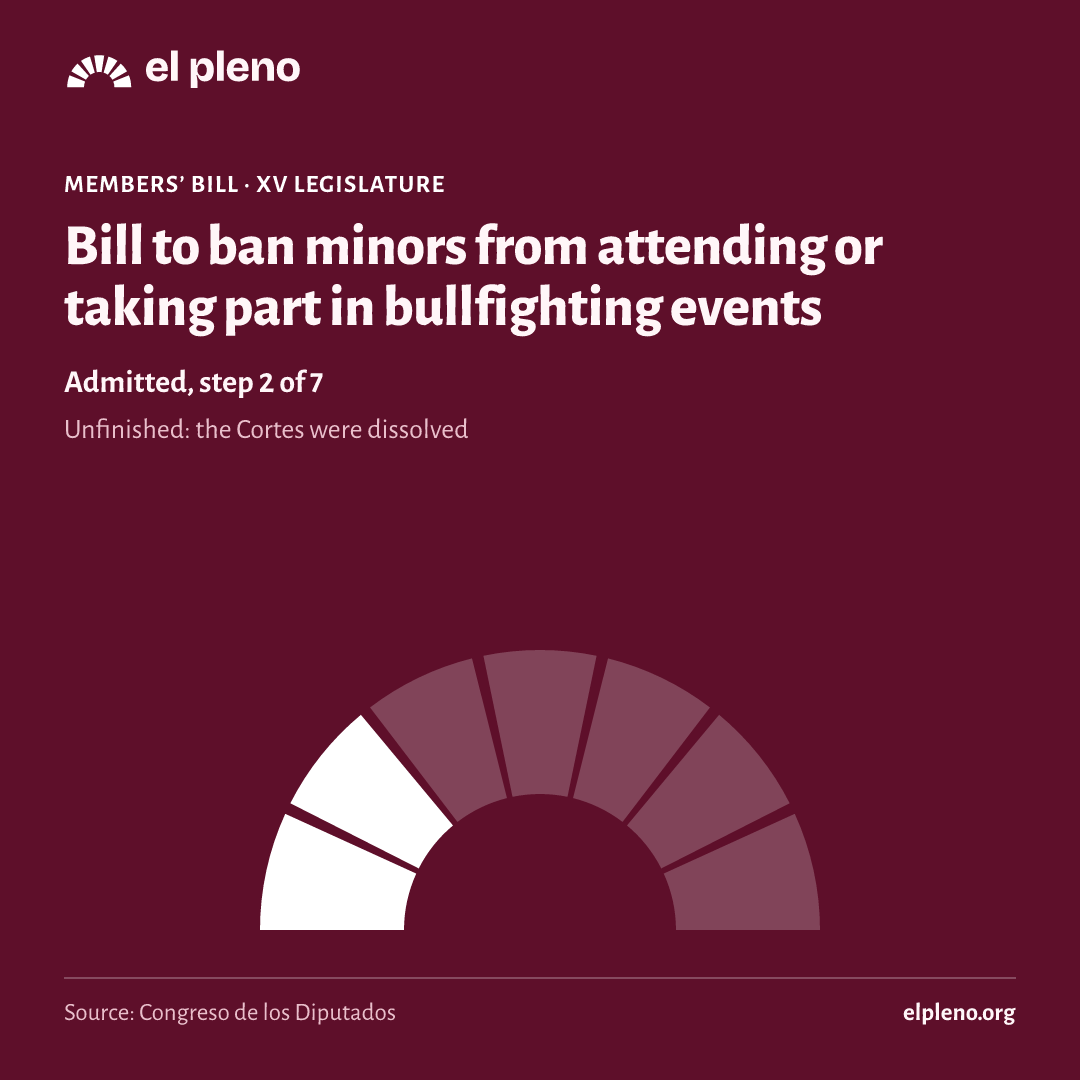
Source: Congreso de los Diputados, file 122/000145· updated 11 Nov
Automatic summary, not yet reviewed
- The bill would ban anyone under eighteen from entering bullrings or authorized venues hosting bullfighting events, including bullfighting schools that use animals in their practice. Breaking this rule would be considered a very serious offense.
- Minors would be barred from working as bullfighting professionals. In Spain, a person can currently become a bullfighting professional at age 16.
- Students at bullfighting schools would have to be adults. Currently, the minimum age to take part in practical lessons with live animals is fourteen, and the rules allowing this would be removed.
- Broadcasts, previews, ads, summaries or promotion of shows in which animals are mistreated or killed would be considered content harmful to minors, with the protection consequences set out in the audiovisual law.
- The bill responds to recommendations from the UN Committee on the Rights of the Child, which in 2018 urged Spain to ban the participation of people under 18 as bullfighters and as spectators at bullfighting events.
- The law would take effect the day after its publication in the Official State Gazette (Boletín Oficial del Estado). It is issued under the State's exclusive powers over labor, communications and public order, among other areas.
Who it affects
- People under 18: They could not enter bullrings or venues hosting bullfighting events, work as bullfighting professionals, or attend bullfighting schools.
- Bullfighting event companies and organizers: Allowing minors in would be a very serious offense.
- Bullfighting schools: They could only accept adult students.
- TV channels and audiovisual platforms: Broadcasting or promoting shows involving animal mistreatment or killing would be considered content harmful to minors.
- Parents: They could not take their underage children to bullfighting events.
Words worth knowing
- Proposición de ley
- A bill introduced by a parliamentary group. It is not an approved law: it is still going through the legislative process.
- Comité de los Derechos del Niño
- UN Committee on the Rights of the Child: a body of 18 experts that monitors whether countries comply with the Convention on the Rights of the Child.
- Infracción muy grave
- Very serious offense: the most serious type of violation under the law, carrying the toughest penalties.
- Interés superior del menor
- Best interests of the child: the principle that children's and teens' well-being prevails over any other right or interest.
It summarizes the text as it was introduced. It is written by artificial intelligence and may contain mistakes: the official text is what counts. Read the official text · How we make summaries
Where it stands
How far did it get?
It took 2 of 7 steps. It reached Admitted, and today it is unfinished.
- Introduced20 December 2024Someone registers the text in the Congreso.
- Admitted16 January 2025The Bureau of the Congreso accepts it and, for a members’ bill, the plenary decides whether to consider it.
- Amendmentsnot reachedGroups propose changes.
- Committeenot reachedA committee goes through the text in detail.
- Plenarynot reachedAll 350 deputies vote.
- Senatenot reachedThe Senate can pass it, amend it or veto it.
- BOEnot reachedIt is published in the Official State Gazette (BOE) and comes into force.
See the 6 official steps on a timeline
Was there a plenary vote?
We have no plenary vote linked to this law in the Congreso’s data.
What happens next
What happens now?
The legislature ended before it finished. To go on, someone would have to introduce it again in the new Cortes.
It has not been presented again yet.
Sources
Where does all this come from?
- Congreso de los Diputados, file 122/000145
Official title, type, author, dates and stage.
Retrieved 11 November 2026
- Congreso de los Diputados, procedure
The date of each step, with its official wording.
Retrieved 12 November 2026
- The data comes from the open files of the Congreso, the Senate and the BOE, unaltered.
- Each deputy’s province is the one of their seat on the day of the vote.
- We only say “passed” or “rejected” when the majority needed is certain; otherwise we say which side had more votes.