What it is
Bill proposes lifetime pension and reparation for trans and LGTBI dictatorship victims
It is a members’ bill. Introduced by parliamentary groups, the Senate, regional governments or citizens. It was introduced on 19 November 2024. Introduced by: Grupo Parlamentario Mixto Grupo Parlamentario Plurinacional SUMAR.
Official title: Private member's Memory and Justice Bill for the Reparation of trans and LGTBI Persons who were victims of the dictatorship on grounds of Sexual Orientation, Identity and/or Gender Expression.
Source: Congreso de los Diputados, file 122/000142· updated 11 Nov
Automatic summary, not yet reviewed
- The bill would recognize and provide reparation to trans and LGTBI people who suffered human rights violations and institutional violence because of their sexual orientation, gender identity or expression, aiming to guarantee them a dignified old age.
- Potential beneficiaries include people targeted by the Vagos y Maleantes Law (after its 1954 amendment), the 1970 Social Danger and Rehabilitation Law, or the public scandal crime before its 1988 amendment, as well as women held in centers of the Women's Protection Board because of their sexual orientation.
- The bill would create a lifetime financial benefit paid from the State Budget, equal to the minimum Social Security pension for people over 65 without dependents. It would be compatible with non-contributory benefits, and this income would not count when deciding eligibility for those benefits.
- The benefit amount would increase by 50% for people who were deprived of liberty under the laws listed in the bill.
- The Ministry of the Presidency, Justice and Relations with the Courts would process applications. Applications must be filed within one year of the law taking effect, and decisions are due within 12 months; if no decision is issued by then, the request would be deemed approved.
- Beyond money, the bill includes symbolic reparation: research, publications and memory spaces; priority access to public housing and senior residences; a budget line to preserve LGTBI documentary and audiovisual memory; and state recognition of psychiatric abuse with an apology.
Who it affects
- Trans and LGTBI people persecuted under the Vagos y Maleantes Law (1954 amendment) or the 1970 Social Danger and Rehabilitation Law.: They could receive a lifetime financial benefit and reparation measures.
- People convicted of the public scandal crime under Article 431 of the Criminal Code before its 1988 amendment.: They could also be beneficiaries.
- Women held in centers of the Women's Protection Board because of their sexual orientation.: They could be covered by the proposed law.
- People who were deprived of liberty under those laws.: Their benefit would increase by 50%.
Words worth knowing
- Prestación no contributiva (non-contributory benefit)
- Public financial aid given without having previously paid into Social Security.
- Prestación económica vitalicia (lifetime financial benefit)
- Money paid regularly for the rest of a person's life.
- Presupuestos Generales del Estado (State Budget)
- The State's annual public budget, which allocates money to the country's expenses.
- Reparación simbólica (symbolic reparation)
- Non-monetary measures, such as public apologies, monuments or events that recognize what happened to victims.
It summarizes the text as it was introduced. It is written by artificial intelligence and may contain mistakes: the official text is what counts. Read the official text · How we make summaries
Where it stands
How far did it get?
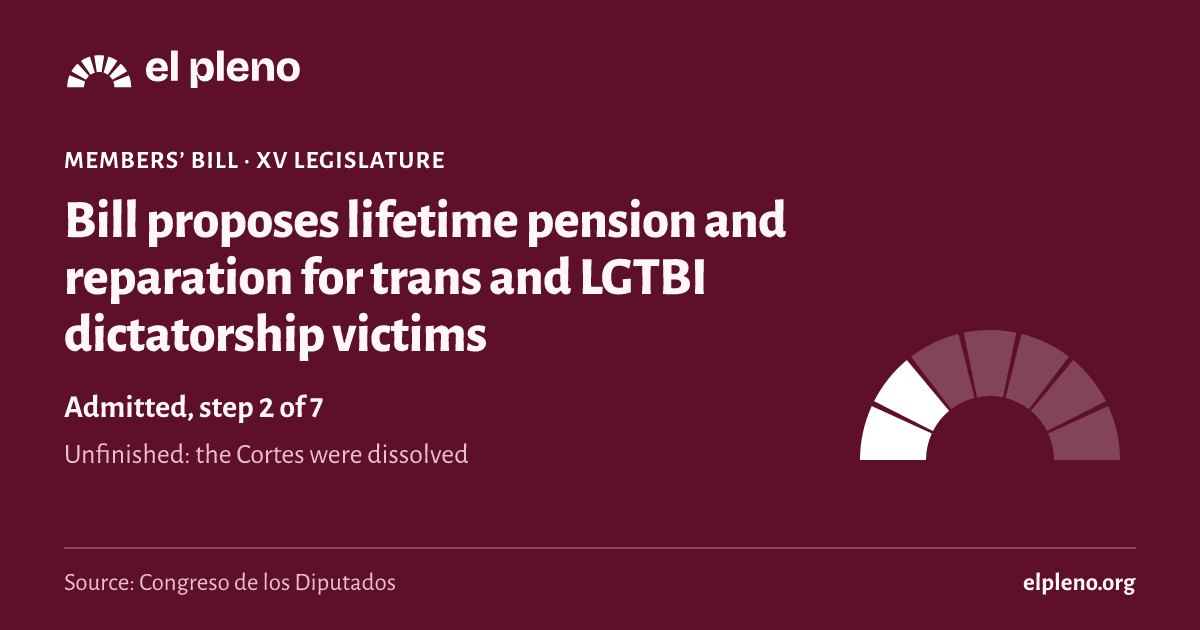
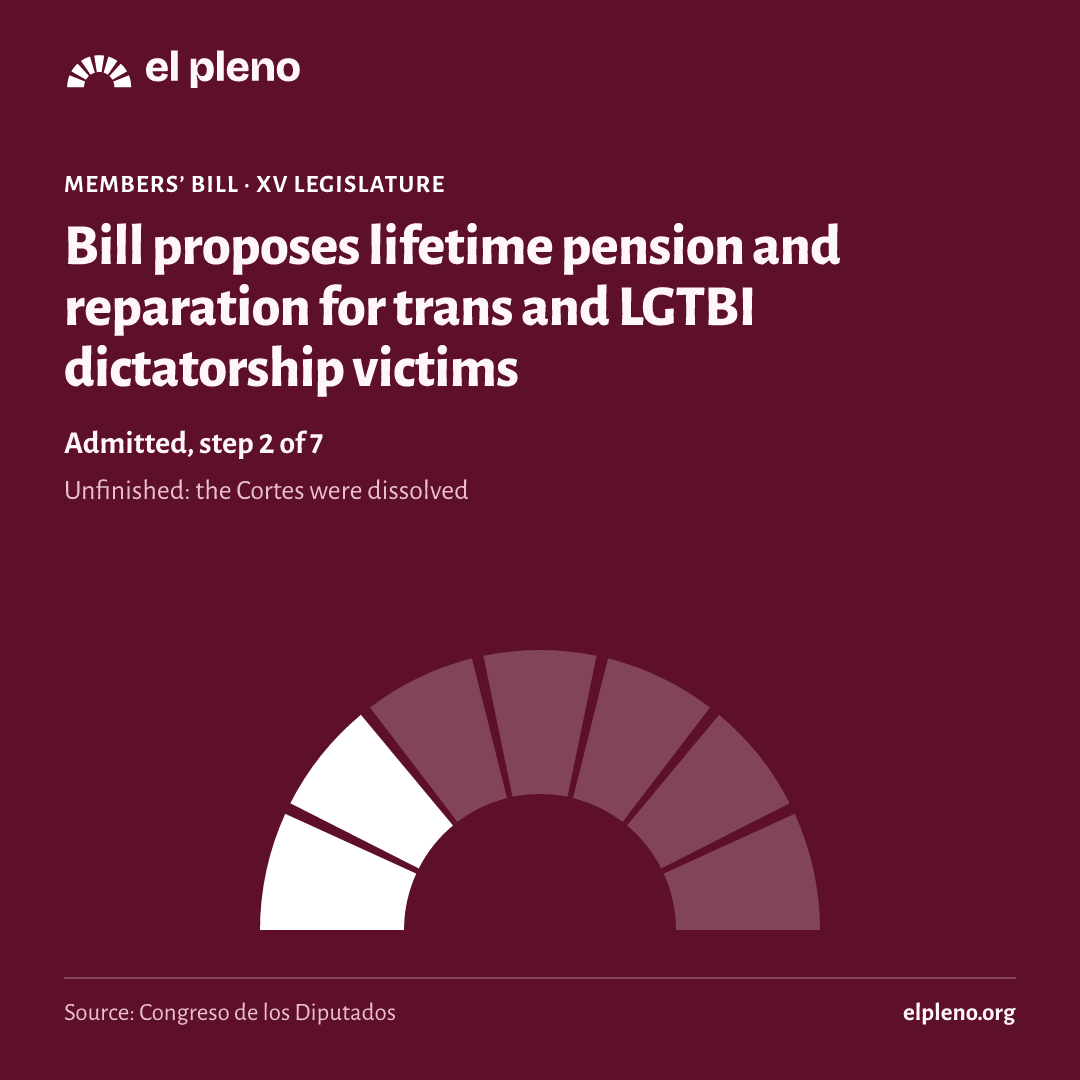
It took 2 of 7 steps. It reached Admitted, and today it is unfinished.
- Introduced19 November 2024Someone registers the text in the Congreso.
- Admitted26 November 2024The Bureau of the Congreso accepts it and, for a members’ bill, the plenary decides whether to consider it.
- Amendmentsnot reachedGroups propose changes.
- Committeenot reachedA committee goes through the text in detail.
- Plenarynot reachedAll 350 deputies vote.
- Senatenot reachedThe Senate can pass it, amend it or veto it.
- BOEnot reachedIt is published in the Official State Gazette (BOE) and comes into force.
See the 6 official steps on a timeline
Was there a plenary vote?
We have no plenary vote linked to this law in the Congreso’s data.
What happens next
What happens now?
The legislature ended before it finished. To go on, someone would have to introduce it again in the new Cortes.
It has not been presented again yet.
Sources
Where does all this come from?
- Congreso de los Diputados, file 122/000142
Official title, type, author, dates and stage.
Retrieved 11 November 2026
- Congreso de los Diputados, procedure
The date of each step, with its official wording.
Retrieved 13 November 2026
- The data comes from the open files of the Congreso, the Senate and the BOE, unaltered.
- Each deputy’s province is the one of their seat on the day of the vote.
- We only say “passed” or “rejected” when the majority needed is certain; otherwise we say which side had more votes.