What it is
Proposal to strengthen living wills for end-of-life care
It is a members’ bill. Introduced by parliamentary groups, the Senate, regional governments or citizens. It was introduced on 17 October 2024. Introduced by: Grupo Parlamentario Socialista.
Official title: Private member's bill on the right to grant advance directives.
Source: Congreso de los Diputados, file 122/000133· updated 11 Nov
Automatic summary, not yet reviewed
- The bill would recognize the right of every adult in Spain to state in advance, in writing, what care and treatment they want at the end of their life, and also to request the assistance in dying regulated by the euthanasia law.
- Living wills could be made in a public document or under the applicable rules, and in the second case they would need to be registered in the National Registry to be valid nationwide. They would have to appear in a visible place in the patient's medical record.
- Patients could appoint a representative to make sure their instructions are followed and, in situations not covered, to be guided by the values stated in the document. If the person keeps the capacity to decide at the end of life, their wishes at that moment prevail.
- The bill would amend Article 11 of Law 41/2002 to update the rules on living wills and change their current limits, removing the reference to good clinical practice that could reduce their effectiveness.
Who it affects
- Adults who want to put in writing their wishes about care and treatment at the end of life.: They could make a living will in a public document or under the applicable rules, and change or revoke it at any time.
- Patients in the end-of-life process.: If they keep the capacity to decide, their wishes at that moment prevail over any prior instructions.
- Representatives appointed in living wills.: They must follow their assigned duties, seek the person's best interest, and ensure the instructions are carried out.
- Health professionals and health centers, public and private.: They must keep living wills visible in the medical record and cannot ignore their existence.
Words worth knowing
- Instrucciones previas (living will)
- A document in which a person states in advance what care and treatment they want if they reach a point when they cannot express it themselves.
- Lex artis
- A Latin phrase referring to good clinical practice, that is, how health professionals normally act.
- Historia clínica (medical record)
- The document holding all of a patient's health information.
- Prestación de ayuda para morir (assistance in dying)
- The assistance regulated by the Spanish euthanasia law for people who request it under certain conditions.
It summarizes the text as it was introduced. It is written by artificial intelligence and may contain mistakes: the official text is what counts. Read the official text · How we make summaries
Where it stands
How far did it get?
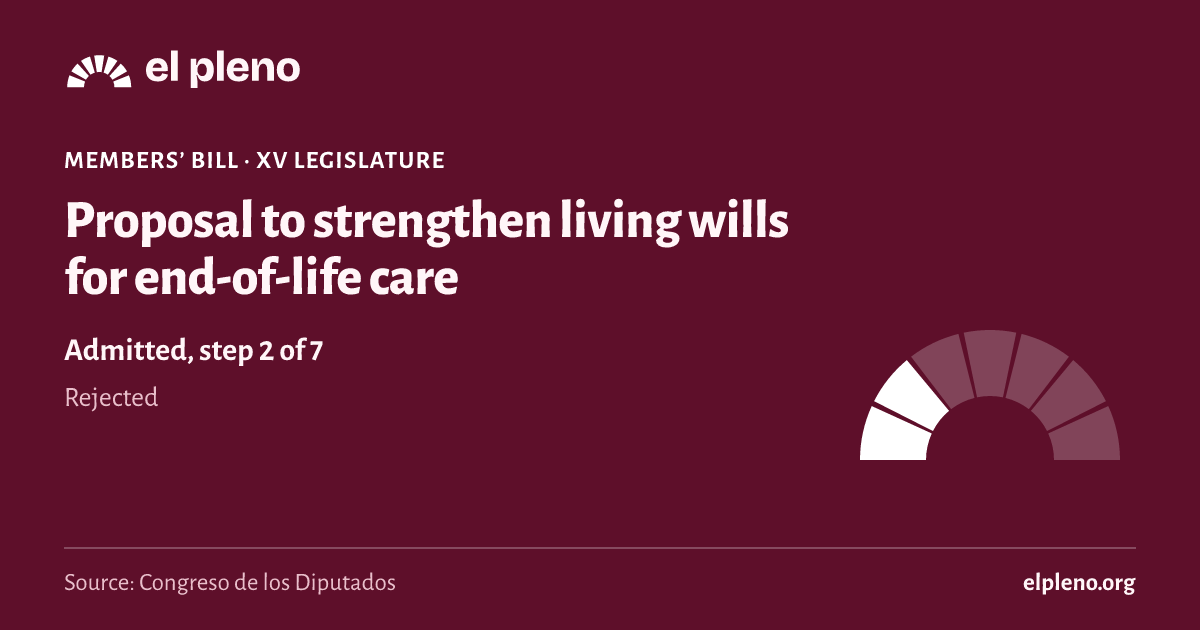
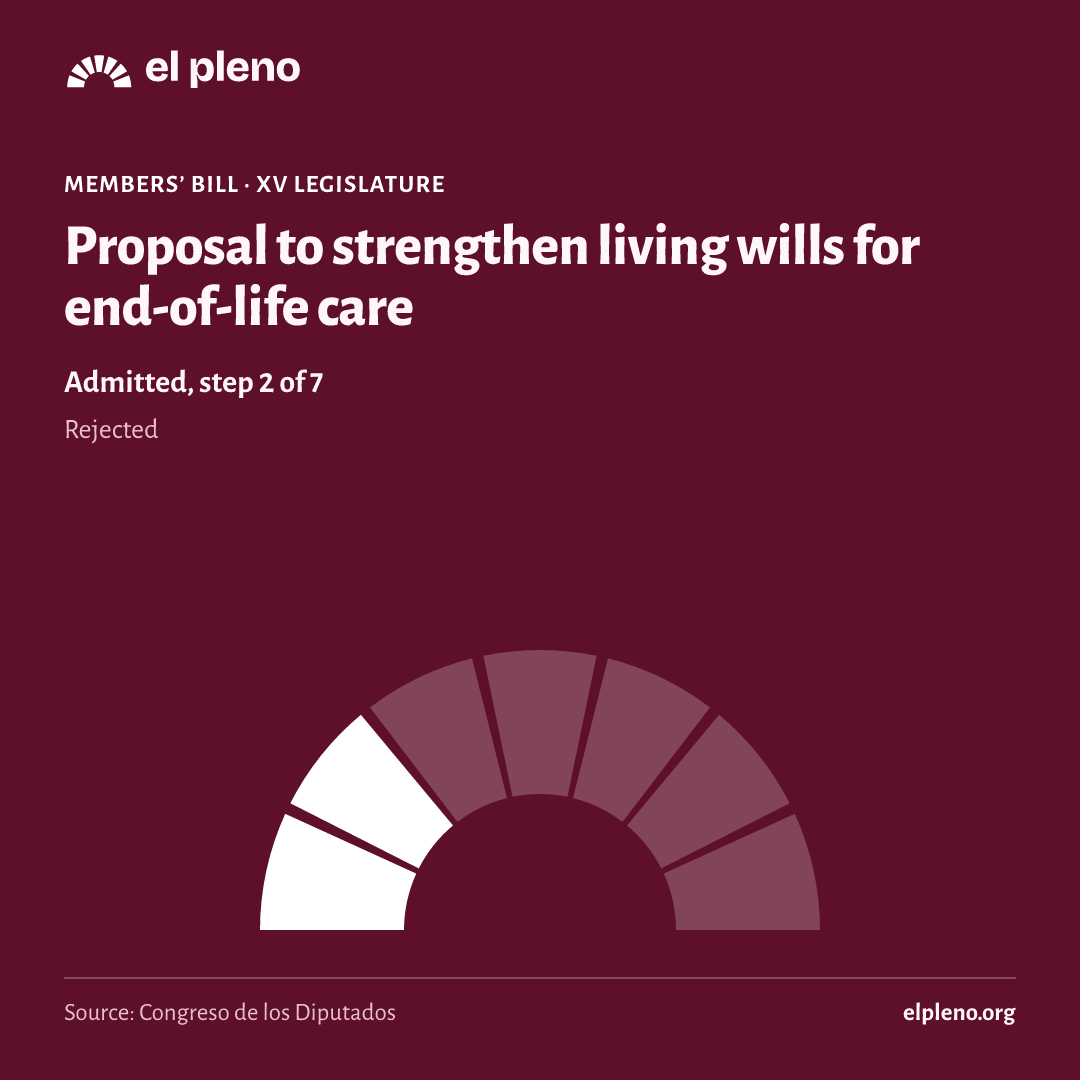
It took 2 of 7 steps. It reached Admitted, and today it is rejected.
- Introduced17 October 2024Someone registers the text in the Congreso.
- Admitted22 October 2024The Bureau of the Congreso accepts it and, for a members’ bill, the plenary decides whether to consider it.
- Amendmentsnot reachedGroups propose changes.
- Committeenot reachedA committee goes through the text in detail.
- Plenarynot reachedAll 350 deputies vote.
- Senatenot reachedThe Senate can pass it, amend it or veto it.
- BOEnot reachedIt is published in the Official State Gazette (BOE) and comes into force.
See the 6 official steps on a timeline
10 December 2024
How did the plenary vote?
Voted on: Private member's bill of the Socialist Parliamentary Group, on the right to grant advance directives.
Source: Congreso de los Diputados, vote 2 of sitting 83· updated 10 Nov
Each dot is a seat. Tap one, or use the arrow keys, to see who it is.
Your province
How did the deputies from your province vote?
And your senators: the Senate does not link its votes to this law in its open data, so we cannot put them side by side here.
Or see how most of each province voted
- A Coruña Tie 4 yes · 4 no
- Albacete Tie 2 yes · 2 no
- Alicante/Alacant More votes against 5 yes · 7 no
- Almería More votes against 2 yes · 3 no
- Araba/Álava Tie 2 yes · 2 no
- Asturias More votes against 3 yes · 4 no
- Ávila More votes against 1 yes · 2 no
- Badajoz More votes against 2 yes · 3 no
- Barcelona More votes in favour 22 yes · 10 no
- Bizkaia More votes in favour 5 yes · 3 no
- Burgos Tie 2 yes · 2 no
- Cáceres Tie 2 yes · 2 no
- Cádiz More votes against 4 yes · 5 no
- Cantabria More votes against 2 yes · 3 no
- Castellón/Castelló More votes against 2 yes · 3 no
- Ceuta No count 0 yes · 0 no
- Ciudad Real More votes against 2 yes · 3 no
- Córdoba Tie 3 yes · 3 no
- Cuenca More votes against 1 yes · 2 no
- Gipuzkoa More votes in favour 4 yes · 2 no
- Girona More votes in favour 4 yes · 2 no
- Granada More votes against 3 yes · 4 no
- Guadalajara More votes against 1 yes · 2 no
- Huelva More votes against 2 yes · 3 no
- Huesca More votes against 1 yes · 2 no
- Illes Balears Tie 4 yes · 4 no
- Jaén More votes against 2 yes · 3 no
- La Rioja Tie 2 yes · 2 no
- Las Palmas Tie 4 yes · 4 no
- León Tie 2 yes · 2 no
- Lleida More votes in favour 3 yes · 1 no
- Lugo More votes against 1 yes · 3 no
- Madrid More votes against 14 yes · 20 no
- Málaga More votes against 4 yes · 7 no
- Melilla More votes against 0 yes · 1 no
- Murcia More votes against 4 yes · 6 no
- Navarra More votes in favour 3 yes · 2 no
- Ourense More votes against 1 yes · 3 no
- Palencia More votes against 1 yes · 2 no
- Pontevedra More votes in favour 4 yes · 3 no
- Salamanca More votes against 1 yes · 3 no
- Santa Cruz de Tenerife Tie 3 yes · 3 no · 1 abst.
- Segovia More votes against 1 yes · 2 no
- Sevilla More votes in favour 7 yes · 5 no
- Soria Tie 1 yes · 1 no
- Tarragona More votes in favour 4 yes · 2 no
- Teruel More votes against 1 yes · 2 no
- Toledo More votes against 2 yes · 4 no
- Valencia/València More votes against 7 yes · 8 no
- Valladolid More votes against 1 yes · 3 no
- Zamora More votes against 1 yes · 2 no
- Zaragoza More votes against 3 yes · 4 no
More details: how each group and each province voted
The groups
Who voted in favour and who against?
In favour, most of Euskal Herria Bildu, Plurinacional SUMAR, Republicano, Socialista and Mixto. Against, most of Vasco (EAJ-PNV), Junts per Catalunya, Popular en el Congreso and VOX. 2 deputies voted differently from their group.
By province: in 9 most voted in favour; in 30, against.
Coloured by how most of each province’s deputies voted.
- In favour: 9
- Against: 30
- Tie: 12
| Group | Seats | How it voted |
|---|---|---|
| Euskal Herria Bildu | 6 | 6 in favour |
| Plurinacional SUMAR | 27 | 26 in favour · 1 did not vote |
| Republicano | 7 | 7 in favour |
| Socialista | 120 | 118 in favour · 2 did not vote |
| Vasco (EAJ-PNV) | 5 | 5 against |
| Junts per Catalunya | 7 | 7 against |
| Mixto | 8 | 5 in favour · 1 against · 1 abst. · 1 did not vote |
| Popular en el Congreso | 137 | 134 against · 3 did not vote |
| VOX | 33 | 33 against |
What happens next
What happens now?
It goes no further. A similar one could be introduced later.
Sources
Where does all this come from?
- Congreso de los Diputados, file 122/000133
Official title, type, author, dates and stage.
Retrieved 11 November 2026
- Congreso de los Diputados, procedure
The date of each step, with its official wording.
Retrieved 12 November 2026
- Congreso de los Diputados, vote 2 of sitting 83
The count and every seat’s vote.
Retrieved 10 November 2026
- The data comes from the open files of the Congreso, the Senate and the BOE, unaltered.
- Each deputy’s province is the one of their seat on the day of the vote.
- We only say “passed” or “rejected” when the majority needed is certain; otherwise we say which side had more votes.