What it is
Bill would ban trade with illegal settlements in occupied territories
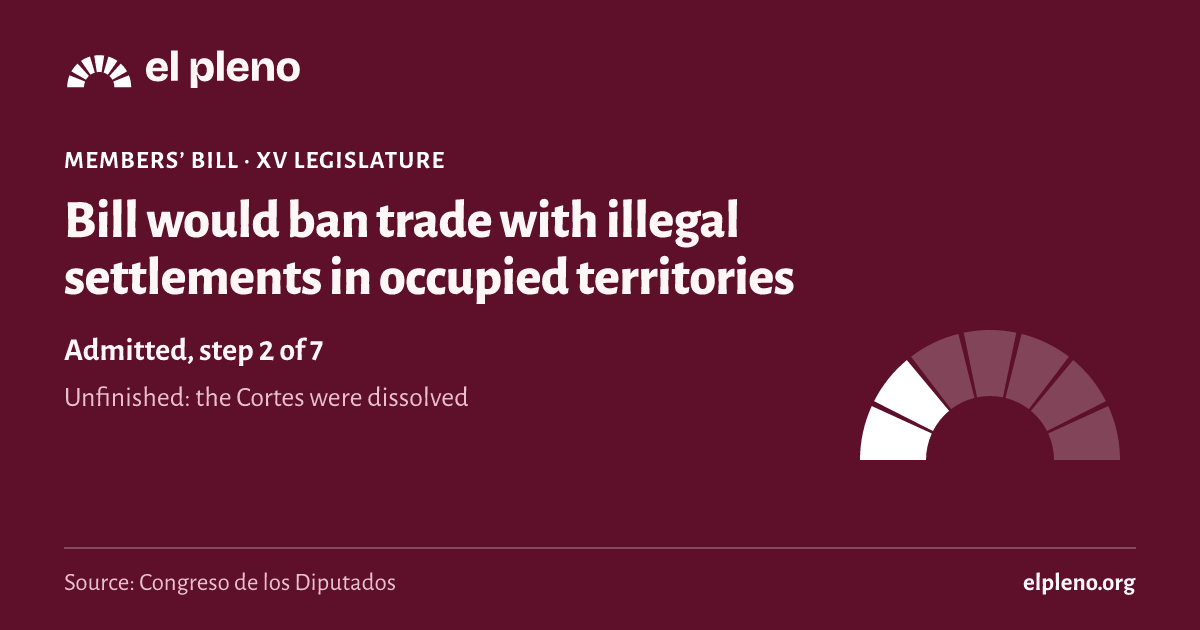
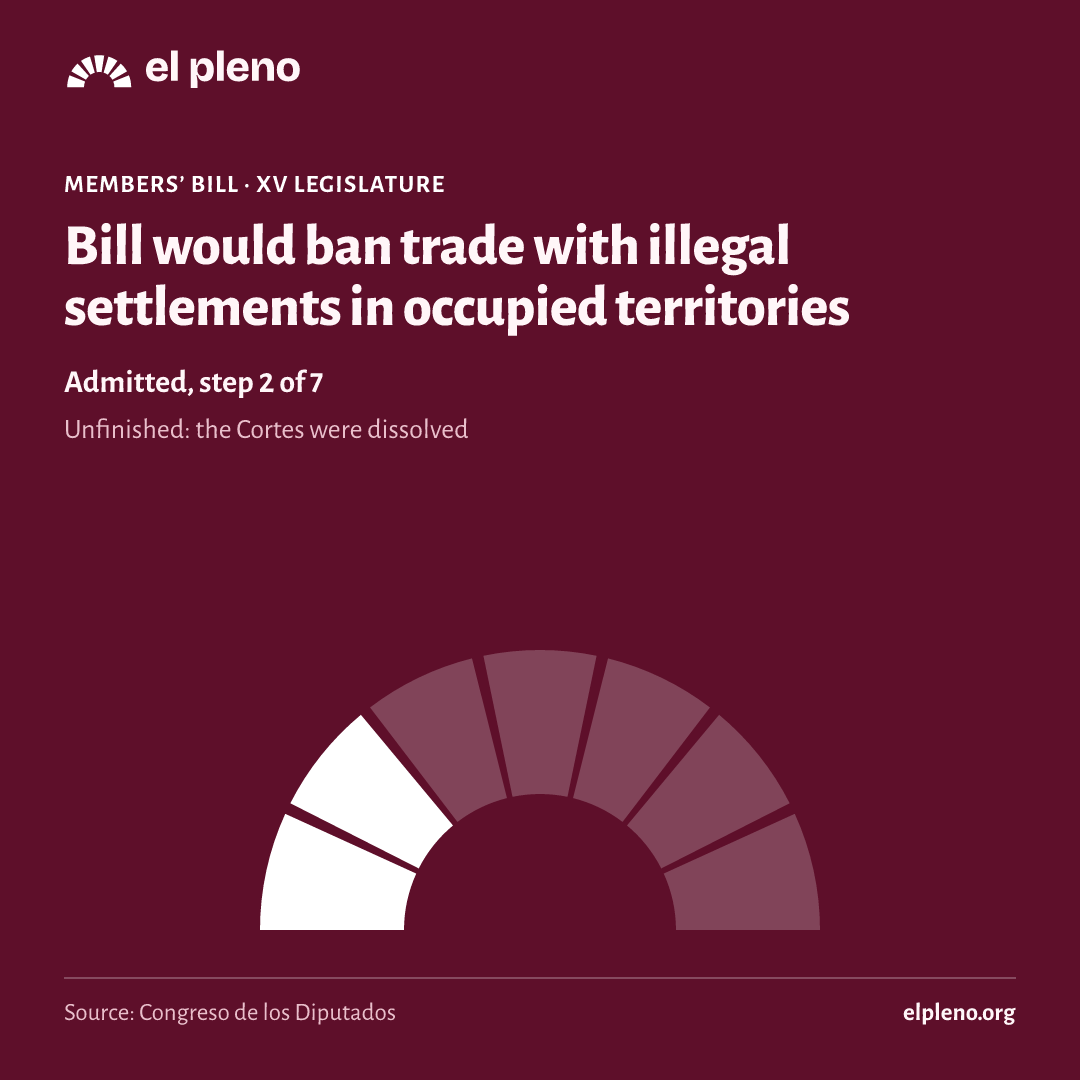
Admitted step 2 of 7· LapsedIt is a members’ bill. Introduced by parliamentary groups, the Senate, regional governments or citizens. It was introduced on 27 June 2024. Introduced by: Grupo Parlamentario Plurinacional SUMAR.
Official title: Private member's bill regarding the regulation of economic and commercial activities with settlements established in occupied military territories.
Source: Congreso de los Diputados, file 122/000120· updated 11 Nov
Automatic summary, not yet reviewed
- The bill would make Spain meet its international obligations by banning and punishing commercial activity with products and resources from illegal settlements in occupied territories, for both the public sector and private companies and individuals.
- It defines an illegal settlement as one in a militarily occupied territory whose illegality has been declared by the United Nations, an international court, a European Union institution, or a rule issued by the Spanish Government.
- It would amend the anti-smuggling law so that importing, exporting or trading goods from those settlements becomes the crime of smuggling, punishable by five to ten years in prison and a fine, regardless of the value of the goods.
- It would amend the public sector contracts law to ban hiring companies listed by the United Nations for operating in illegal settlements.
- It would amend the general subsidies law so those same companies could not receive public subsidies.
- It would ban any public entity from signing agreements or collaborations with organizations based or active in those settlements. Existing agreements could run their course but could not be extended.
Who it affects
- Companies and traders: Those who import, export or sell products or resources from illegal settlements could face smuggling charges and prison time.
- Companies on UN lists: Those operating in illegal settlements would be barred from public contracts and subsidies.
- Public sector entities: They could not sign agreements or collaborate with organizations active in those settlements.
- Individuals and legal entities in general: They would be subject to the ban on trading products from those settlements.
Words worth knowing
- Contrabando (smuggling)
- Moving goods across borders outside customs laws; here it would be expanded to cover trade with products from illegal settlements.
- Asentamiento ilegal (illegal settlement)
- A settlement built in a militarily occupied territory when its illegality has been declared by international bodies, courts, or the Spanish Government.
- Potencia ocupante (occupying power)
- The state that militarily controls a territory that is not its own, under the Fourth Geneva Convention.
- Ley Orgánica (organic law)
- A type of Spanish law reserved for major matters, such as criminal law, requiring a special vote in Congress.
It summarizes the text as it was introduced. It is written by artificial intelligence and may contain mistakes: the official text is what counts. Read the official text · How we make summaries
Where it stands
How far did it get?
It took 2 of 7 steps. It reached Admitted, and today it is lapsed.
- Introduced27 June 2024Someone registers the text in the Congreso.
- Admitted2 July 2024The Bureau of the Congreso accepts it and, for a members’ bill, the plenary decides whether to consider it.
- Amendmentsnot reachedGroups propose changes.
- Committeenot reachedA committee goes through the text in detail.
- Plenarynot reachedAll 350 deputies vote.
- Senatenot reachedThe Senate can pass it, amend it or veto it.
- BOEnot reachedIt is published in the Official State Gazette (BOE) and comes into force.
See the 6 official steps on a timeline
Was there a plenary vote?
We have no plenary vote linked to this law in the Congreso’s data.
What happens next
What happens now?
The legislature ended before it finished. To go on, someone would have to introduce it again in the new Cortes.
It has not been presented again yet.
Sources
Where does all this come from?
- Congreso de los Diputados, file 122/000120
Official title, type, author, dates and stage.
Retrieved 11 November 2026
- Congreso de los Diputados, procedure
The date of each step, with its official wording.
Retrieved 12 November 2026
- The data comes from the open files of the Congreso, the Senate and the BOE, unaltered.
- Each deputy’s province is the one of their seat on the day of the vote.
- We never say “passed” because of a vote: the files do not say which majority was needed.