What it is
Bill to investigate baby thefts and support victims
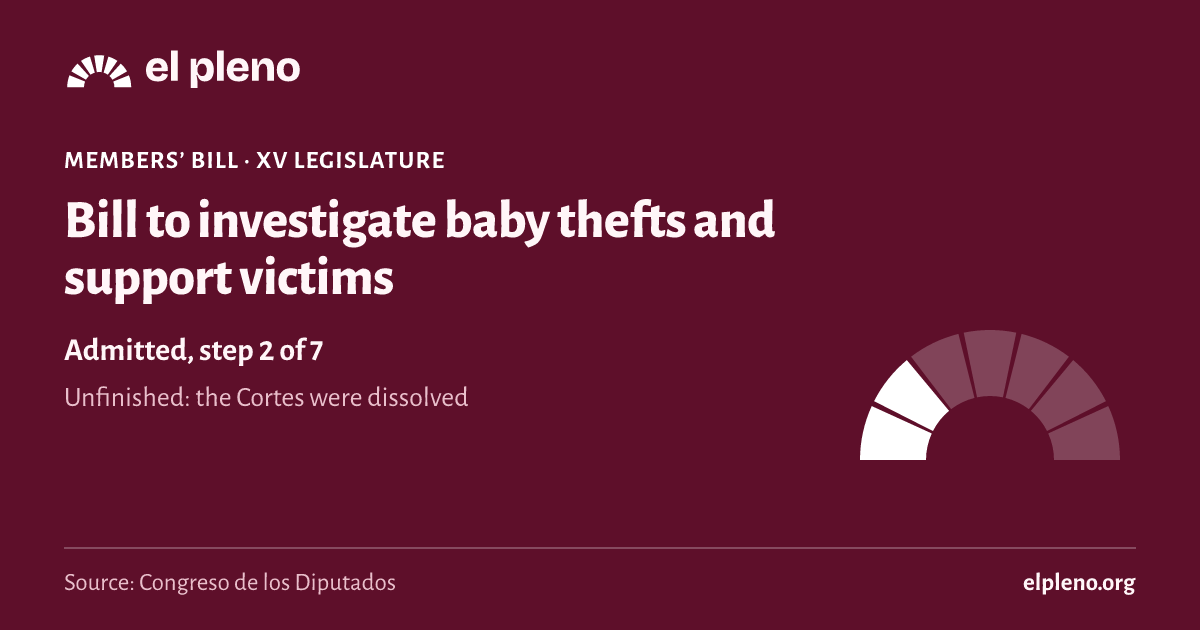
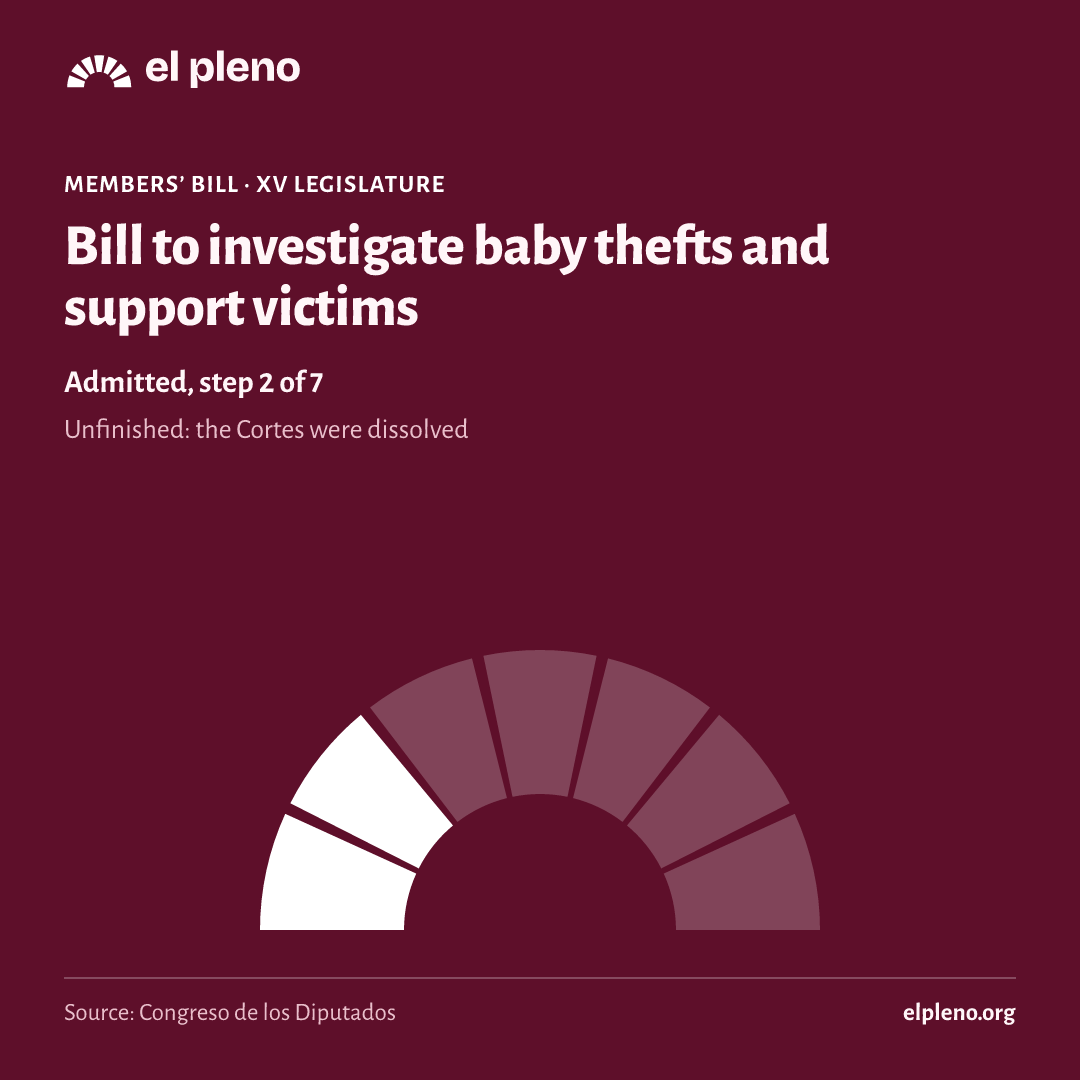
Admitted step 2 of 7· LapsedIt is a members’ bill. Introduced by parliamentary groups, the Senate, regional governments or citizens. It was introduced on 11 June 2024. Introduced by: Grupo Parlamentario Mixto Grupo Parlamentario Plurinacional SUMAR.
Official title: Private member's bill on 'stolen babies' in the Spanish State: forced disappearance of minors.
Source: Congreso de los Diputados, file 122/000113· updated 11 Nov
Automatic summary, not yet reviewed
- The bill would recognize and guarantee victims' rights to truth, justice, reparation and guarantees of non-repetition for the so-called baby theft (forced disappearance of minors) since July 17, 1936. It would also make investigations easier and create the administrative procedures needed for this.
- Victims would include people who suspect, based on any evidence, that they were taken from their birth family, their biological parents, and relatives up to the fourth degree. Adoptive parents who prove fraud or deception in the adoption would also qualify. Public authorities covered would include government bodies, public hospitals, Civil Registries and military and historical archives; private parties would include hospitals, residences, religious orders and, especially, the Catholic Church.
- Public authorities would have to search for missing children and their relatives, review and, if applicable, annul adoptions stemming from a forced disappearance, answer victims' requests within two months, give them access to files and information, and provide free legal and psychological assistance. Private parties would have a maximum of three months to respond.
- Victims would have the right to access public and private archives and records, including cemetery books, municipal statistical bulletins and admission, birth and adoption records. They would also have the right to judicial protection, with free exhumations and DNA testing, and to a comprehensive reparation program including free assistance, record corrections and mediation for reunions, with the person who was taken always deciding.
- The bill would create a State Archive of Baby Theft Victims under a Special Prosecutor's Office, a single free state DNA bank run by the National Institute of Toxicology, and a State Commission for the Right to Identity that would recognize victim status and lead the national search plan. It would also create a specialized police unit and extend free legal aid to victims.
- Compensation would only be recognized if ordered by a court decision. The Government would have six months to issue implementing rules, after hearing victims' associations, and the law would take effect the day after publication in the Official State Gazette, although financial obligations would wait for the next General State Budget Law.
Who it affects
- People who suspect they were stolen at birth or that their identity was altered.: They could be recognized as victims and access searches, archives, DNA testing and free support.
- Biological parents and relatives up to the fourth degree of people who were taken.: They could be recognized as victims, request information and access mediation for reunions.
- Adoptive parents who prove fraud or deception in the adoption.: They could be considered victims of these crimes.
- Public administrations, hospitals, registries, archives and private entities such as religious orders and the Catholic Church.: They would have duties to preserve archives, give access to information and respond to victims within set deadlines.
Words worth knowing
- Desaparición forzada (forced disappearance)
- When someone disappears with the participation or consent of the State, which hides what happened.
- Lesa humanidad (crime against humanity)
- Very serious crimes seen as an offense against all humanity, such as mass murder or persecution.
- Fiscalía Especial (Special Prosecutor's Office)
- A body within the Public Prosecutor's Office dedicated to one specific type of case, here baby thefts.
- Exhumación (exhumation)
- Removing a body or remains from a grave to examine them, for example to identify them through DNA testing.
- Filiación (filiation)
- The legal relationship between a person and their parents, which determines their family identity.
It summarizes the text as it was introduced. It is written by artificial intelligence and may contain mistakes: the official text is what counts. Read the official text · How we make summaries
Where it stands
How far did it get?
It took 2 of 7 steps. It reached Admitted, and today it is lapsed.
- Introduced11 June 2024Someone registers the text in the Congreso.
- Admitted18 June 2024The Bureau of the Congreso accepts it and, for a members’ bill, the plenary decides whether to consider it.
- Amendmentsnot reachedGroups propose changes.
- Committeenot reachedA committee goes through the text in detail.
- Plenarynot reachedAll 350 deputies vote.
- Senatenot reachedThe Senate can pass it, amend it or veto it.
- BOEnot reachedIt is published in the Official State Gazette (BOE) and comes into force.
See the 6 official steps on a timeline
Was there a plenary vote?
We have no plenary vote linked to this law in the Congreso’s data.
What happens next
What happens now?
The legislature ended before it finished. To go on, someone would have to introduce it again in the new Cortes.
It has not been presented again yet.
Sources
Where does all this come from?
- Congreso de los Diputados, file 122/000113
Official title, type, author, dates and stage.
Retrieved 11 November 2026
- Congreso de los Diputados, procedure
The date of each step, with its official wording.
Retrieved 12 November 2026
- The data comes from the open files of the Congreso, the Senate and the BOE, unaltered.
- Each deputy’s province is the one of their seat on the day of the vote.
- We never say “passed” because of a vote: the files do not say which majority was needed.