What it is
Proposal to change how people become judges in Spain
Admitted step 2 of 7· LapsedIt is a members’ bill. Introduced by parliamentary groups, the Senate, regional governments or citizens. It was introduced on 31 May 2024. Introduced by: Grupo Parlamentario Plurinacional SUMAR.
Official title: Private member's Organic Bill on the reform of the access system to the judicial career.
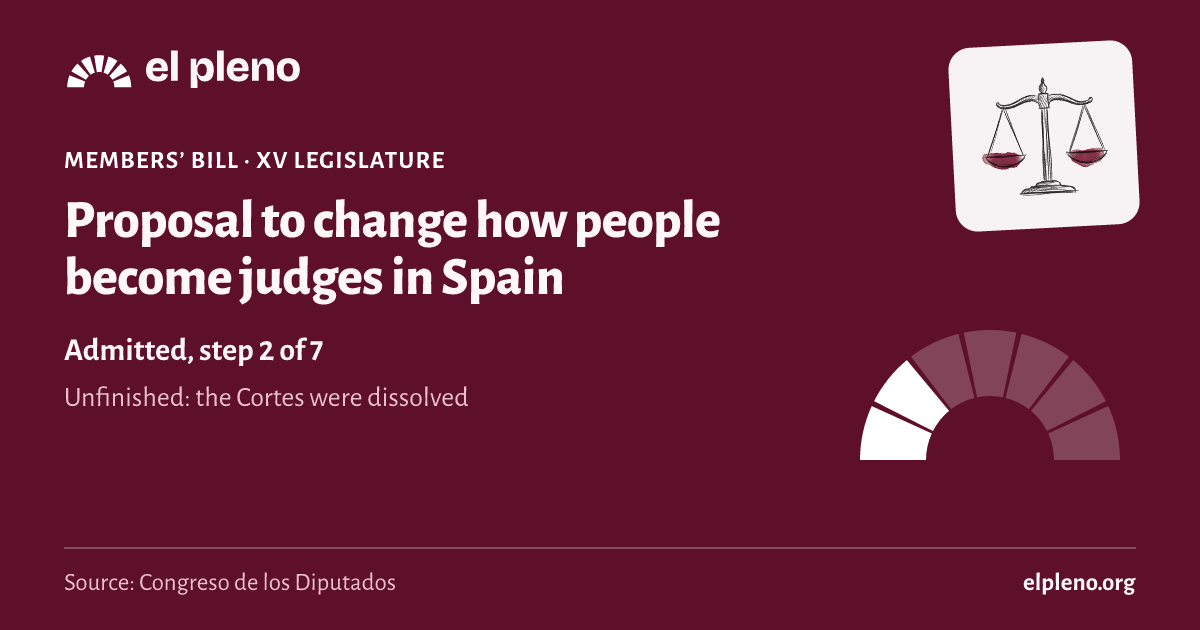
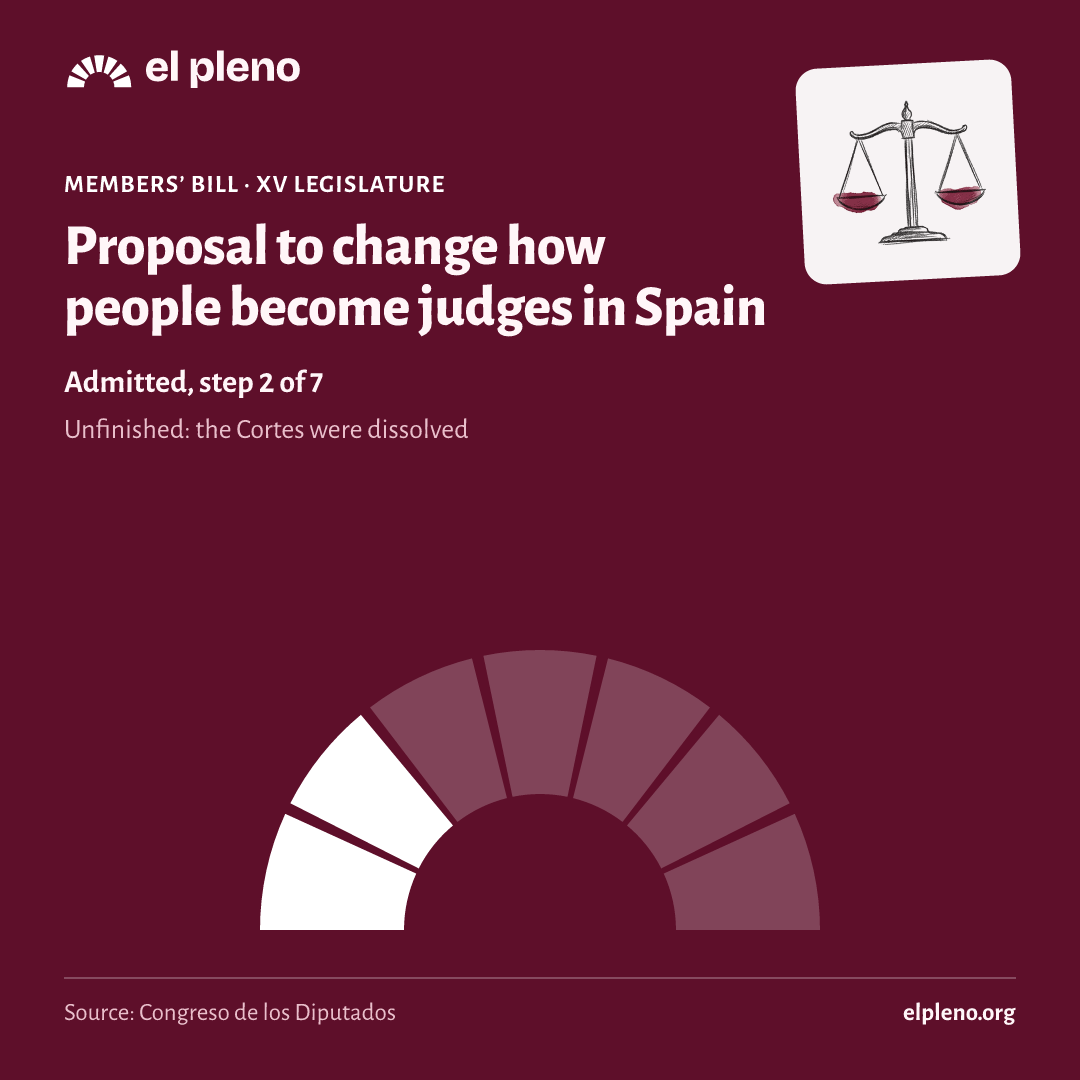
Source: Congreso de los Diputados, file 122/000109· updated 11 Nov
Automatic summary, not yet reviewed
- The bill would change the system for entering the judiciary, which today relies on a memorization-heavy exam barely reformed since the 19th century. It proposes entry through the Judicial School, selecting candidates with the best academic records in law.
- Candidates with high grades would enter the Judicial School and complete two academic years of theoretical and practical training. They would then take a competitive exam, and completing the program would earn a master's degree equivalent to the one required to practice as a lawyer.
- Entering the Judicial School would come with a grant, based on the applicant's economic and social situation. The goal is that no one is excluded for lacking money to fund years of preparation.
- Training would include a multidisciplinary theory program covering human rights, equality and violence against women, plus supervised internships and a period serving as substitute judges. The theory course would last at least nine months and the internships at least four.
- If passed, the Government would have one year to present a bill creating a common entry system for the judiciary, the prosecutor's office, court clerks, state attorneys and the legal staff of the General Council of the Judiciary. It would include a multiple-choice test, a two-year master's at public universities and at least two years of specialized training.
- The bill would be an organic law and would take effect twenty days after publication in the Official State Gazette. Note that this is a proposal still in the legislative process, not an approved law.
Who it affects
- Law school graduates with strong grades: They could enter the Judicial School without taking the traditional competitive exam.
- People currently studying for the judicial exam: The preparation and exam format would change, with training at the Judicial School and grants available.
- Judges who work as private exam coaches: The new system would reduce the role of private exam coaching.
- Prosecutors, court clerks and state attorneys: A future common entry system with the judiciary would be proposed for them.
Words worth knowing
- Carrera Judicial
- The body of all judges in Spain, similar to a professional corps.
- Oposición
- A competitive state exam used to fill public positions, here the position of judge.
- Escuela Judicial
- The Judicial School, a center under the General Council of the Judiciary that trains future judges.
- Concurso oposición
- A selection process combining an exam with an assessment of merit.
- Ley orgánica
- An organic law, a type of Spanish law reserved for major matters such as justice, requiring special majorities to pass.
It summarizes the text as it was introduced. It is written by artificial intelligence and may contain mistakes: the official text is what counts. Read the official text · How we make summaries
Where it stands
How far did it get?
It took 2 of 7 steps. It reached Admitted, and today it is lapsed.
- Introduced31 May 2024Someone registers the text in the Congreso.
- Admitted5 June 2024The Bureau of the Congreso accepts it and, for a members’ bill, the plenary decides whether to consider it.
- Amendmentsnot reachedGroups propose changes.
- Committeenot reachedA committee goes through the text in detail.
- Plenarynot reachedAll 350 deputies vote.
- Senatenot reachedThe Senate can pass it, amend it or veto it.
- BOEnot reachedIt is published in the Official State Gazette (BOE) and comes into force.
See the 6 official steps on a timeline
Was there a plenary vote?
We have no plenary vote linked to this law in the Congreso’s data.
What happens next
What happens now?
The legislature ended before it finished. To go on, someone would have to introduce it again in the new Cortes.
It has not been presented again yet.
Sources
Where does all this come from?
- Congreso de los Diputados, file 122/000109
Official title, type, author, dates and stage.
Retrieved 11 November 2026
- Congreso de los Diputados, procedure
The date of each step, with its official wording.
Retrieved 12 November 2026
- The data comes from the open files of the Congreso, the Senate and the BOE, unaltered.
- Each deputy’s province is the one of their seat on the day of the vote.
- We never say “passed” because of a vote: the files do not say which majority was needed.