What it is
Bill to create a register of interests for media owners and executives
Admitted step 2 of 7· LapsedIt is a members’ bill. Introduced by parliamentary groups, the Senate, regional governments or citizens. It was introduced on 7 May 2024. Introduced by: Grupo Parlamentario Mixto.
Official title: Private member's bill on the registry of interests of owners or executives of media outlets.
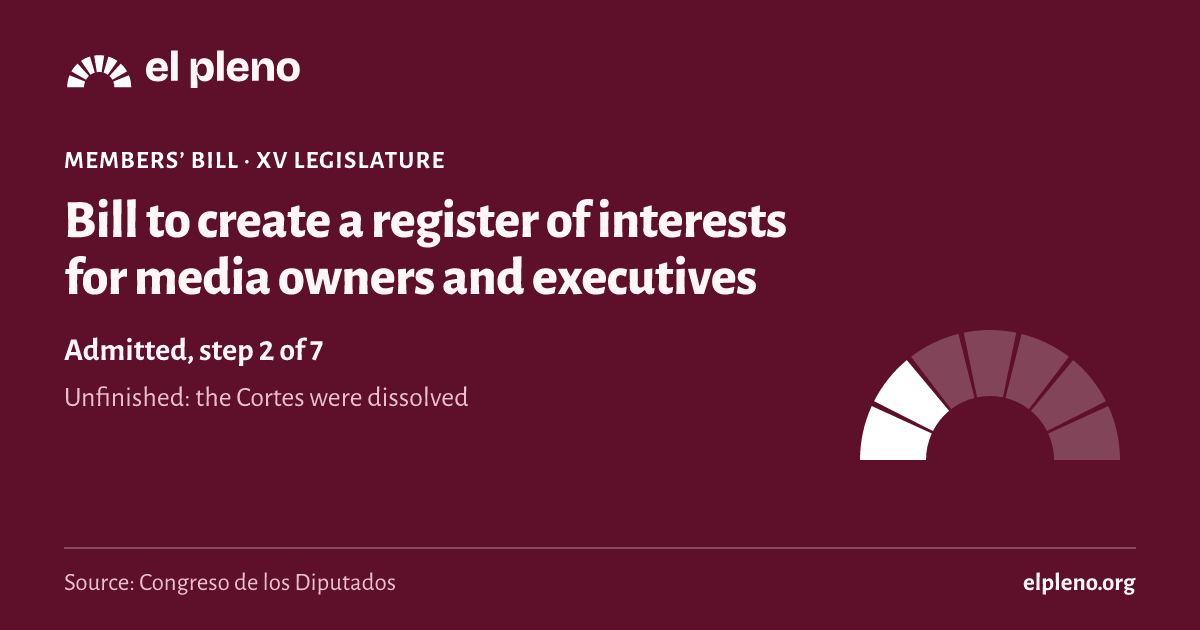

Source: Congreso de los Diputados, file 122/000096· updated 11 Nov
Automatic summary, not yet reviewed
- The bill would apply to TV and radio stations broadcasting nationwide, their production companies, and print and digital general-interest media. It would also cover anyone holding at least 10% of those companies, and hosts of news or political affairs programs.
- Companies, their board members, and those directing their content would have to file a declaration of assets and interests. The deadline would be one month from the law taking effect or from taking the position.
- The declaration would include stakes in any company, listed or not, with its economic activity, and, above 10%, any contracts with public administrations and their amounts. It would also state whether the person has income from more than one of these entities, and be updated whenever the data change.
- The declarations would be kept in a register of interests under the Ministry of the Presidency, with public access. The law would take effect the day after its publication in the official state gazette (Boletín Oficial del Estado).
Who it affects
- Companies and individuals holding national TV and radio licenses, and their contracted production companies: They would have to declare their assets and interests within one month.
- Companies and individuals owning print or digital general-interest media: They would have to declare their assets and interests within one month.
- Anyone holding at least 10% of those companies: They would have to declare and detail their stakes above 10%.
- Board members and content directors of those entities: They would have to file the declaration upon taking the position.
- Hosts and presenters of news or political affairs programs: They would be subject to the declaration of assets and interests.
Words worth knowing
- Proposición de ley
- A bill introduced by a parliamentary group. It is not an approved law until it passes the legislative process.
- Licencia de Televisión Digital Terrestre
- Official authorization to broadcast on digital terrestrial television.
- Ondas hertzianas
- Radio transmission over airwaves, without cable or internet.
- Sociedad cotizada
- A company whose shares are traded on the stock market.
It summarizes the text as it was introduced. It is written by artificial intelligence and may contain mistakes: the official text is what counts. Read the official text · How we make summaries
Where it stands
How far did it get?
It took 2 of 7 steps. It reached Admitted, and today it is lapsed.
- Introduced7 May 2024Someone registers the text in the Congreso.
- Admitted14 May 2024The Bureau of the Congreso accepts it and, for a members’ bill, the plenary decides whether to consider it.
- Amendmentsnot reachedGroups propose changes.
- Committeenot reachedA committee goes through the text in detail.
- Plenarynot reachedAll 350 deputies vote.
- Senatenot reachedThe Senate can pass it, amend it or veto it.
- BOEnot reachedIt is published in the Official State Gazette (BOE) and comes into force.
See the 6 official steps on a timeline
Was there a plenary vote?
We have no plenary vote linked to this law in the Congreso’s data.
What happens next
What happens now?
The legislature ended before it finished. To go on, someone would have to introduce it again in the new Cortes.
Sources
Where does all this come from?
- Congreso de los Diputados, file 122/000096
Official title, type, author, dates and stage.
Retrieved 11 November 2026
- Congreso de los Diputados, procedure
The date of each step, with its official wording.
Retrieved 12 November 2026
- The data comes from the open files of the Congreso, the Senate and the BOE, unaltered.
- Each deputy’s province is the one of their seat on the day of the vote.
- We never say “passed” because of a vote: the files do not say which majority was needed.