What it is
Bill to eliminate regional government offices abroad
Admitted step 2 of 7· LapsedIt is a members’ bill. Introduced by parliamentary groups, the Senate, regional governments or citizens. It was introduced on 26 April 2024. Introduced by: Grupo Parlamentario VOX.
Official title: Private member's bill amending Law 2/2014, of 25 March, on the External Action and Service of the State, for the elimination of regional offices abroad.
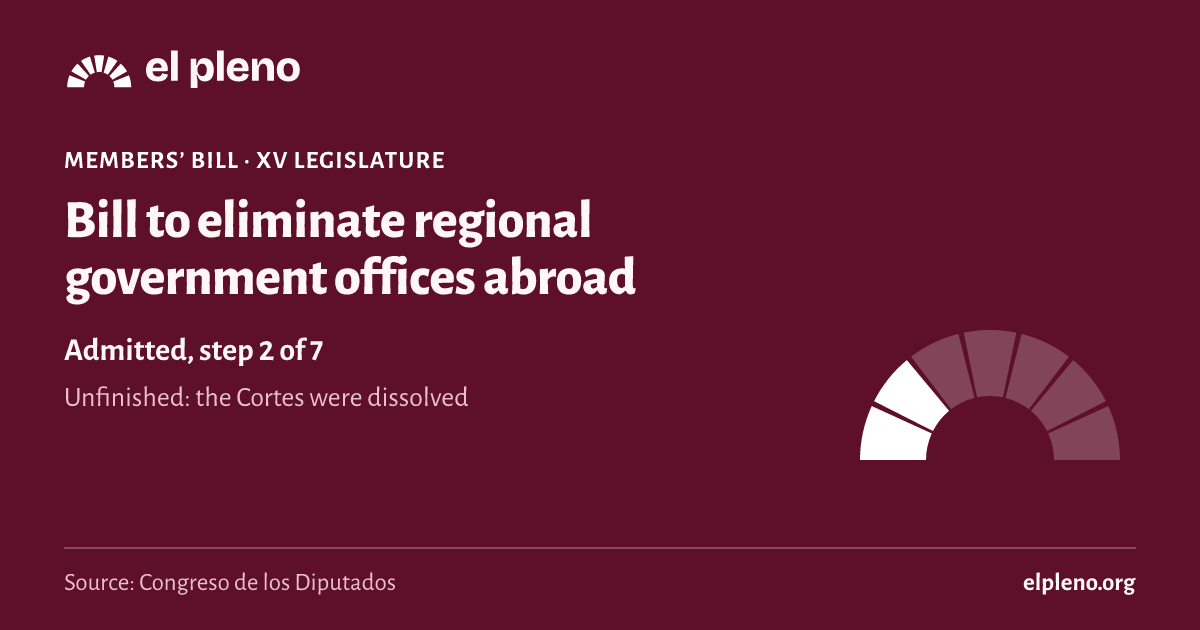
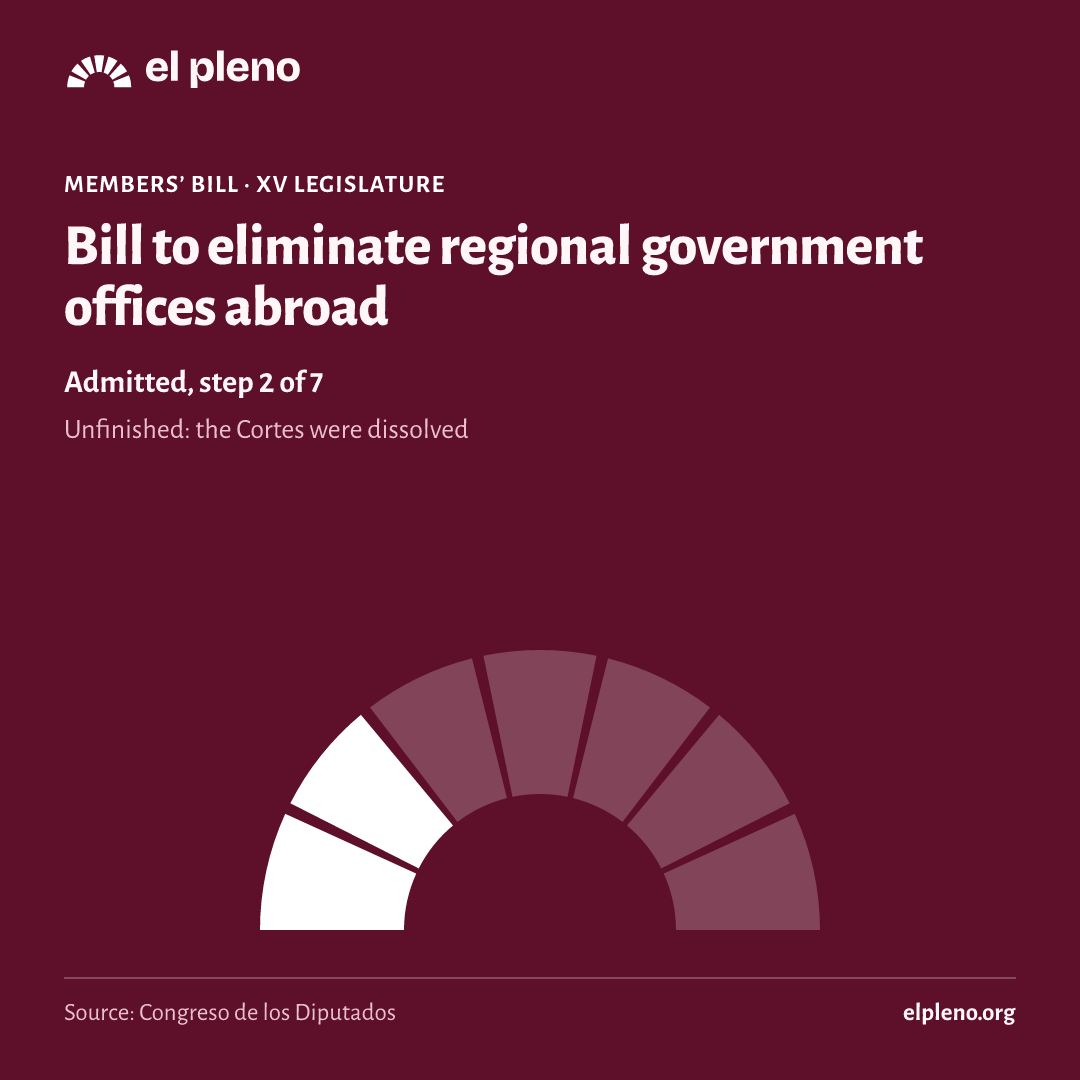
Source: Congreso de los Diputados, file 122/000093· updated 11 Nov
Automatic summary, not yet reviewed
- The bill, introduced by the VOX parliamentary group, proposes amending Law 2/2014 on State Foreign Action to eliminate regional offices abroad. It has only been admitted for processing; it is not an approved law.
- The new Article 11 would stop autonomous communities from setting up their own foreign outreach plans or signing international agreements, and states that the Government regulates and coordinates these activities.
- The new Article 12 would require autonomous communities to act abroad through Spanish embassies, with prior notice to the Ministry of Foreign Affairs, and would ban creating regional offices abroad.
- The ninth additional provision would be changed so that the Cervantes Institute focuses on spreading Spanish culture and language abroad, in coordination with the State and in collaboration with the autonomous communities.
- The law relies on the State's exclusive powers over international relations and the legal framework of public administrations, and would take effect the day after publication in the Official State Gazette.
Who it affects
- Autonomous communities and autonomous cities: They could not have their own offices abroad and would have to act through Spanish embassies.
- Local governments: Their activities abroad would be subject to the Government's guidelines.
- Central Government: It would gain control and coordination of all foreign action by regional administrations.
- Cervantes Institute: Its role in promoting Spanish culture and language abroad would be set out.
Words worth knowing
- Proposición de ley
- A bill introduced by a parliamentary group. It is not a law until approved.
- Conflicto positivo de competencia
- A dispute before the Constitutional Court when the Government and an autonomous community both claim the same power.
- Reserva competencial
- A matter the Constitution assigns exclusively to the State, here international relations.
It summarizes the text as it was introduced. It is written by artificial intelligence and may contain mistakes: the official text is what counts. Read the official text · How we make summaries
Where it stands
How far did it get?
It took 2 of 7 steps. It reached Admitted, and today it is lapsed.
- Introduced26 April 2024Someone registers the text in the Congreso.
- Admitted30 April 2024The Bureau of the Congreso accepts it and, for a members’ bill, the plenary decides whether to consider it.
- Amendmentsnot reachedGroups propose changes.
- Committeenot reachedA committee goes through the text in detail.
- Plenarynot reachedAll 350 deputies vote.
- Senatenot reachedThe Senate can pass it, amend it or veto it.
- BOEnot reachedIt is published in the Official State Gazette (BOE) and comes into force.
See the 6 official steps on a timeline
Was there a plenary vote?
We have no plenary vote linked to this law in the Congreso’s data.
What happens next
What happens now?
The legislature ended before it finished. To go on, someone would have to introduce it again in the new Cortes.
Sources
Where does all this come from?
- Congreso de los Diputados, file 122/000093
Official title, type, author, dates and stage.
Retrieved 11 November 2026
- Congreso de los Diputados, procedure
The date of each step, with its official wording.
Retrieved 12 November 2026
- The data comes from the open files of the Congreso, the Senate and the BOE, unaltered.
- Each deputy’s province is the one of their seat on the day of the vote.
- We never say “passed” because of a vote: the files do not say which majority was needed.