What it is
Bill would make prison officers agents of the authority
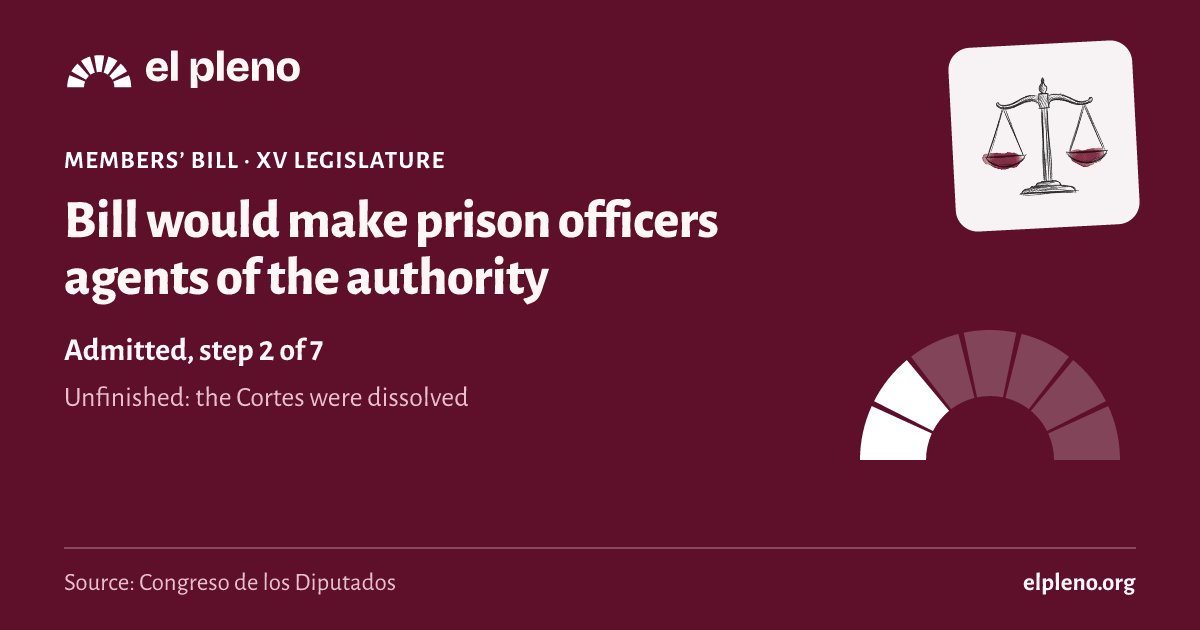
Admitted step 2 of 7· LapsedIt is a members’ bill. Introduced by parliamentary groups, the Senate, regional governments or citizens. It was introduced on 20 March 2024. Introduced by: Grupo Parlamentario VOX.
Official title: Private member's Organic Bill amending Organic Law 1/1979, of 26 September, General Penitentiary, to recognize the status of authority agents to prison officials in the performance of their professional duties.

Source: Congreso de los Diputados, file 122/000078· updated 11 Nov
Automatic summary, not yet reviewed
- The bill would amend Article 80 of the General Penitentiary Law so that prison officers would be agents of the authority, like the State Law Enforcement Corps. Their reports and complaints would be presumed true, unless proven otherwise.
- If a prison officer or prison staff member suffers personal or material damage on the job, the Administration would have to pay compensation, unless the damage was caused by their own willful misconduct, negligence or carelessness.
- If a prison officer is arrested or sent to prison, they would be kept separate from other detainees. Transfers under custody would also be carried out separately from other inmates.
- The explanatory statement justifies the bill by pointing to staff shortages, an aging workforce, and the assaults suffered by the more than 20,000 prison workers.
Who it affects
- Prison officers: Would become agents of the authority and gain greater legal and economic protection.
- Prison civilian staff: Would be entitled to compensation for damages and to be held separately if arrested or imprisoned.
- Prison Administration: Would have to provide staff with resources, training and compensation.
Words worth knowing
- Agente de la autoridad
- A person the law empowers to act on behalf of the Administration, whose statements carry special legal weight, such as a police officer.
- Presunción de veracidad
- What the officer writes in a report or complaint is presumed true unless someone proves otherwise.
- Principio de indemnidad
- The Administration protects and compensates its employee if they suffer harm while doing their job.
- Ley orgánica
- A type of Spanish law reserved for major matters, requiring a special majority in the Congress of Deputies to pass.
It summarizes the text as it was introduced. It is written by artificial intelligence and may contain mistakes: the official text is what counts. Read the official text · How we make summaries
Where it stands
How far did it get?
It took 2 of 7 steps. It reached Admitted, and today it is lapsed.
- Introduced20 March 2024Someone registers the text in the Congreso.
- Admitted2 April 2024The Bureau of the Congreso accepts it and, for a members’ bill, the plenary decides whether to consider it.
- Amendmentsnot reachedGroups propose changes.
- Committeenot reachedA committee goes through the text in detail.
- Plenarynot reachedAll 350 deputies vote.
- Senatenot reachedThe Senate can pass it, amend it or veto it.
- BOEnot reachedIt is published in the Official State Gazette (BOE) and comes into force.
See the 6 official steps on a timeline
Was there a plenary vote?
We have no plenary vote linked to this law in the Congreso’s data.
What happens next
What happens now?
The legislature ended before it finished. To go on, someone would have to introduce it again in the new Cortes.
Sources
Where does all this come from?
- Congreso de los Diputados, file 122/000078
Official title, type, author, dates and stage.
Retrieved 11 November 2026
- Congreso de los Diputados, procedure
The date of each step, with its official wording.
Retrieved 12 November 2026
- The data comes from the open files of the Congreso, the Senate and the BOE, unaltered.
- Each deputy’s province is the one of their seat on the day of the vote.
- We never say “passed” because of a vote: the files do not say which majority was needed.