What it is
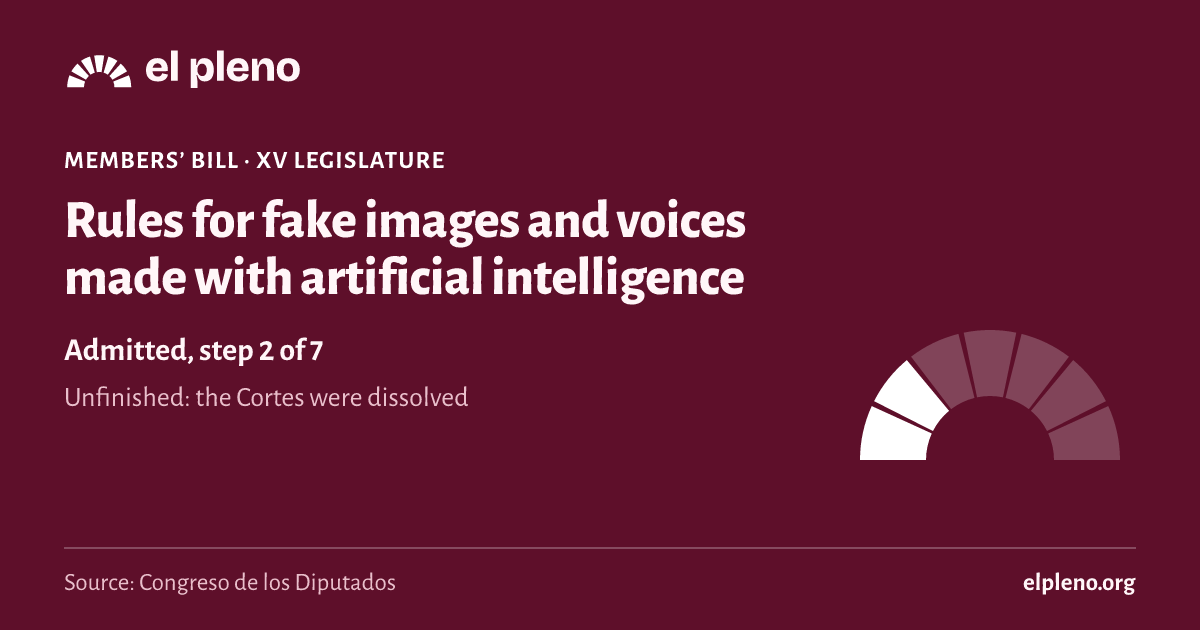
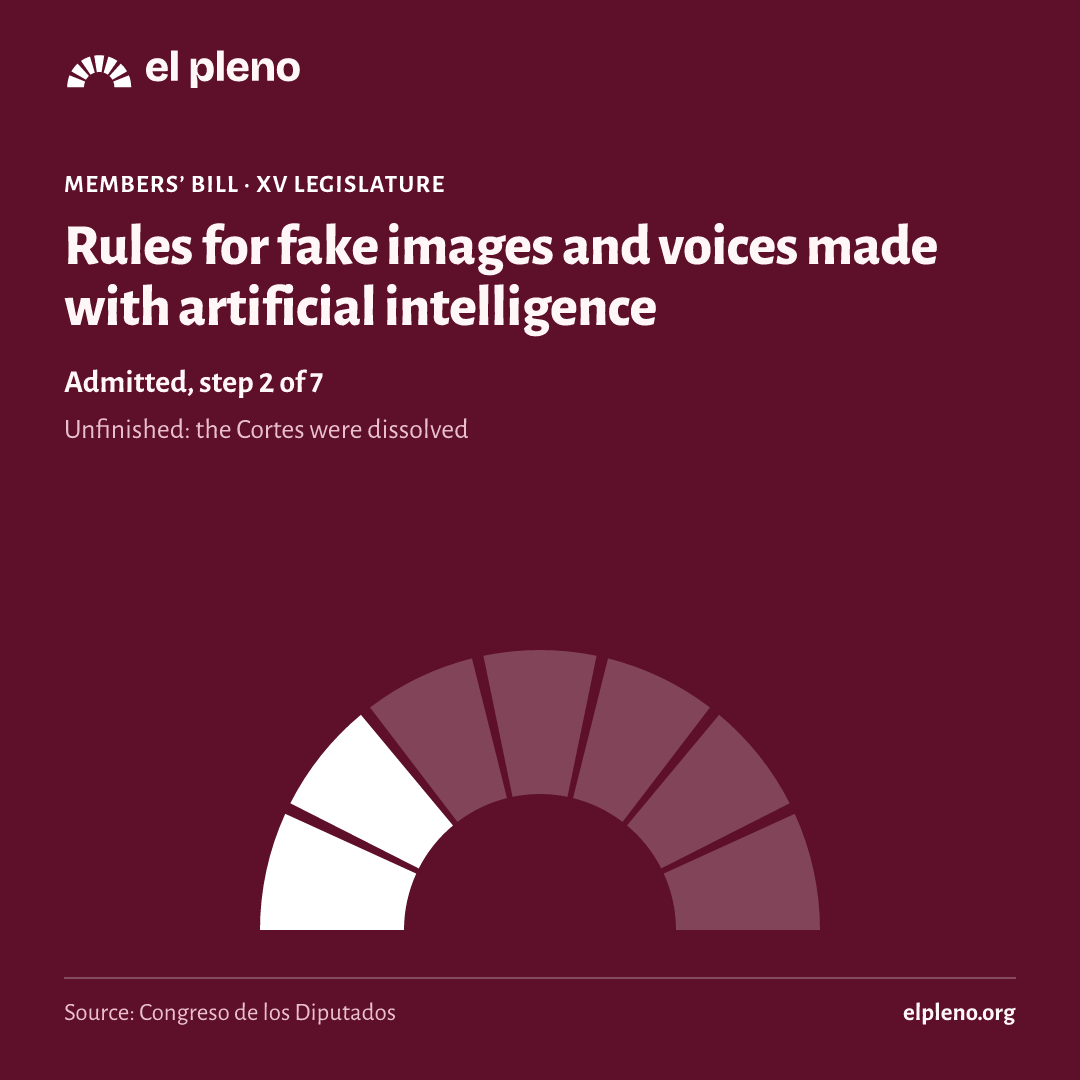
Rules for fake images and voices made with artificial intelligence
Admitted step 2 of 7· LapsedIt is a members’ bill. Introduced by parliamentary groups, the Senate, regional governments or citizens. It was introduced on 12 March 2024. Introduced by: Grupo Parlamentario Plurinacional SUMAR.
Official title: Private member's Organic Bill regulating the simulation of images and voices of persons generated by means of artificial intelligence.
Source: Congreso de los Diputados, file 122/000073· updated 11 Nov
Automatic summary, not yet reviewed
- The bill would ban sharing images, videos or audio generated with artificial intelligence without the consent of the person shown or heard, unless they carry a clear warning that they are artificial. For audio, the warning must play before and after the generated voice.
- Sharing or using images, videos or voices generated by artificial intelligence without authorization would count as an unlawful intrusion into honor, privacy and self-image, unless the required warning is included.
- The Criminal Code would treat the unauthorized recreation of a person's image or voice with artificial intelligence for public distribution as defamation (injuria), and such simulations spread on social media would count as defamation made with publicity.
- Judges could order, at the request of the affected person, the urgent removal of simulated images, videos or voices generated by artificial intelligence as a precautionary measure.
- Using images or sounds created by artificial intelligence in advertising, or retouching bodies with image software, without a clear and prominent warning would be unfair competition.
- A new election crime would be created: maliciously spreading altered images or audio of candidates from the call of the election until voting ends, punishable by three months to one year or a fine.
Who it affects
- People whose image or voice is copied with artificial intelligence: They could require prior consent, clear warnings and urgent removal of content.
- Creators and distributors of AI-generated images, videos or voices: They would need permission or must include warnings, or face offenses and crimes.
- Companies that advertise: They would have to clearly disclose the use of AI-generated images or sounds or retouched bodies.
- Candidates in elections: They would be protected against malicious spread of altered images or voices.
- Civil society and the Congress of Deputies (Congreso de los Diputados): Two councils would be created to oversee artificial intelligence and advise on its use.
Words worth knowing
- Deepfake
- A very realistic video, image or audio that makes it look like a person did or said something they never did, made with artificial intelligence.
- Injuria
- A Spanish crime of damaging someone's honor or reputation through acts or words that harm their dignity.
- Medida cautelar
- A precautionary measure: a judge's decision to protect someone while the lawsuit is ongoing, such as urgently removing content.
- Ley orgánica
- An organic law, a type of Spanish law reserved for major matters like fundamental rights, requiring special majorities to pass.
- Proposición de ley
- A bill introduced by members of parliament; it is not yet an approved law.
It summarizes the text as it was introduced. It is written by artificial intelligence and may contain mistakes: the official text is what counts. Read the official text · How we make summaries
Where it stands
How far did it get?
It took 2 of 7 steps. It reached Admitted, and today it is lapsed.
- Introduced12 March 2024Someone registers the text in the Congreso.
- Admitted19 March 2024The Bureau of the Congreso accepts it and, for a members’ bill, the plenary decides whether to consider it.
- Amendmentsnot reachedGroups propose changes.
- Committeenot reachedA committee goes through the text in detail.
- Plenarynot reachedAll 350 deputies vote.
- Senatenot reachedThe Senate can pass it, amend it or veto it.
- BOEnot reachedIt is published in the Official State Gazette (BOE) and comes into force.
See the 6 official steps on a timeline
Was there a plenary vote?
We have no plenary vote linked to this law in the Congreso’s data.
What happens next
What happens now?
The legislature ended before it finished. To go on, someone would have to introduce it again in the new Cortes.
Sources
Where does all this come from?
- Congreso de los Diputados, file 122/000073
Official title, type, author, dates and stage.
Retrieved 11 November 2026
- Congreso de los Diputados, procedure
The date of each step, with its official wording.
Retrieved 12 November 2026
- The data comes from the open files of the Congreso, the Senate and the BOE, unaltered.
- Each deputy’s province is the one of their seat on the day of the vote.
- We never say “passed” because of a vote: the files do not say which majority was needed.