What it is
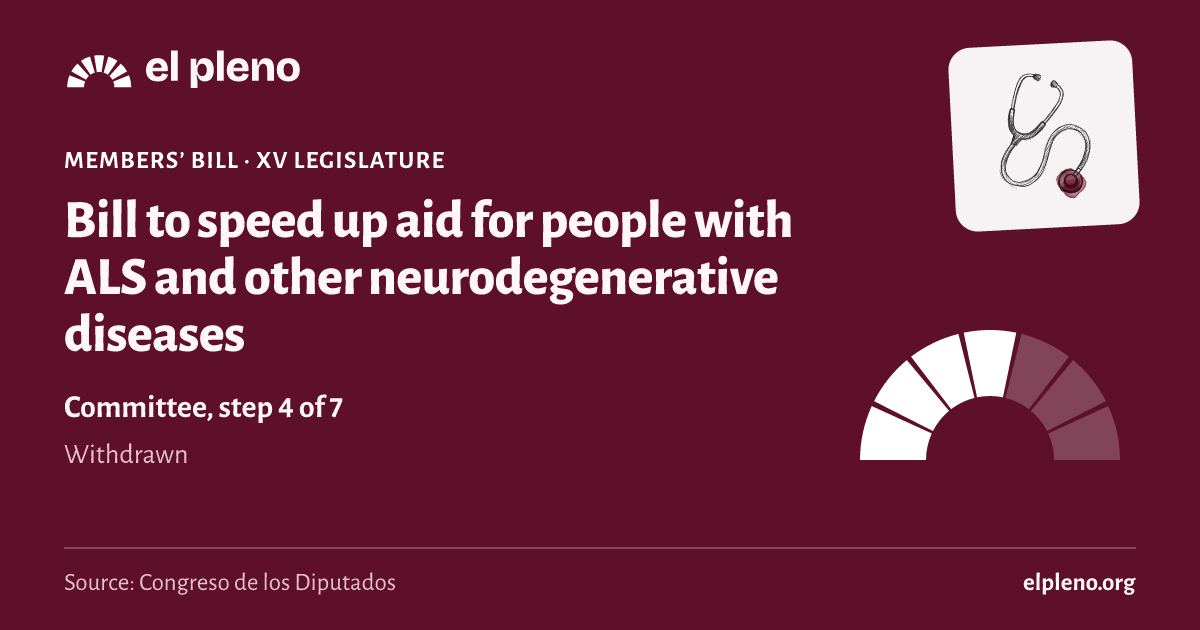
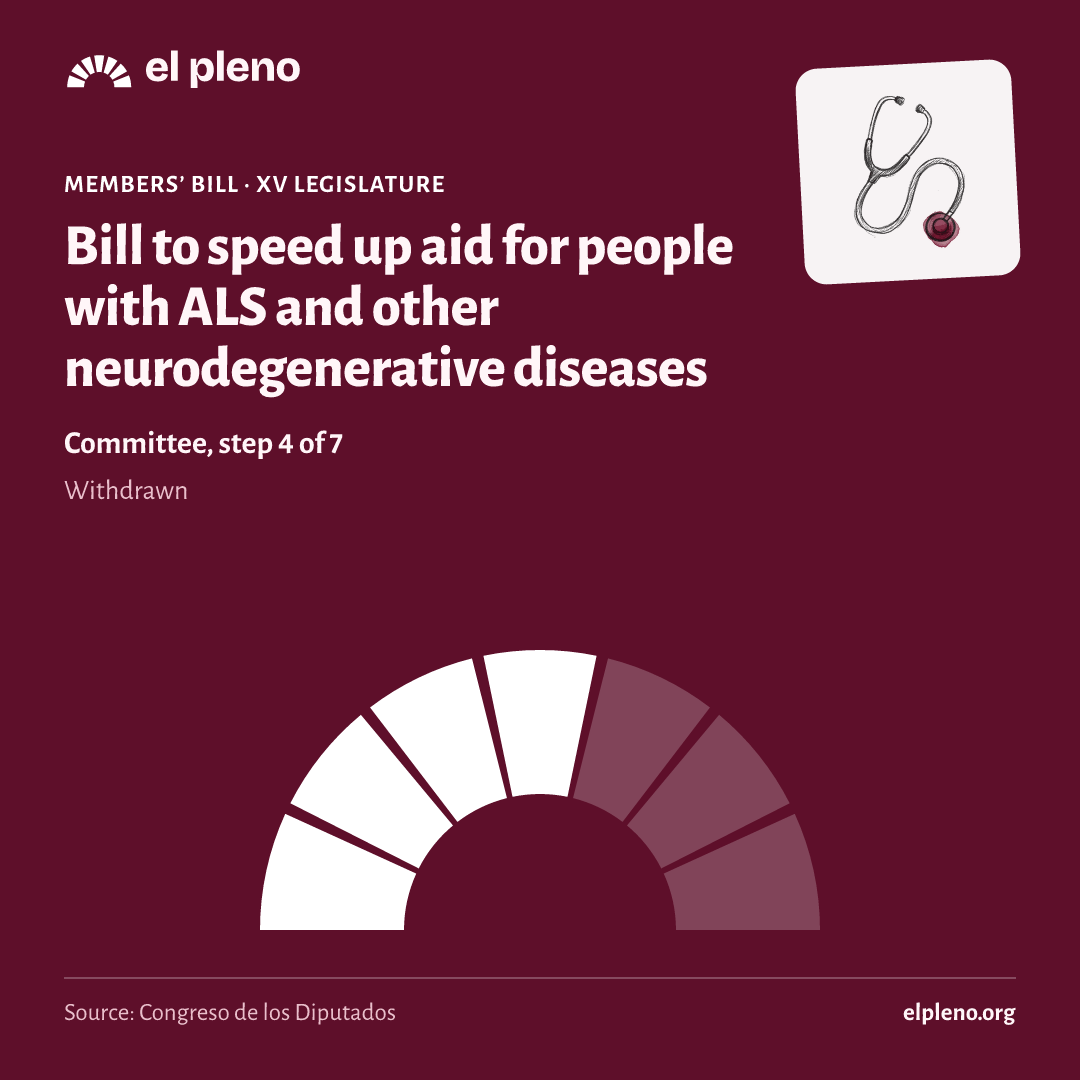
Bill to speed up aid for people with ALS and other neurodegenerative diseases
It is a members’ bill. Introduced by parliamentary groups, the Senate, regional governments or citizens. It was introduced on 12 March 2024. Introduced by: Grupo Parlamentario Socialista.
Official title: Private member's bill for the comprehensive care of people affected by neurodegenerative diseases, such as Amyotrophic Lateral Sclerosis (ALS).
Source: Congreso de los Diputados, file 122/000070· updated 11 Nov
Automatic summary, not yet reviewed
- The bill would establish that people with a permanent disability pension (total, absolute or major disability) or a civil service pension for permanent incapacity for service are considered to have a disability of 33 percent or higher for all purposes. The same would apply to people officially recognized as being in a situation of dependency at any level. This would avoid paperwork and delays in accessing public aid and benefits.
- The bill would create an urgent procedure in the Dependency System for cases where life expectancy and disease progression matter, such as people with neurodegenerative diseases. Under this procedure, decisions on dependency benefits and reviews of the degree of dependency and of the individual care program would have to be issued within a maximum of three months.
- The bill would include households with a person in a situation of electricity dependence among the beneficiaries of the electricity social bonus, as long as they stay within the income threshold set for this purpose.
- The bill would clarify that rehabilitation for patients with functional deficits aims to facilitate, maintain or restore the greatest possible degree of functional capacity and independence, even if full recovery is not possible. It would also extend sociosanitary care to people with diseases that cause dependency or disability, and provide for coordination bodies between health and social services.
- The bill would require the Government, within six months of the law taking effect, to update the Dependency System services catalog to adapt it to people who need home physiotherapy, to propose specific ALS training for professional caregivers in the Dependency System, and to include patient travel to reference centers (CSUR) in other autonomous communities in the National Health System services portfolio.
- The bill would also create a network of residential centers adapted to people with ALS and set up an interministerial working group to establish a maximum response time for the most important social benefits, such as those of the Dependency System.
Who it affects
- People with neurodegenerative diseases, such as ALS, Alzheimer's, Parkinson's or Huntington's disease: Faster access to aid, benefits and health and social care.
- People with a permanent disability pension or recognized dependency: They would be considered to have a disability of at least 33 percent without extra paperwork.
- Households with a person who depends on electrically powered medical equipment: They could qualify for the electricity social bonus if they meet the income limit.
- Professional caregivers in the Dependency System: They would receive specific training on neurodegenerative diseases.
Words worth knowing
- Situación de dependencia (situation of dependency)
- An officially recognized state in which a person needs help from others to handle daily tasks.
- Bono social eléctrico (electricity social bonus)
- A discount on the electricity bill for certain consumers in vulnerable situations.
- Electrodependencia (electricity dependence)
- Depending on a machine connected to the power grid, such as a ventilator, to maintain health or life.
- CSUR (centros, servicios y unidades de referencia)
- Specialized health centers that serve patients from all over Spain for specific diseases.
- Clases pasivas (civil service pension scheme)
- The former pension system for public employees, before the current Social Security system.
It summarizes the text as it was introduced. It is written by artificial intelligence and may contain mistakes: the official text is what counts. Read the official text · How we make summaries
Where it stands
How far did it get?
It took 4 of 7 steps. It reached Committee, and today it is withdrawn.
- Introduced12 March 2024Someone registers the text in the Congreso.
- Admitted19 March 2024The Bureau of the Congreso accepts it and, for a members’ bill, the plenary decides whether to consider it.
- Amendments6 May 2024Groups propose changes.
- Committee11 June 2024A committee goes through the text in detail.
- Plenarynot reachedAll 350 deputies vote.
- Senatenot reachedThe Senate can pass it, amend it or veto it.
- BOEnot reachedIt is published in the Official State Gazette (BOE) and comes into force.
See the 12 official steps on a timeline
20 June 2024
How did the plenary vote?
Voted on: Vote on the amendment to the whole with alternative text to the Private member's bill for the comprehensive care of people affected by neurodegenerative diseases, such as Amyotrophic Lateral Sclerosis (ALS), submitted by the VOX Parliamentary Group.
This law had 2 votes; this is the latest with every deputy’s vote. See them all
Source: Congreso de los Diputados, vote 25 of sitting 49· updated 10 Nov
Each dot is a seat. Tap one, or use the arrow keys, to see who it is.
Your province
How did the deputies from your province vote?
And your senators: the Senate does not link its votes to this law in its open data, so we cannot put them side by side here.
Or see how most of each province voted
- A Coruña More votes against 0 yes · 8 no
- Albacete More votes against 0 yes · 4 no
- Alicante/Alacant More votes against 2 yes · 10 no
- Almería More votes against 1 yes · 5 no
- Araba/Álava More votes against 0 yes · 4 no
- Asturias More votes against 1 yes · 6 no
- Ávila More votes against 0 yes · 3 no
- Badajoz More votes against 1 yes · 4 no
- Barcelona More votes against 2 yes · 29 no
- Bizkaia More votes against 0 yes · 8 no
- Burgos More votes against 0 yes · 4 no
- Cáceres More votes against 0 yes · 4 no
- Cádiz More votes against 1 yes · 8 no
- Cantabria More votes against 1 yes · 4 no
- Castellón/Castelló More votes against 1 yes · 4 no
- Ceuta More votes against 0 yes · 1 no
- Ciudad Real More votes against 1 yes · 4 no
- Córdoba More votes against 1 yes · 5 no
- Cuenca More votes against 0 yes · 3 no
- Gipuzkoa More votes against 0 yes · 6 no
- Girona More votes against 0 yes · 6 no
- Granada More votes against 1 yes · 6 no
- Guadalajara More votes against 1 yes · 2 no
- Huelva More votes against 1 yes · 4 no
- Huesca More votes against 0 yes · 3 no
- Illes Balears More votes against 1 yes · 7 no
- Jaén More votes against 1 yes · 4 no
- La Rioja More votes against 0 yes · 4 no
- Las Palmas More votes against 1 yes · 7 no
- León More votes against 0 yes · 4 no
- Lleida More votes against 0 yes · 4 no
- Lugo More votes against 0 yes · 4 no
- Madrid More votes against 5 yes · 32 no
- Málaga More votes against 2 yes · 9 no
- Melilla More votes against 0 yes · 1 no
- Murcia More votes against 2 yes · 8 no
- Navarra More votes against 0 yes · 5 no
- Ourense More votes against 0 yes · 4 no
- Palencia More votes against 0 yes · 3 no
- Pontevedra More votes against 0 yes · 7 no
- Salamanca More votes against 0 yes · 4 no
- Santa Cruz de Tenerife More votes against 0 yes · 7 no
- Segovia More votes against 0 yes · 3 no
- Sevilla More votes against 1 yes · 11 no
- Soria More votes against 0 yes · 2 no
- Tarragona More votes against 0 yes · 6 no
- Teruel More votes against 0 yes · 3 no
- Toledo More votes against 1 yes · 5 no
- Valencia/València More votes against 2 yes · 14 no
- Valladolid More votes against 1 yes · 4 no
- Zamora More votes against 0 yes · 3 no
- Zaragoza More votes against 1 yes · 6 no
More details: how each group and each province voted
The groups
Who voted in favour and who against?
In favour, most of VOX. Against, most of Euskal Herria Bildu, Plurinacional SUMAR, Republicano, Socialista, Vasco (EAJ-PNV), Junts per Catalunya, Mixto and Popular en el Congreso.
By province: in 0 most voted in favour; in 52, against.
Coloured by how most of each province’s deputies voted.
- In favour: 0
- Against: 52
| Group | Seats | How it voted |
|---|---|---|
| Euskal Herria Bildu | 6 | 6 against |
| Plurinacional SUMAR | 27 | 26 against · 1 did not vote |
| Republicano | 7 | 7 against |
| Socialista | 120 | 120 against |
| Vasco (EAJ-PNV) | 5 | 5 against |
| Junts per Catalunya | 7 | 7 against |
| Mixto | 8 | 8 against |
| Popular en el Congreso | 137 | 137 against |
| VOX | 33 | 33 in favour |
What happens next
What happens now?
Whoever introduced it withdrew it, or it was merged into another one. It goes no further.
Sources
Where does all this come from?
- Congreso de los Diputados, file 122/000070
Official title, type, author, dates and stage.
Retrieved 11 November 2026
- Congreso de los Diputados, procedure
The date of each step, with its official wording.
Retrieved 12 November 2026
- Congreso de los Diputados, vote 25 of sitting 49
The count and every seat’s vote.
Retrieved 10 November 2026
- The data comes from the open files of the Congreso, the Senate and the BOE, unaltered.
- Each deputy’s province is the one of their seat on the day of the vote.
- We only say “passed” or “rejected” when the majority needed is certain; otherwise we say which side had more votes.