What it is
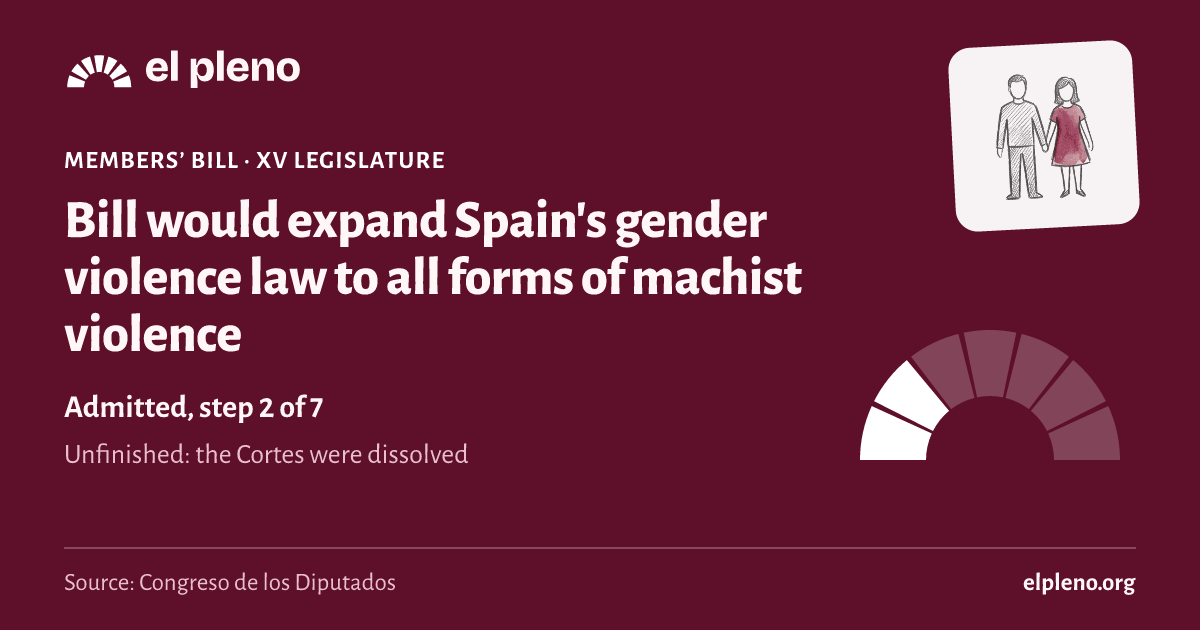
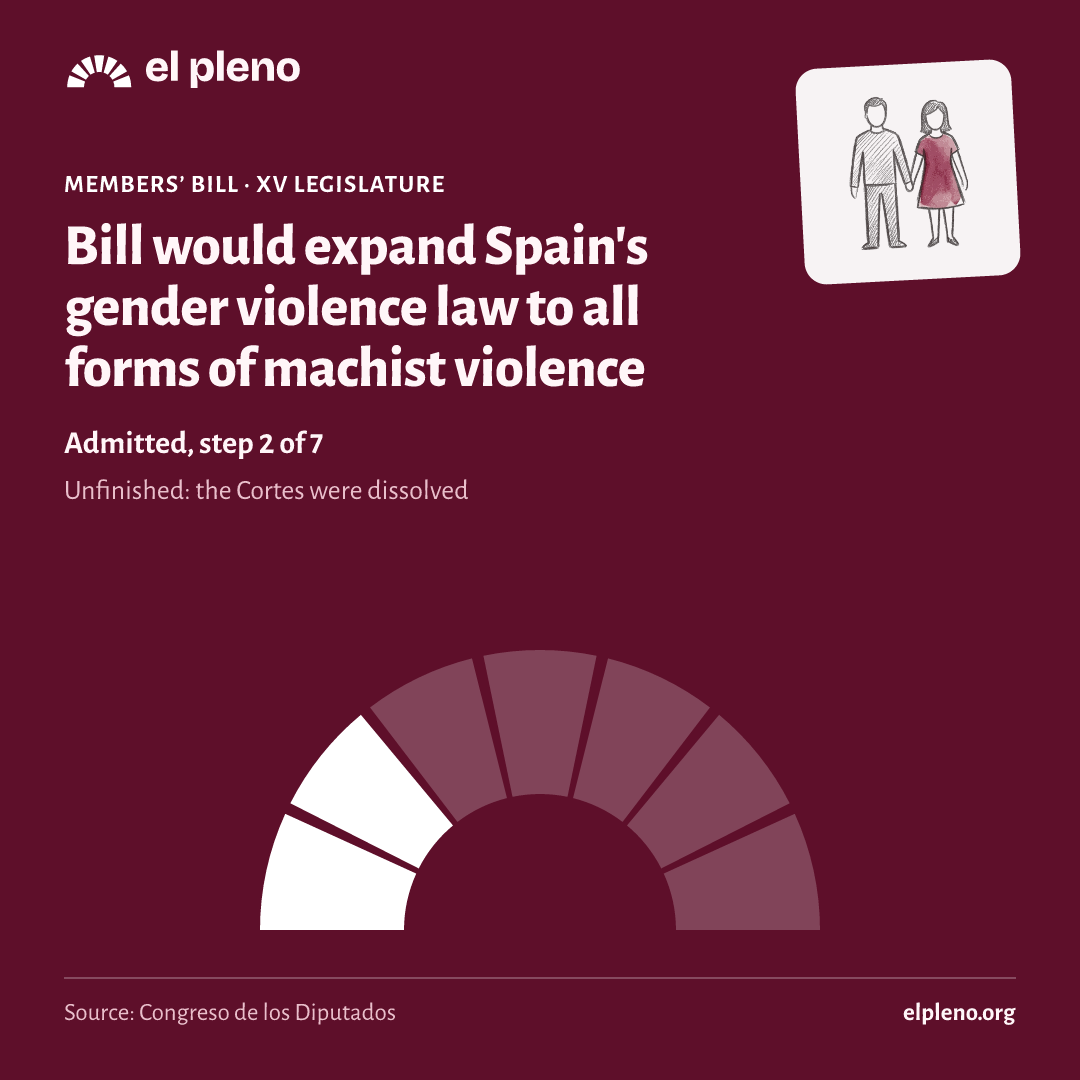
Bill would expand Spain's gender violence law to all forms of machist violence
Admitted step 2 of 7· LapsedIt is a members’ bill. Introduced by parliamentary groups, the Senate, regional governments or citizens. It was introduced on 8 March 2024. Introduced by: Grupo Parlamentario Mixto.
Official title: Private member's bill for an Organic Law amending Organic Law 1/2004, of 28 December, on Comprehensive Protection Measures against Gender Violence.
Source: Congreso de los Diputados, file 122/000066· updated 11 Nov
Automatic summary, not yet reviewed
- The bill would expand the scope of the 2004 law to cover all acts of violence against women, not only violence by a partner or ex-partner, and would define gender violence as machist violence, including vicarious violence and digital violence.
- It would create a permanent National Plan for Awareness and Prevention, with education programs, campaigns and yearly evaluation, and would guarantee that victims of any circumstance (age, nationality, disability, etc.) have the rights in the law, with comprehensive care including information, health, safe housing and legal advice.
- It would recognize new rights: health care through the public health system, a right to reparation with compensation for damages, and accreditation of violence without requiring a prior police report, since reports from social or specialized services could suffice.
- It would strengthen organization and coordination: mandatory training for professionals who assist victims or deal with perpetrators, a State Strategy against Machist Violence, and a Government Delegation with enough specialized staff.
- It would guarantee funding and oversight: a stable budget line for the State, autonomous communities and municipalities, evaluation reports every three years to be sent to the Spanish Parliament, and a stronger Child Support Guarantee Fund against unpaid child support.
- It would allow part of the personal income tax (IRPF) quota to fund social interest activities benefiting victims, amending Royal Decree-Law 7/2013. The law would take effect the day after its publication in the Official State Gazette.
Who it affects
- Women victims of any form of machist violence: New rights to information, comprehensive care, health care, reparation and compensation.
- Minor children of victims: They would be considered direct victims entitled to comprehensive care.
- Health, police, justice, legal, prosecution and social services professionals: Mandatory initial and ongoing training.
- State, regional and local administrations: Duties of coordination, protocols and stable funding.
- IRPF taxpayers: Part of their tax quota could go to aid for victims.
Words worth knowing
- Violencia vicaria (vicarious violence)
- Violence inflicted on a woman's children, relatives or close ones in order to harm her.
- Proposición de ley orgánica (organic bill)
- A proposal to amend a law affecting fundamental rights; it needs a special majority in the Congress of Deputies. It is not approved yet.
- Convenio de Estambul (Istanbul Convention)
- European treaty requiring states to prevent and combat violence against women.
- Fondo de Garantía de Alimentos (Child Support Guarantee Fund)
- State fund that pays court-ordered child support when the debtor fails to pay.
- Asignación tributaria del IRPF (IRPF tax assignment)
- Percentage of the personal income tax earmarked to fund social interest activities.
It summarizes the text as it was introduced. It is written by artificial intelligence and may contain mistakes: the official text is what counts. Read the official text · How we make summaries
Where it stands
How far did it get?
It took 2 of 7 steps. It reached Admitted, and today it is lapsed.
- Introduced8 March 2024Someone registers the text in the Congreso.
- Admitted12 March 2024The Bureau of the Congreso accepts it and, for a members’ bill, the plenary decides whether to consider it.
- Amendmentsnot reachedGroups propose changes.
- Committeenot reachedA committee goes through the text in detail.
- Plenarynot reachedAll 350 deputies vote.
- Senatenot reachedThe Senate can pass it, amend it or veto it.
- BOEnot reachedIt is published in the Official State Gazette (BOE) and comes into force.
See the 6 official steps on a timeline
Was there a plenary vote?
We have no plenary vote linked to this law in the Congreso’s data.
What happens next
What happens now?
The legislature ended before it finished. To go on, someone would have to introduce it again in the new Cortes.
Sources
Where does all this come from?
- Congreso de los Diputados, file 122/000066
Official title, type, author, dates and stage.
Retrieved 11 November 2026
- Congreso de los Diputados, procedure
The date of each step, with its official wording.
Retrieved 12 November 2026
- The data comes from the open files of the Congreso, the Senate and the BOE, unaltered.
- Each deputy’s province is the one of their seat on the day of the vote.
- We never say “passed” because of a vote: the files do not say which majority was needed.