What it is
VOX bill to toughen the Penal Code and repeal the animal law
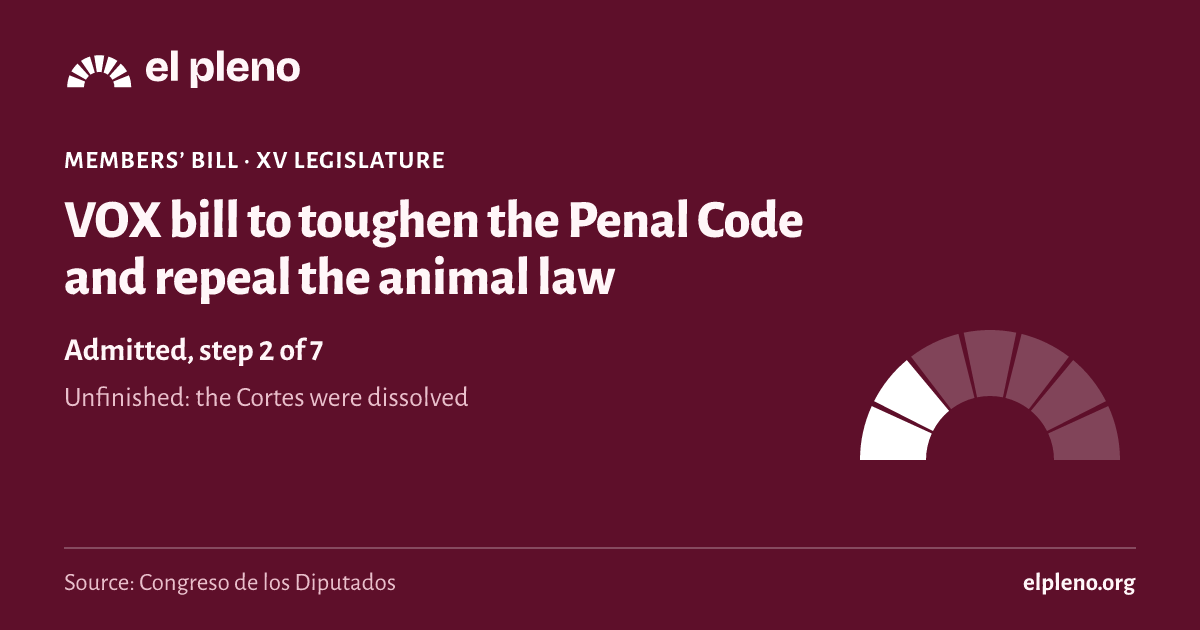
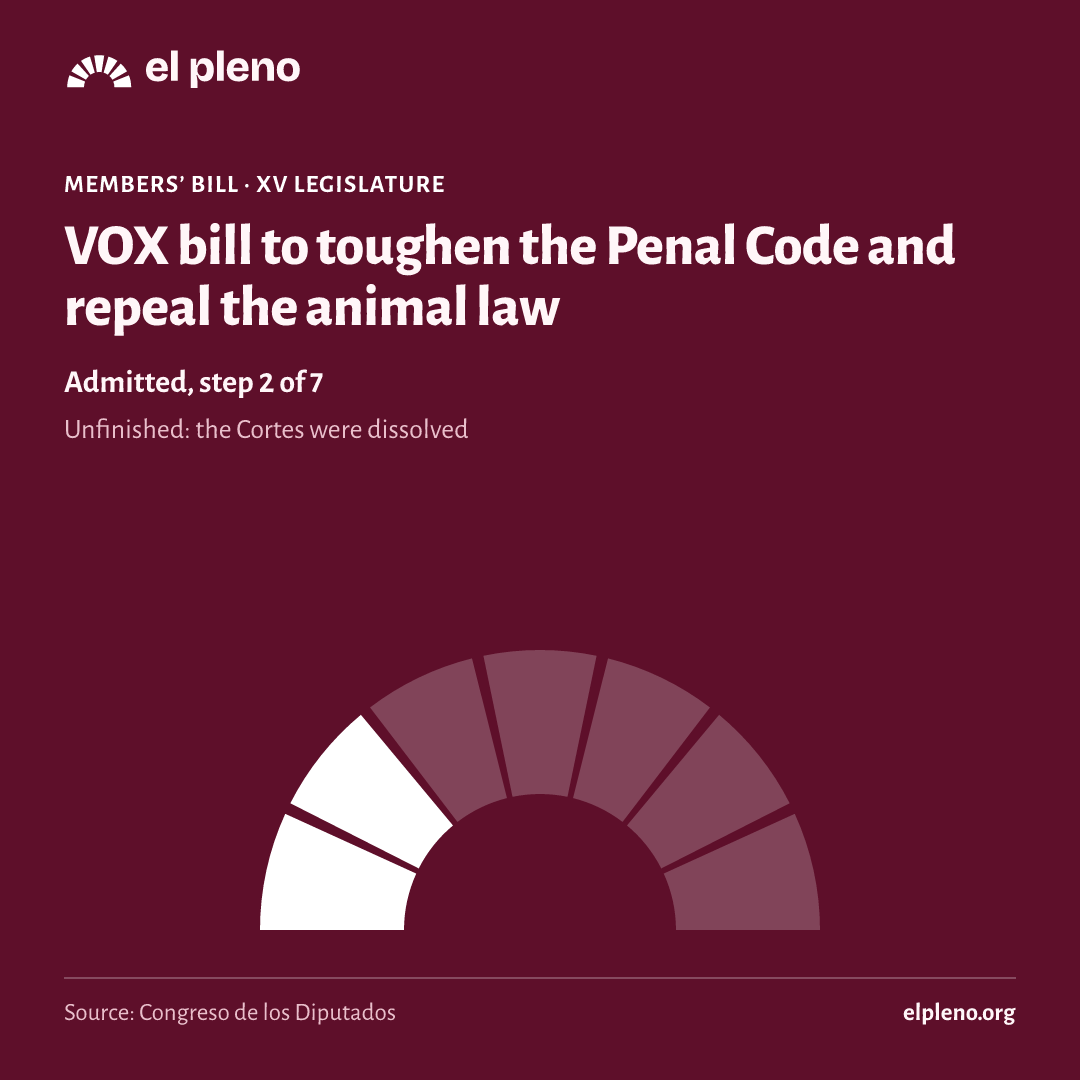
Admitted step 2 of 7· LapsedIt is a members’ bill. Introduced by parliamentary groups, the Senate, regional governments or citizens. It was introduced on 22 December 2023. Introduced by: Grupo Parlamentario VOX.
Official title: Private member's bill for an Organic Law on the protection of animals.
Source: Congreso de los Diputados, file 122/000046· updated 11 Nov
Automatic summary, not yet reviewed
- The bill would reform the Penal Code so that abuse and abandonment are only punished for domestic animals or animals under human control, not for any vertebrate animal. It would again distinguish between domestic and wild animals.
- It would set prison terms of three months to one year for abuse causing serious injury or sexual exploitation, and six to eighteen months if the animal dies. Abandoning an animal in dangerous conditions would be punished with a fine.
- It would keep and adjust penalties for hunting or fishing protected species, trafficking in them, using poison or explosives, and hunting or fishing without permission on land under special rules.
- It would repeal Law 7/2023 on the protection of the rights and welfare of animals, and remove from the Penal Code the title and articles that the 2023 reform added on crimes against animals.
Who it affects
- People who abuse or abandon domestic animals or animals under human control: They could face prison terms, fines, and bans on keeping animals or working with them.
- Hunters, fishers, and shellfish gatherers: They would remain subject to penalties for taking protected species, acting without permission, or using banned methods.
- Pet owners and people who work with animals: Repealing Law 7/2023 would remove the obligations that law imposed on them.
Words worth knowing
- Proposición de ley
- A bill introduced by a parliamentary group to become a law. It is not approved yet.
- Ley orgánica
- A type of Spanish law reserved for major matters, such as the Penal Code, which requires a higher majority to pass.
- Inhabilitación especial
- A penalty that bars someone from a profession, trade, or right, such as keeping animals or hunting, for a period of time.
- Derogar
- To repeal, that is, to make a law or part of it no longer valid.
It summarizes the text as it was introduced. It is written by artificial intelligence and may contain mistakes: the official text is what counts. Read the official text · How we make summaries
Where it stands
How far did it get?
It took 2 of 7 steps. It reached Admitted, and today it is lapsed.
- Introduced22 December 2023Someone registers the text in the Congreso.
- Admitted9 January 2024The Bureau of the Congreso accepts it and, for a members’ bill, the plenary decides whether to consider it.
- Amendmentsnot reachedGroups propose changes.
- Committeenot reachedA committee goes through the text in detail.
- Plenarynot reachedAll 350 deputies vote.
- Senatenot reachedThe Senate can pass it, amend it or veto it.
- BOEnot reachedIt is published in the Official State Gazette (BOE) and comes into force.
See the 6 official steps on a timeline
Was there a plenary vote?
We have no plenary vote linked to this law in the Congreso’s data.
What happens next
What happens now?
The legislature ended before it finished. To go on, someone would have to introduce it again in the new Cortes.
Sources
Where does all this come from?
- Congreso de los Diputados, file 122/000046
Official title, type, author, dates and stage.
Retrieved 11 November 2026
- Congreso de los Diputados, procedure
The date of each step, with its official wording.
Retrieved 12 November 2026
- The data comes from the open files of the Congreso, the Senate and the BOE, unaltered.
- Each deputy’s province is the one of their seat on the day of the vote.
- We never say “passed” because of a vote: the files do not say which majority was needed.