What it is
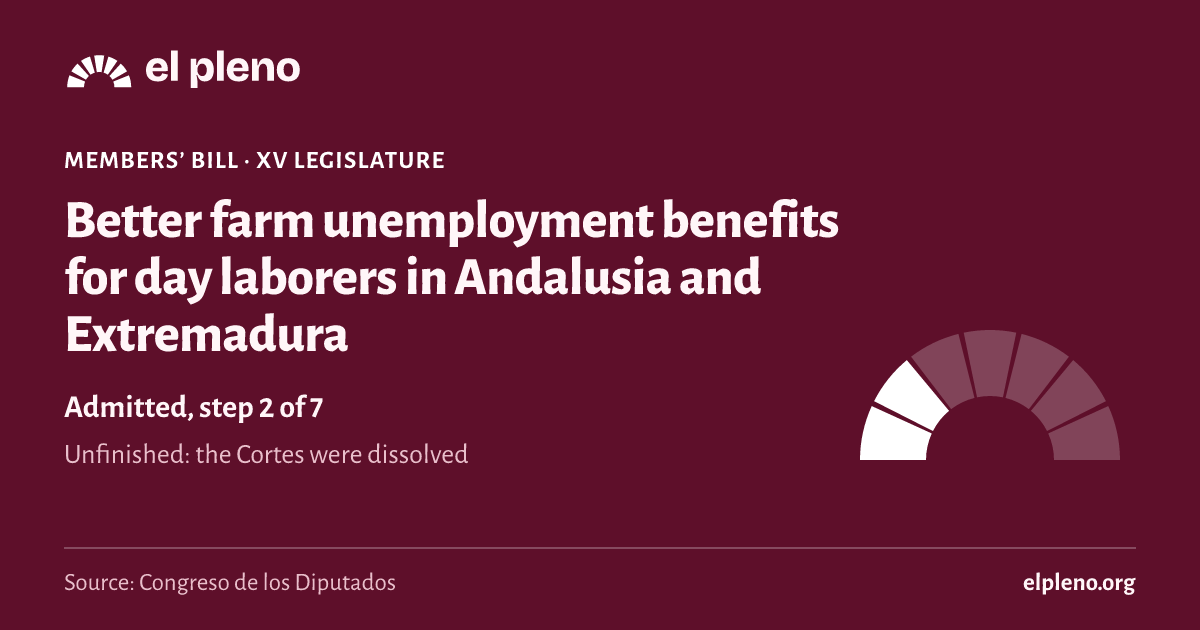
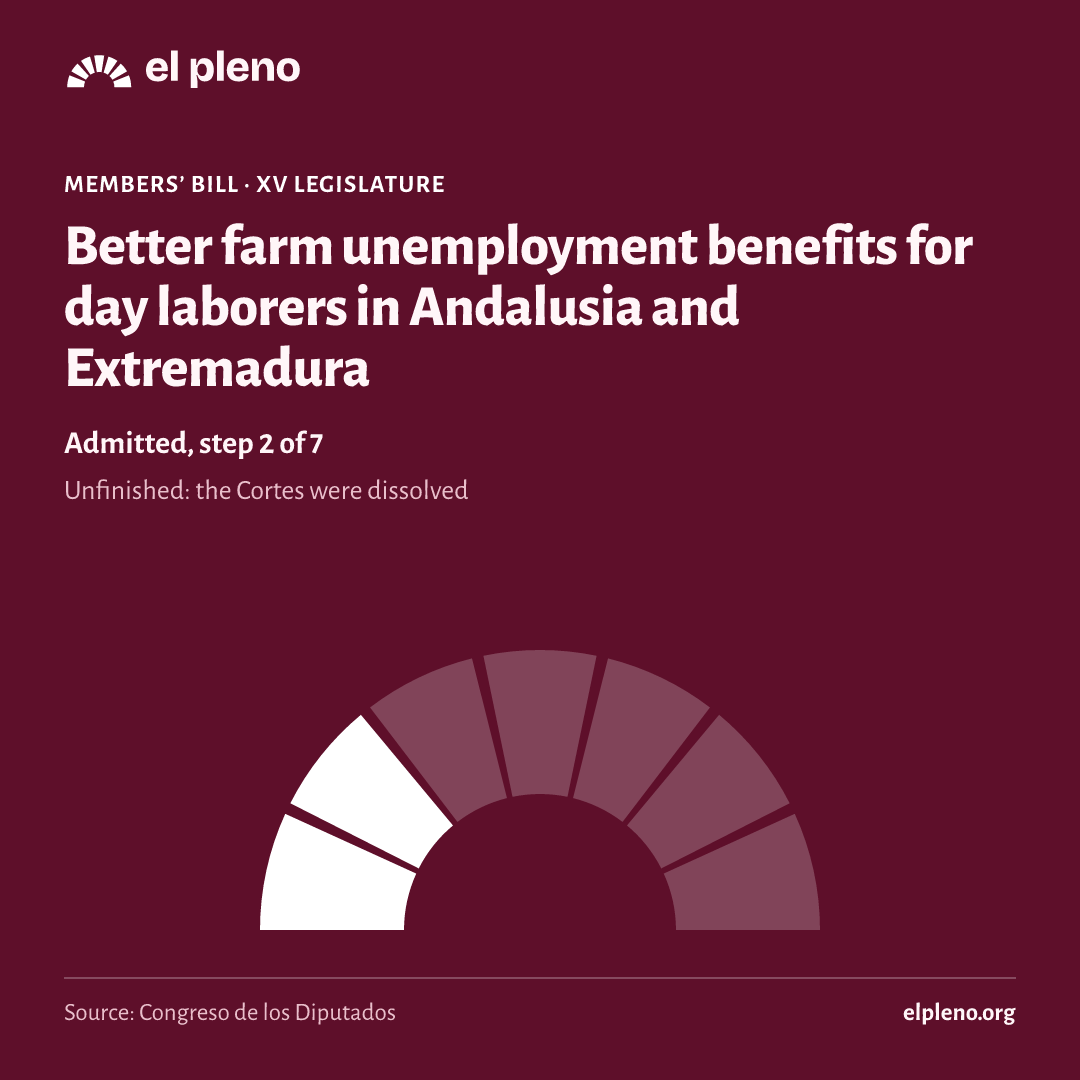
Better farm unemployment benefits for day laborers in Andalusia and Extremadura
Admitted step 2 of 7· LapsedIt is a members’ bill. Introduced by parliamentary groups, the Senate, regional governments or citizens. It was introduced on 21 December 2023. Introduced by: Grupo Parlamentario Mixto.
Official title: Private member's bill to improve the working conditions and unemployment social protection of agricultural employees and temporary agricultural workers in Andalusia and Extremadura.
Source: Congreso de los Diputados, file 122/000044· updated 11 Nov
Automatic summary, not yet reviewed
- The bill would replace the current farm subsidy and the farm income benefit with a new agricultural unemployment subsidy for seasonal farm workers in Andalusia and Extremadura. A first application would only require 30 days of contributions in the 24 months before unemployment, and later applications would need no minimum period.
- The new subsidy would be tied to the minimum wage: it would start at 50% for workers with 0 to 9 days worked and reach 75% with 170 or more days contributed in the previous year.
- The Social Security registration system would change: employers would have to register seasonal farm workers before the workday starts, removing the current rule that allowed registration until noon on that day.
- The bill would define who counts as a farm employer and what counts as farm work, making clear that workers supplied by temp agencies or service companies do not count. Farm cooperatives could organize work crews and lend them to their members.
- The bill would extend means-tested unemployment protection to farm workers over 52, and current recipients of the farm subsidy and the farm income benefit would move into the new special subsidy.
- To fight off-the-books work, standards would be set to estimate expected workdays based on each workplace's output, and the Government would strengthen labor inspection with specialized teams for the farm sector.
Who it affects
- Seasonal farm workers in Andalusia and Extremadura, who would get a new subsidy with easier access requirements and an amount tied to the minimum wage.: new subsidy with easier requirements
- Farm workers over 52, who would gain means-tested unemployment protection.: extended protection
- Farm companies and farm employers, who would have to register workers before the workday starts and face more inspection.: more duties and inspection
- Farm cooperatives and agricultural transformation societies, which could organize work crews and lend them to members.: new ability to organize work crews
- Temp agencies and service companies in the farm sector, whose supplied workers would be excluded from the special farm system.: exclusion from the special system
Words worth knowing
- Peonadas
- Days of farm work performed and contributed to Social Security, used to qualify for benefits.
- SETACA
- Special System for Salaried Agricultural Workers: the Social Security scheme where seasonal farm workers pay contributions.
- Renta agraria
- Current benefit for seasonal farm workers in Andalusia and Extremadura that the bill would replace with the new subsidy.
- Economía sumergida
- Off-the-books work that is not declared or paid into Social Security, for example when the employer does not register the worker.
- ETT
- Temp agency (empresa de trabajo temporal): a company that hires workers and supplies them to other companies.
It summarizes the text as it was introduced. It is written by artificial intelligence and may contain mistakes: the official text is what counts. Read the official text · How we make summaries
Where it stands
How far did it get?
It took 2 of 7 steps. It reached Admitted, and today it is lapsed.
- Introduced21 December 2023Someone registers the text in the Congreso.
- Admitted9 January 2024The Bureau of the Congreso accepts it and, for a members’ bill, the plenary decides whether to consider it.
- Amendmentsnot reachedGroups propose changes.
- Committeenot reachedA committee goes through the text in detail.
- Plenarynot reachedAll 350 deputies vote.
- Senatenot reachedThe Senate can pass it, amend it or veto it.
- BOEnot reachedIt is published in the Official State Gazette (BOE) and comes into force.
See the 6 official steps on a timeline
Was there a plenary vote?
We have no plenary vote linked to this law in the Congreso’s data.
What happens next
What happens now?
The legislature ended before it finished. To go on, someone would have to introduce it again in the new Cortes.
Sources
Where does all this come from?
- Congreso de los Diputados, file 122/000044
Official title, type, author, dates and stage.
Retrieved 11 November 2026
- Congreso de los Diputados, procedure
The date of each step, with its official wording.
Retrieved 12 November 2026
- The data comes from the open files of the Congreso, the Senate and the BOE, unaltered.
- Each deputy’s province is the one of their seat on the day of the vote.
- We never say “passed” because of a vote: the files do not say which majority was needed.