What it is
Bill to legalize and regulate cannabis for adults
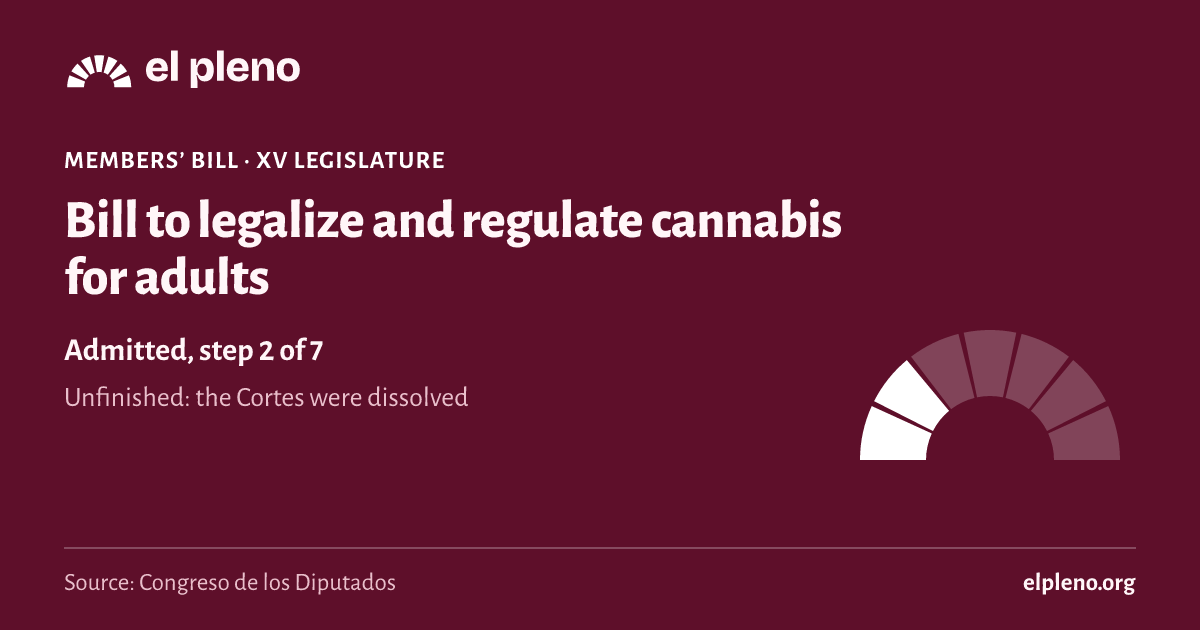
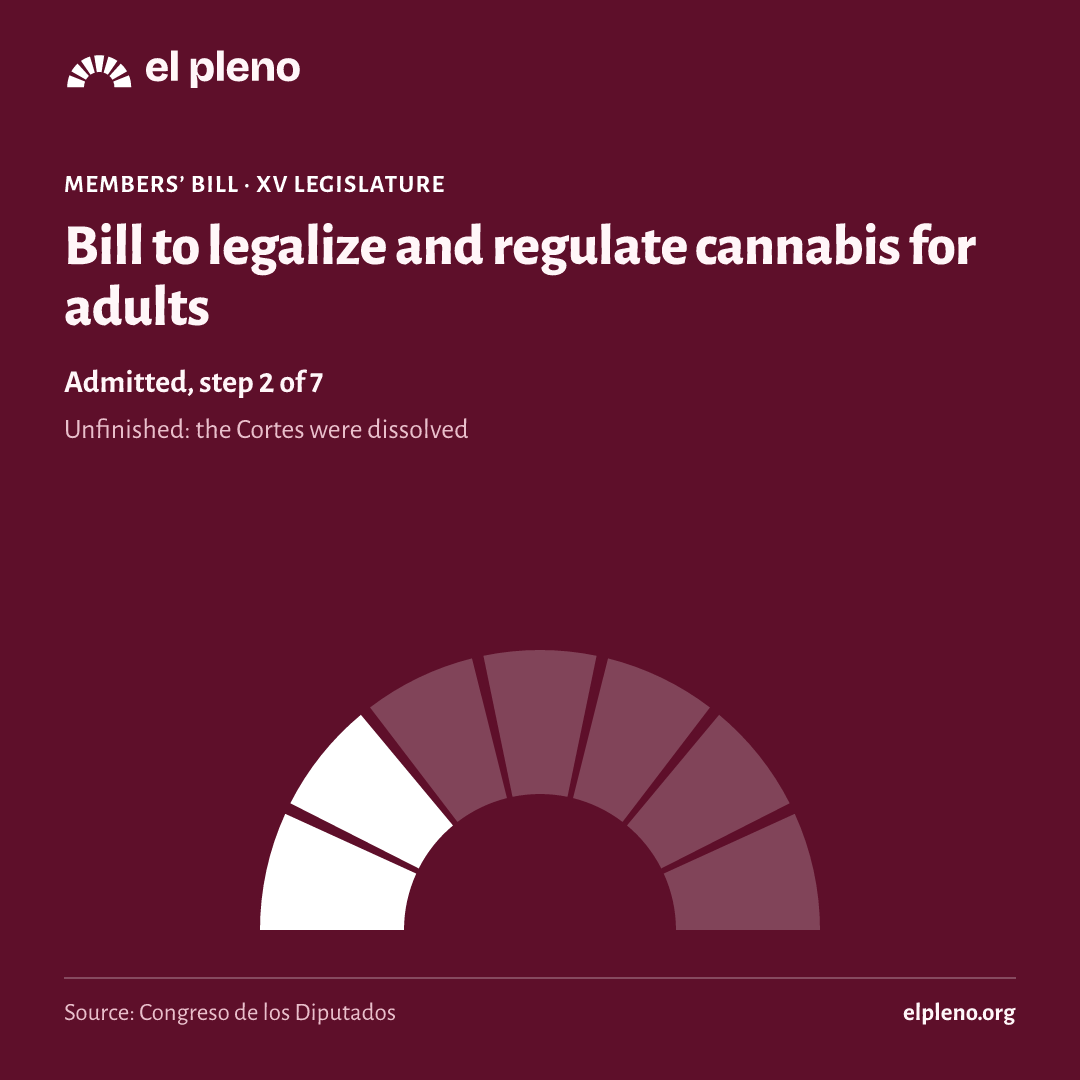
Admitted step 2 of 7· LapsedIt is a members’ bill. Introduced by parliamentary groups, the Senate, regional governments or citizens. It was introduced on 21 December 2023. Introduced by: Grupo Parlamentario Mixto.
Official title: Private member's bill for the Comprehensive Regulation and Control of Cannabis in Adults.
Source: Congreso de los Diputados, file 122/000041· updated 11 Nov
Automatic summary, not yet reviewed
- The bill would allow people over 18 to possess and consume cannabis, and would regulate the whole plant cycle: growing, production, sale and consumption, with limits and controls.
- Access to cannabis would be possible through two routes: self-management (home growing and cooperative cannabis social clubs) and the regulated market (licensed clubs, dispensaries and non-psychoactive cannabis dispensaries).
- It would create the AECRIC, an independent public body attached to the Ministry of Social Rights, which would oversee the whole market, grant licenses and inspect companies.
- All activities covered by the bill would be strictly forbidden for minors, with no exceptions, and smoked consumption would only be allowed in private settings and in authorized consumption spaces.
- The bill sets quantity limits: for example, up to 100 grams of dried cannabis flowers to carry in public places, and a maximum of 25 grams per purchase or dispensing.
- Home growing would be allowed without registration for personal use, individually or in a group of up to five people living together, with limits on volume and lighting power depending on outdoor or indoor growing.
- It would create a special tax on cannabis products, graduated by THC content, and two thirds of the revenue would go to education, health and the 2030 Agenda.
- If the law came into force, pending fines for cannabis possession would be annulled, and people whose actions would fall under the new legal activities could be released and have their records erased.
Who it affects
- Adult consumers: They could legally buy, possess and consume cannabis through the planned channels, within quantity limits.
- People who grow for their own use: Home growing would be regulated with clear limits and no registration required.
- Cannabis social clubs: They could become legal as cooperatives (nonprofit) or as licensed businesses, with obligations and controls.
- Businesses in the sector: They could apply for licenses for production, processing, sale, distribution and other activities, under AECRIC oversight.
- People fined or convicted over cannabis: Unexecuted fines would be annulled and records could be erased in cases that become legal.
Words worth knowing
- AECRIC
- Agencia Española de Control de la Regulación Integral del Cannabis: the public body that would oversee the entire regulated cannabis market.
- THC
- The main psychoactive compound in cannabis, the one that affects the mind.
- Sumidades floridas
- The flowering tops of the cannabis plant, where most of its active compounds are concentrated.
- SoftCRIC
- A control software through which licensed companies would report their daily operations to the AECRIC.
- Cannabis no psicoactivo
- Non-psychoactive cannabis: flowers of the plant with less than 1% total THC, so they do not affect the mind.
It summarizes the text as it was introduced. It is written by artificial intelligence and may contain mistakes: the official text is what counts. Read the official text · How we make summaries
Where it stands
How far did it get?
It took 2 of 7 steps. It reached Admitted, and today it is lapsed.
- Introduced21 December 2023Someone registers the text in the Congreso.
- Admitted9 January 2024The Bureau of the Congreso accepts it and, for a members’ bill, the plenary decides whether to consider it.
- Amendmentsnot reachedGroups propose changes.
- Committeenot reachedA committee goes through the text in detail.
- Plenarynot reachedAll 350 deputies vote.
- Senatenot reachedThe Senate can pass it, amend it or veto it.
- BOEnot reachedIt is published in the Official State Gazette (BOE) and comes into force.
See the 6 official steps on a timeline
Was there a plenary vote?
We have no plenary vote linked to this law in the Congreso’s data.
What happens next
What happens now?
The legislature ended before it finished. To go on, someone would have to introduce it again in the new Cortes.
Sources
Where does all this come from?
- Congreso de los Diputados, file 122/000041
Official title, type, author, dates and stage.
Retrieved 11 November 2026
- Congreso de los Diputados, procedure
The date of each step, with its official wording.
Retrieved 12 November 2026
- The data comes from the open files of the Congreso, the Senate and the BOE, unaltered.
- Each deputy’s province is the one of their seat on the day of the vote.
- We never say “passed” because of a vote: the files do not say which majority was needed.