What it is
Bill to guarantee mental health care and rights in Spain
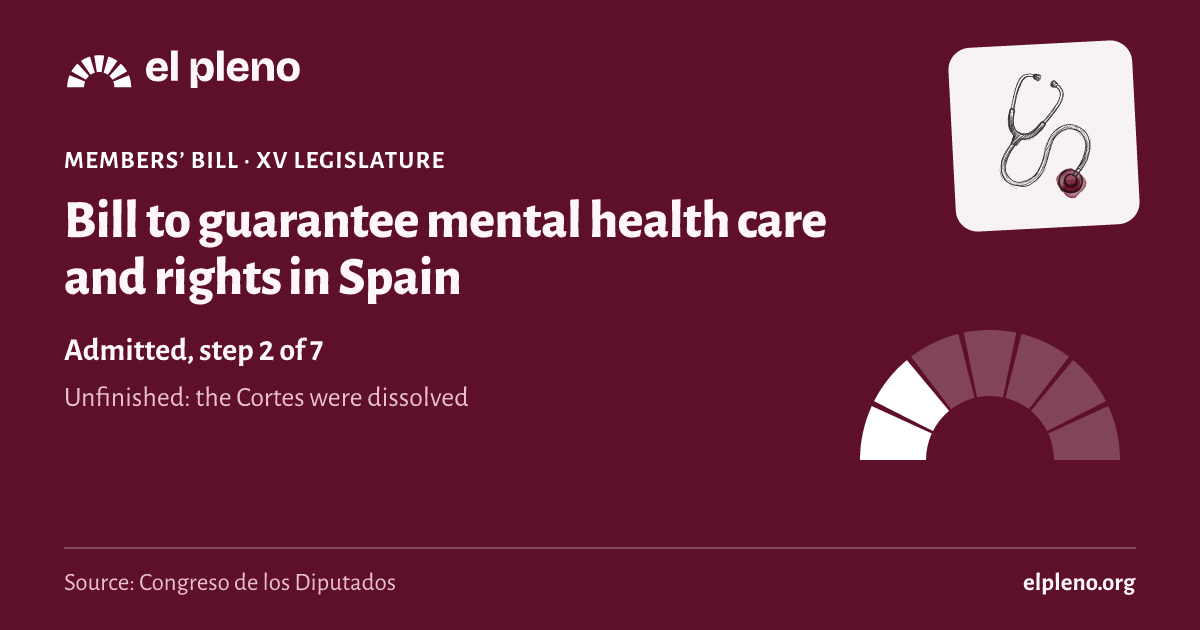
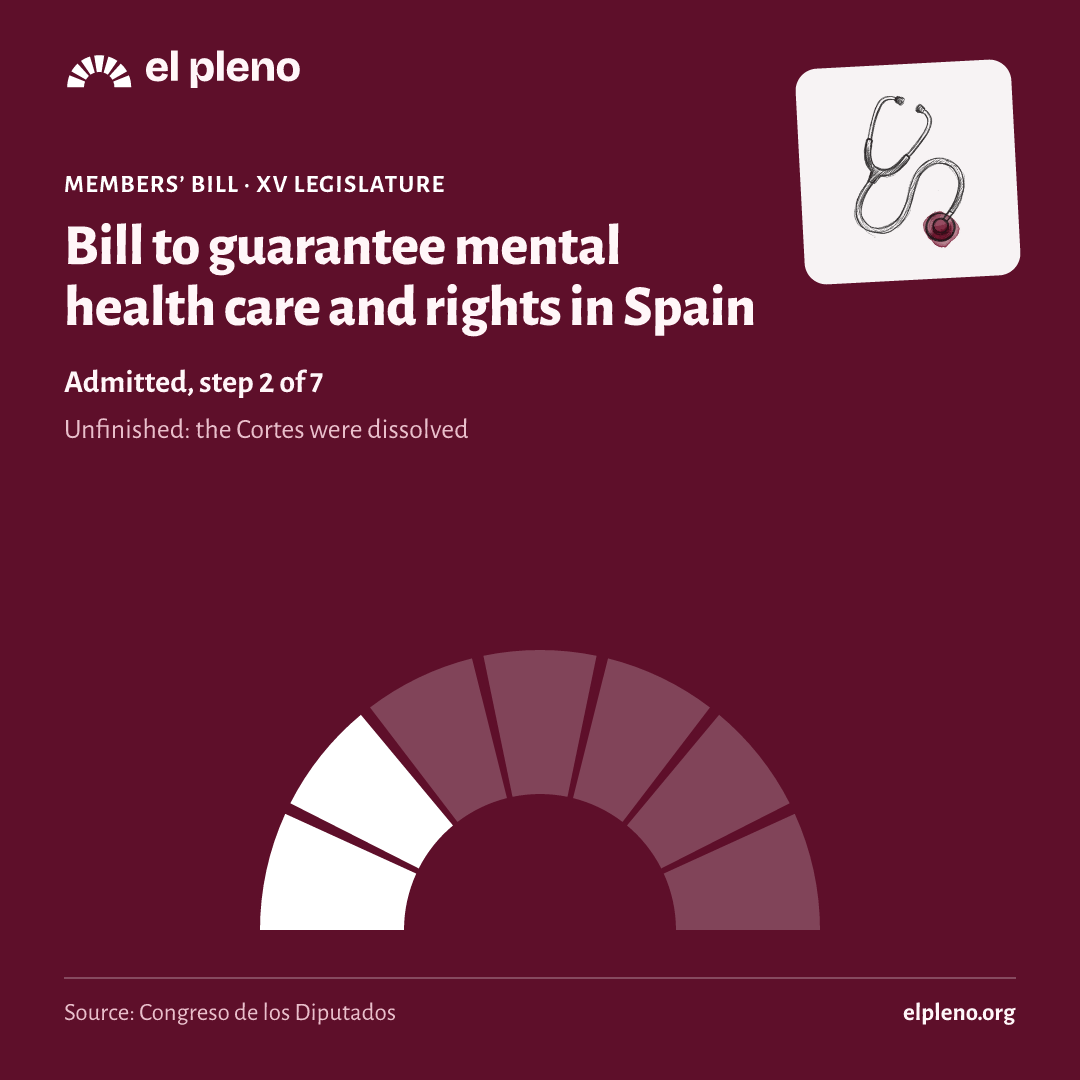
Admitted step 2 of 7· LapsedIt is a members’ bill. Introduced by parliamentary groups, the Senate, regional governments or citizens. It was introduced on 21 December 2023. Introduced by: Grupo Parlamentario Mixto.
Official title: Private member's bill on the General Mental Health Act
Source: Congreso de los Diputados, file 122/000040· updated 11 Nov
Automatic summary, not yet reviewed
- The bill would guarantee the right to mental health protection and universal access to mental health services, with no discrimination based on origin, sex, age or other personal or social circumstances.
- It would strengthen patient autonomy: treatments would require free consent, advance directive documents would be binding, and people could grant a preventive power of attorney before a notary so someone else can decide if they become unable to.
- It would set maximum waiting times for mental health services and minimum staffing ratios: at least 18 psychiatrists, 18 clinical psychologists and 23 mental health nurses per 100,000 residents, to be reached gradually over four years.
- It would require a state suicide prevention protocol, including a free nationwide crisis phone line, a state suicide data registry, and specific training for health, education, emergency and media professionals.
- It would push to eliminate mechanical restraint and other coercive practices, which would have to be recorded, and would restrict involuntary commitment to the cases set by an organic law, always with prior court authorization.
- It would create new bodies: a State Mental Health Center, a Participation Council, and an Ombudsman for people with mental health problems in each autonomous community. It would also amend the occupational risk prevention law so employers protect their workers' mental health.
Who it affects
- People with mental health problems: They would have the right to comprehensive care, maximum waiting times and a say in their treatments.
- People with disabilities or at risk of poverty and social exclusion: They would receive specialized and priority care, with stronger protection against discrimination.
- Children and teenagers: They would have specific rights to information and participation, plus prevention programs in schools and health centers.
- Women with mental health problems: They would receive gender-sensitive care, protection from sexist violence and, if they wish, support for motherhood.
- Companies and workers: Employers would have to assess psychological and social risks in each job and promote the right to disconnect.
Words worth knowing
- Contención mecánica (mechanical restraint)
- Physically immobilizing a person, for example with straps, to prevent harm to themselves or others.
- Documento de voluntades anticipadas (advance directive)
- A document where a person states in writing which treatments they accept or refuse if they later cannot decide.
- Iatrogenia (iatrogenesis)
- Harm or negative effect caused to a patient by a treatment or by medical care itself.
- Prevención cuaternaria (quaternary prevention)
- Avoiding harm from medical activity itself, such as unnecessary treatments or tests.
- Consejo Interterritorial del Sistema Nacional de Salud
- Body where the Spanish state and the autonomous regions agree on basic health care matters.
It summarizes the text as it was introduced. It is written by artificial intelligence and may contain mistakes: the official text is what counts. Read the official text · How we make summaries
Where it stands
How far did it get?
It took 2 of 7 steps. It reached Admitted, and today it is lapsed.
- Introduced21 December 2023Someone registers the text in the Congreso.
- Admitted9 January 2024The Bureau of the Congreso accepts it and, for a members’ bill, the plenary decides whether to consider it.
- Amendmentsnot reachedGroups propose changes.
- Committeenot reachedA committee goes through the text in detail.
- Plenarynot reachedAll 350 deputies vote.
- Senatenot reachedThe Senate can pass it, amend it or veto it.
- BOEnot reachedIt is published in the Official State Gazette (BOE) and comes into force.
See the 6 official steps on a timeline
Was there a plenary vote?
We have no plenary vote linked to this law in the Congreso’s data.
What happens next
What happens now?
The legislature ended before it finished. To go on, someone would have to introduce it again in the new Cortes.
Sources
Where does all this come from?
- Congreso de los Diputados, file 122/000040
Official title, type, author, dates and stage.
Retrieved 11 November 2026
- Congreso de los Diputados, procedure
The date of each step, with its official wording.
Retrieved 12 November 2026
- The data comes from the open files of the Congreso, the Senate and the BOE, unaltered.
- Each deputy’s province is the one of their seat on the day of the vote.
- We never say “passed” because of a vote: the files do not say which majority was needed.