What it is
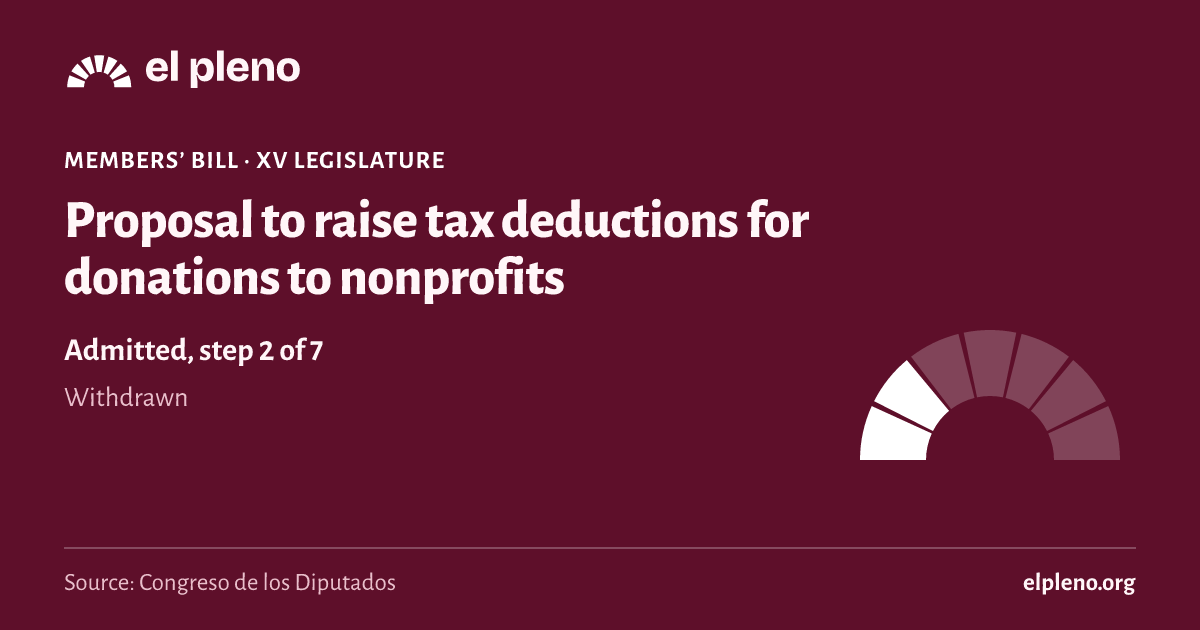
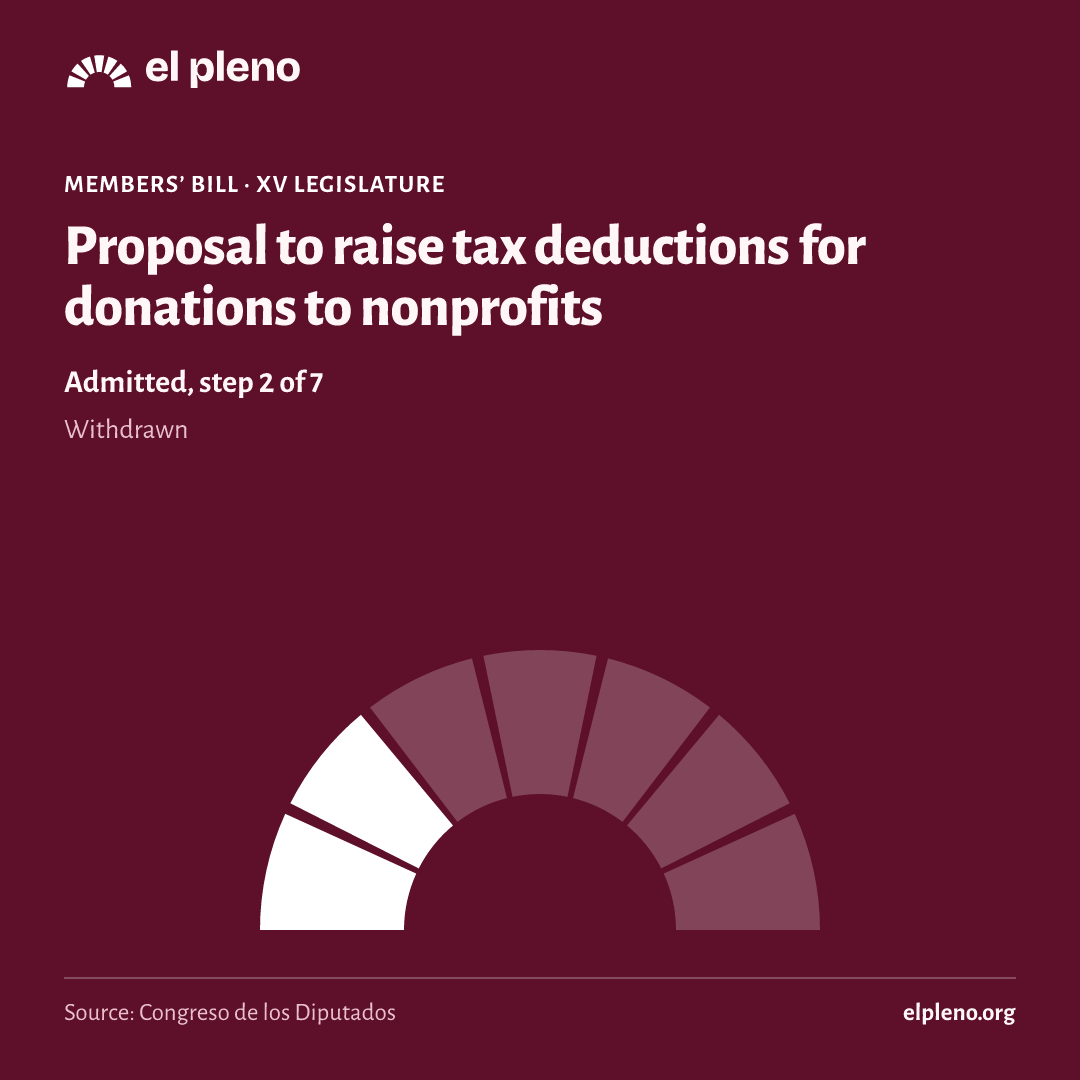
Proposal to raise tax deductions for donations to nonprofits
It is a members’ bill. Introduced by parliamentary groups, the Senate, regional governments or citizens. It was introduced on 7 December 2023. Introduced by: Grupo Parlamentario Junts per Catalunya.
Official title: Private member's bill to amend Law 49/2002, of 23 December, on the tax regime of non-profit entities and tax incentives for patronage.
Source: Congreso de los Diputados, file 122/000026· updated 11 Nov
Automatic summary, not yet reviewed
- The bill would raise the tax deduction for donations from 35% to 50% for individuals and companies, and expand micro-donations from 150 to 300 euros, with a 90% deduction on that portion.
- For loyal donors who give equal or larger amounts to the same entity for three years in a row, the deduction would rise to 60%, instead of the four years currently required.
- Lending the use of a movable or real property without payment would become a deductible donation, and receiving a symbolic honorary mention would not break the donation's tax status.
- Provision of services and in-kind aid under corporate collaboration agreements would get the same tax treatment as donations, and any income they generate would be tax exempt for the collaborator.
- The list of activities exempt from Corporate income tax The personal income tax (IRPF in Spain): what people pay on what they earn from work, business or savings. for nonprofits would grow, adding job-placement programs for people at risk of exclusion, education for gifted students, and innovation.
- A Patronage Council would be created to report to Congress, a 20% deduction for cultural spending would be introduced, and the law would take effect twenty days after publication.
Who it affects
- Individual donors: Could deduct more from personal income tax: 50% generally, 90% up to 300 euros, and 60% for repeat donors.
- Companies that donate or collaborate: A 50% deduction under Corporate Income Tax, 60% for repeat donations, and donation treatment for services and in-kind aid.
- Nonprofit entities: More tax-exempt activities and more stable funding from recurring donations.
- Non-residents donating in Spain: Could apply the same deduction, capped at 15% of their tax base.
- Consumers of cultural products: A new 20% deduction for cultural expenses.
Words worth knowing
- Mecenazgo (patronage)
- Private support, usually financial, for activities of general interest such as culture, sports, or research.
- Micromecenazgo (micro-patronage)
- Small donations from many people, such as online crowdfunding.
- Base imponible (tax base)
- The amount on which taxes are calculated, that is, taxable income.
- Exención (exemption)
- That certain income does not pay tax.
- Convenio de colaboración (collaboration agreement)
- A written agreement under which a company or person helps an entity in exchange for the entity publicizing their participation.
- income tax
- The personal income tax (IRPF in Spain): what people pay on what they earn from work, business or savings.
It summarizes the text as it was introduced. It is written by artificial intelligence and may contain mistakes: the official text is what counts. Read the official text · How we make summaries
Where it stands
How far did it get?
It took 2 of 7 steps. It reached Admitted, and today it is withdrawn.
- Introduced7 December 2023Someone registers the text in the Congreso.
- Admitted12 December 2023The Bureau of the Congreso accepts it and, for a members’ bill, the plenary decides whether to consider it.
- Amendmentsnot reachedGroups propose changes.
- Committeenot reachedA committee goes through the text in detail.
- Plenarynot reachedAll 350 deputies vote.
- Senatenot reachedThe Senate can pass it, amend it or veto it.
- BOEnot reachedIt is published in the Official State Gazette (BOE) and comes into force.
See the 6 official steps on a timeline
Was there a plenary vote?
We have no plenary vote linked to this law in the Congreso’s data.
What happens next
What happens now?
Whoever introduced it withdrew it, or it was merged into another one. It goes no further.
Sources
Where does all this come from?
- Congreso de los Diputados, file 122/000026
Official title, type, author, dates and stage.
Retrieved 11 November 2026
- Congreso de los Diputados, procedure
The date of each step, with its official wording.
Retrieved 13 November 2026
- The data comes from the open files of the Congreso, the Senate and the BOE, unaltered.
- Each deputy’s province is the one of their seat on the day of the vote.
- We only say “passed” or “rejected” when the majority needed is certain; otherwise we say which side had more votes.