What it is
Spanish nationality for Sahrawis born under Spanish rule
It is a members’ bill. Introduced by parliamentary groups, the Senate, regional governments or citizens. It was introduced on 30 November 2023. Introduced by: Grupo Parlamentario Plurinacional SUMAR.
Official title: Private member's bill on the granting of Spanish nationality to Sahrawis born under Spanish administration.
Source: Congreso de los Diputados, file 122/000023· updated 11 Nov
Automatic summary, not yet reviewed
- The bill would grant Spanish nationality by Carta de naturaleza A special grant of Spanish nationality for exceptional circumstances, without needing to live in Spain. (a special grant) to Sahrawis born in Western Sahara before February 26, 1976, even if they do not live in Spain. Their direct descendants in the first degree could also opt for Spanish nationality within five years of their parent's registration.
- The condition of Sahrawi born in those circumstances would be proven with documents such as a Spanish ID card even if expired, the 1974 Spanish census, birth certificates from the Tinduf refugee camps, or birth records, all assessed together.
- The application would be free of charge and must be filed within two years of the law taking effect, extendable by one more year. The Ministry of Justice would decide within twelve months; if it did not answer, the request would be deemed denied by administrative silence. The grant would require swearing or promising loyalty to the King and obedience to the Constitution.
- The bill would amend the Civil Code so that Sahrawis qualify for the reduced two-year legal residence period to apply for nationality by residence, like other groups with historical ties to Spain.
Who it affects
- Sahrawis born in Western Sahara before February 26, 1976.: They could acquire Spanish nationality by special grant even without living in Spain.
- First-degree children of those who obtain nationality this way.: They would have five years to opt for Spanish nationality.
- Sahrawis legally residing in Spain.: They could apply for nationality by residence after only two years of residence.
Words worth knowing
- Carta de naturaleza
- A special grant of Spanish nationality for exceptional circumstances, without needing to live in Spain.
- Silencio administrativo (administrative silence)
- If the administration does not answer within the set period, the application is deemed denied.
- Registro Civil (Civil Registry)
- The public office where key life events, such as birth or nationality, are recorded.
- Apostillada (apostilled)
- An official seal that makes a foreign document valid in Spain.
It summarizes the text as it was introduced. It is written by artificial intelligence and may contain mistakes: the official text is what counts. Read the official text · How we make summaries
Where it stands
How far did it get?
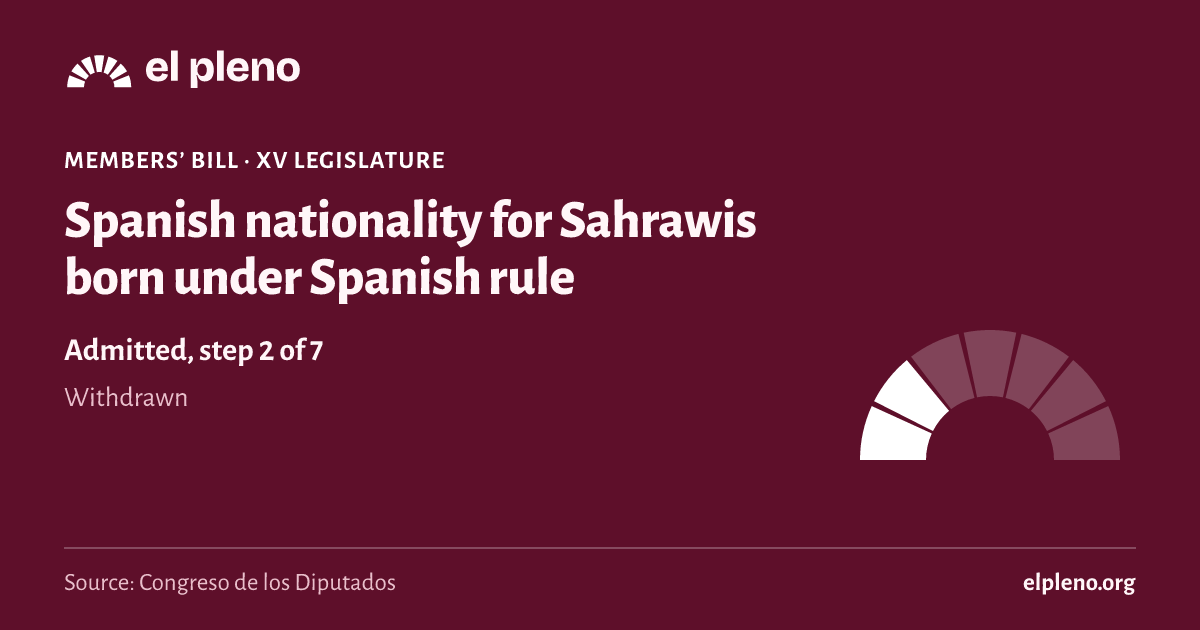
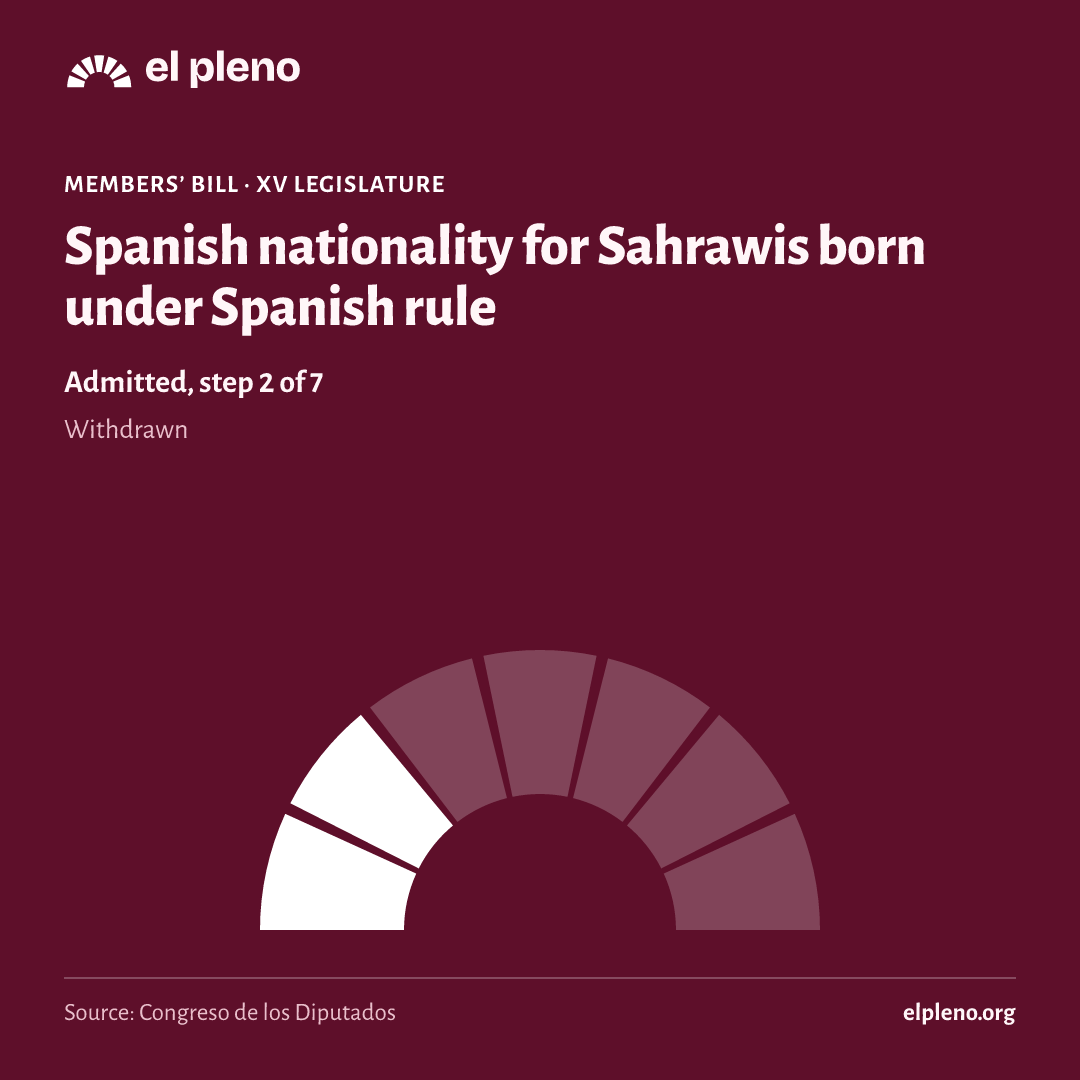
It took 2 of 7 steps. It reached Admitted, and today it is withdrawn.
- Introduced30 November 2023Someone registers the text in the Congreso.
- Admitted5 December 2023The Bureau of the Congreso accepts it and, for a members’ bill, the plenary decides whether to consider it.
- Amendmentsnot reachedGroups propose changes.
- Committeenot reachedA committee goes through the text in detail.
- Plenarynot reachedAll 350 deputies vote.
- Senatenot reachedThe Senate can pass it, amend it or veto it.
- BOEnot reachedIt is published in the Official State Gazette (BOE) and comes into force.
See the 6 official steps on a timeline
Was there a plenary vote?
We have no plenary vote linked to this law in the Congreso’s data.
What happens next
What happens now?
Whoever introduced it withdrew it, or it was merged into another one. It goes no further.
Sources
Where does all this come from?
- Congreso de los Diputados, file 122/000023
Official title, type, author, dates and stage.
Retrieved 11 November 2026
- Congreso de los Diputados, procedure
The date of each step, with its official wording.
Retrieved 12 November 2026
- The data comes from the open files of the Congreso, the Senate and the BOE, unaltered.
- Each deputy’s province is the one of their seat on the day of the vote.
- We only say “passed” or “rejected” when the majority needed is certain; otherwise we say which side had more votes.