What it is
Rules for fake images and voices made with artificial intelligence
It is a members’ bill. Introduced by parliamentary groups, the Senate, regional governments or citizens. It was introduced on 6 October 2023. Introduced by: Grupo Parlamentario Plurinacional SUMAR.
Official title: Private member's Organic Bill regulating the simulation of images and voices of persons generated by means of artificial intelligence.
Source: Congreso de los Diputados, file 122/000011· updated 11 Nov
Automatic summary, not yet reviewed
- The bill would make it a very serious offense to spread AI-generated images, videos or audio without the affected person's permission, unless they carry a clear warning that they are artificial. If the warning does not meet all legal requirements, the offense would be serious.
- The bill would add a new unlawful intrusion to the law protecting honor and one's own image: spreading AI-generated images or voice recordings without authorization and without a clear warning of their artificial origin.
- The bill would create a new crime of defamation using AI-simulated images or voices, and would treat spreading them on social media as defamation with publicity.
- Affected people could request, as a precautionary measure, the urgent removal of fake images, videos or voices generated with artificial intelligence.
- The bill would ban using artificial images or sounds in advertising without clearly warning about it, and would punish with a fine or three months to one year in prison the malicious spread of altered images or audio of candidates during an election campaign.
- The bill would create two new bodies: a Citizen Participation Council with twelve civil society representatives and an Advisory Council of nine members chosen by the Congress of Deputies (Congreso de los Diputados), to oversee and advise on the use of artificial intelligence.
Who it affects
- People who create or spread AI-generated content: They could not spread simulated images or voices without permission or a clear warning that they are artificial.
- People targeted by fake images or voices: They could request the urgent removal of fake content and claim damages to their honor and image.
- Companies and advertisers: They must clearly and prominently warn about the use of artificial images or sounds in their communications.
- Candidates and parties during election campaigns: Maliciously spreading altered images or audio of candidates during a campaign would be punished.
- Civil society and artificial intelligence experts: They would oversee and advise on the use of artificial intelligence.
Words worth knowing
- Injuria
- A statement or act that harms a person's honor or reputation, punished under the Spanish Criminal Code.
- Medida cautelar
- An urgent court decision protecting someone while a lawsuit is resolved, such as removing content.
- Ley orgánica
- A type of Spanish law reserved for major matters, such as fundamental rights, requiring a special majority in Congress.
- Deepfake
- A very realistic fake video, image or audio created with artificial intelligence that simulates a person's actions or words.
It summarizes the text as it was introduced. It is written by artificial intelligence and may contain mistakes: the official text is what counts. Read the official text · How we make summaries
Where it stands
How far did it get?
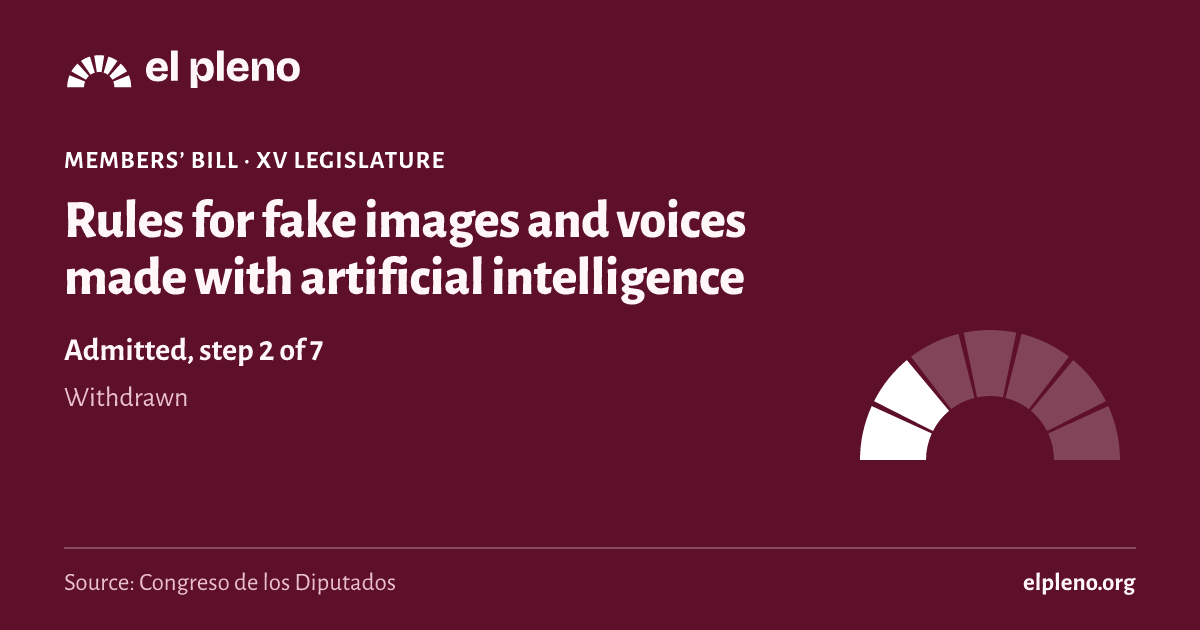
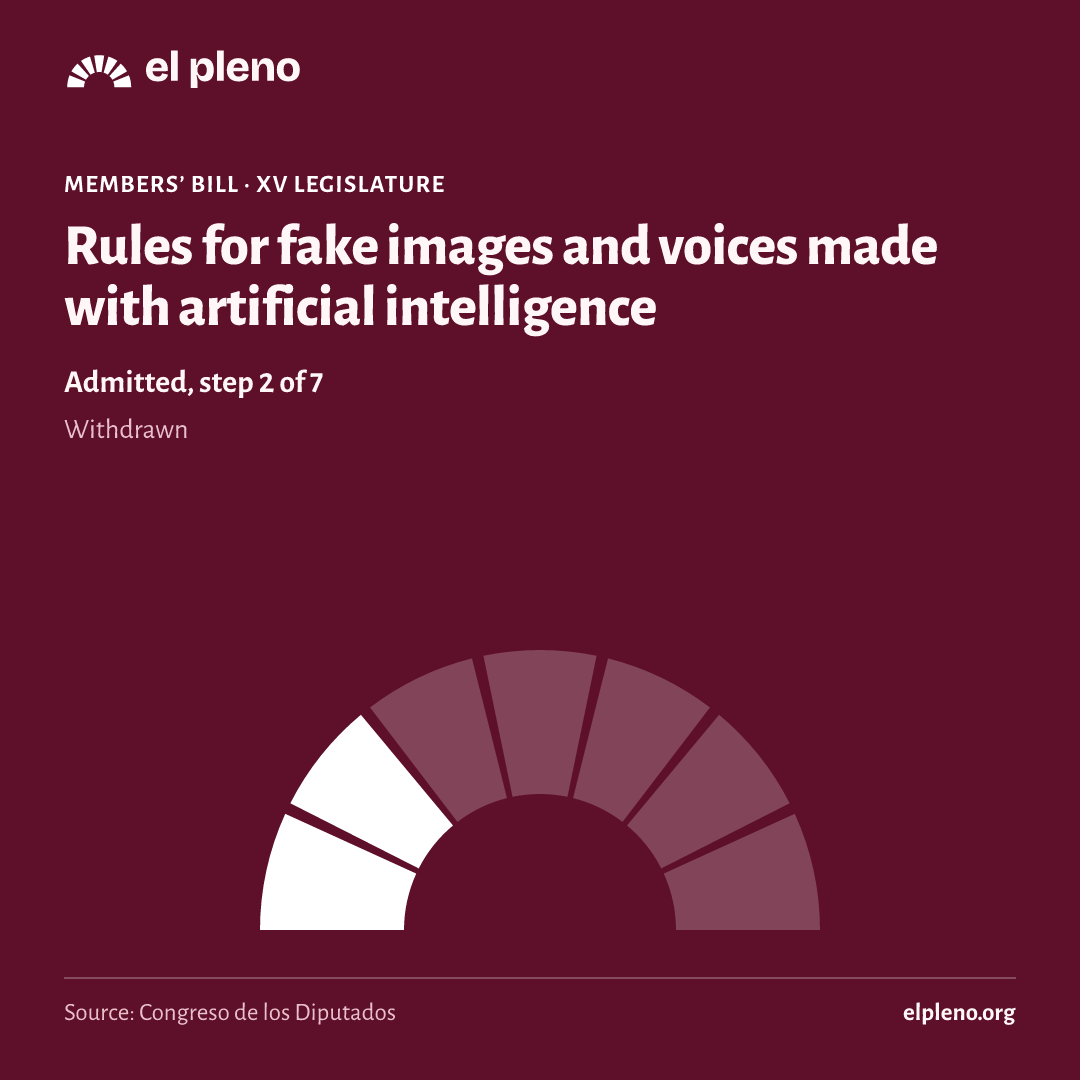
It took 2 of 7 steps. It reached Admitted, and today it is withdrawn.
- Introduced6 October 2023Someone registers the text in the Congreso.
- Admitted10 October 2023The Bureau of the Congreso accepts it and, for a members’ bill, the plenary decides whether to consider it.
- Amendmentsnot reachedGroups propose changes.
- Committeenot reachedA committee goes through the text in detail.
- Plenarynot reachedAll 350 deputies vote.
- Senatenot reachedThe Senate can pass it, amend it or veto it.
- BOEnot reachedIt is published in the Official State Gazette (BOE) and comes into force.
See the 6 official steps on a timeline
Was there a plenary vote?
We have no plenary vote linked to this law in the Congreso’s data.
What happens next
What happens now?
Whoever introduced it withdrew it, or it was merged into another one. It goes no further.
Presented before in:
- XIV Legislature, Congreso de los Diputados· Unfinished Private member's Organic Bill regulating the simulation of images and voices of persons generated by means of artificial intelligence.
Sources
Where does all this come from?
- Congreso de los Diputados, file 122/000011
Official title, type, author, dates and stage.
Retrieved 11 November 2026
- Congreso de los Diputados, procedure
The date of each step, with its official wording.
Retrieved 12 November 2026
- The data comes from the open files of the Congreso, the Senate and the BOE, unaltered.
- Each deputy’s province is the one of their seat on the day of the vote.
- We only say “passed” or “rejected” when the majority needed is certain; otherwise we say which side had more votes.