What it is
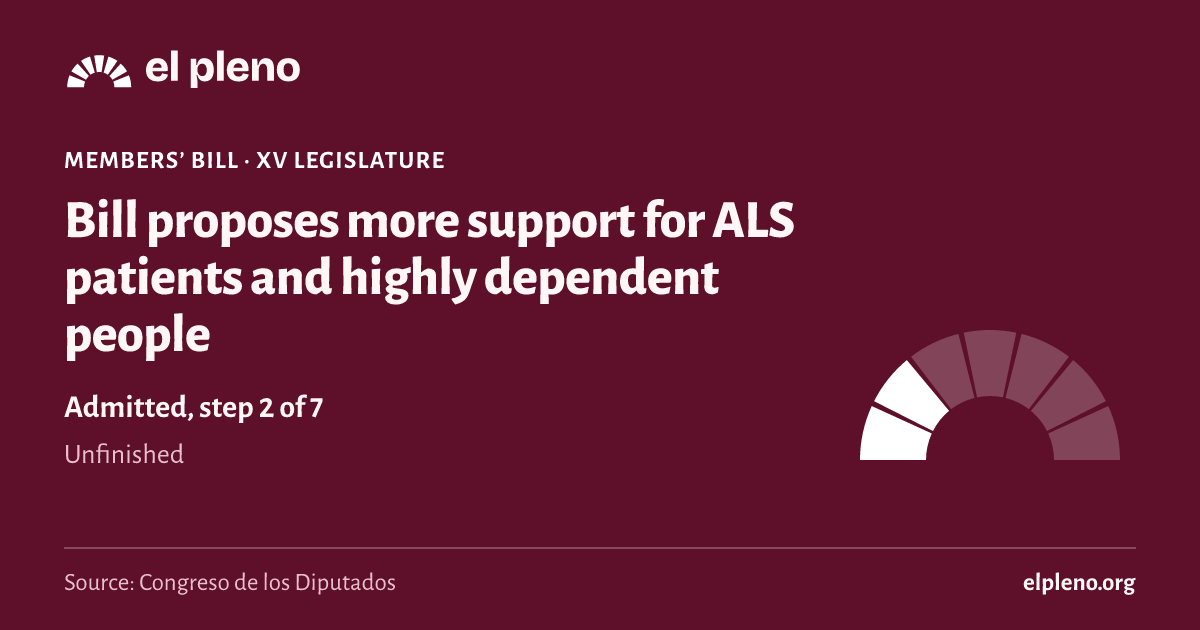
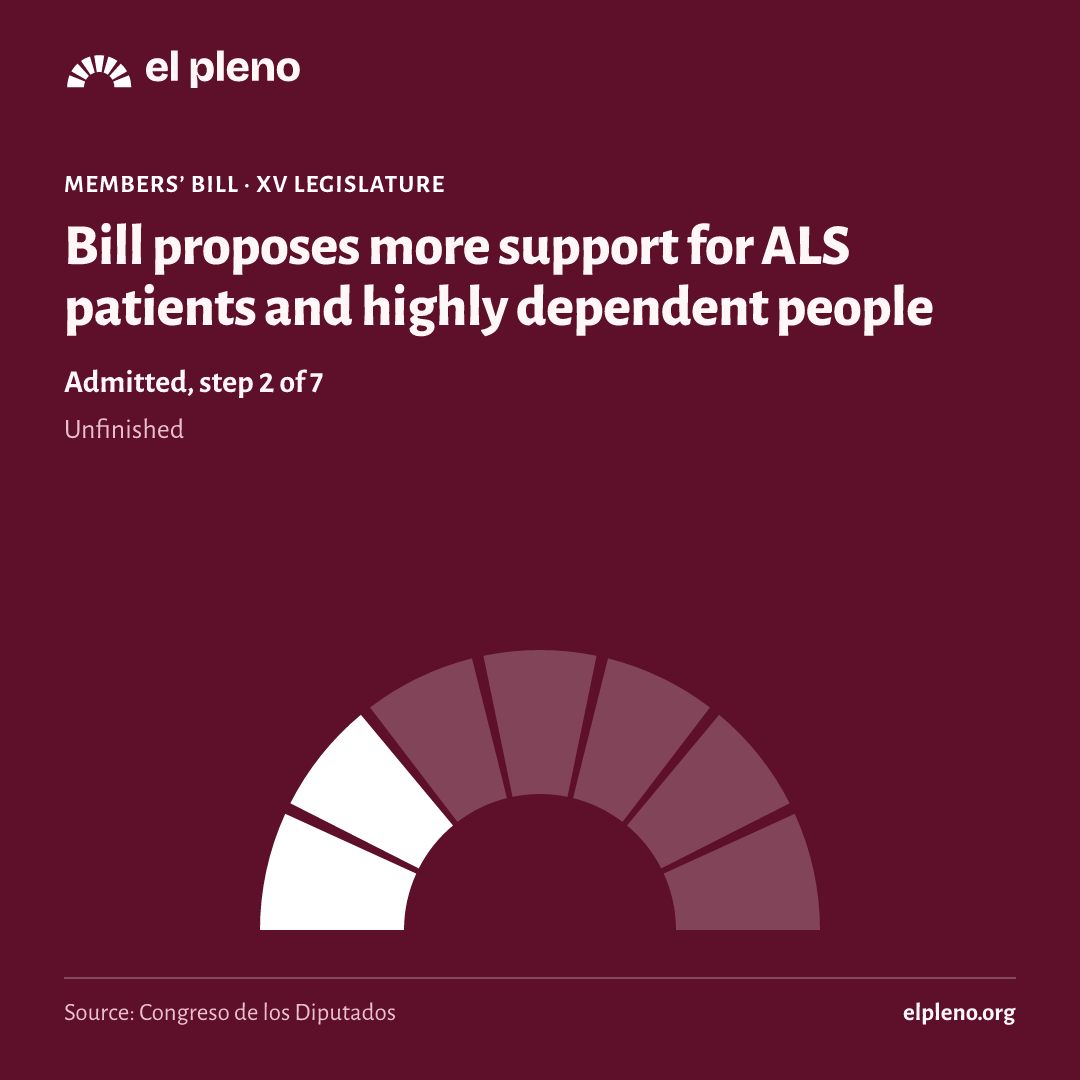
Bill proposes more support for ALS patients and highly dependent people
It is a members’ bill. Introduced by parliamentary groups, the Senate, regional governments or citizens. It was introduced on 4 October 2023. Introduced by: Grupo Parlamentario VOX.
Official title: Private member's bill for comprehensive care for patients with Amyotrophic Lateral Sclerosis (ALS) and other persons in a situation of great dependency.
Source: Congreso de los Diputados, file 122/000008· updated 11 Nov
Automatic summary, not yet reviewed
- The bill proposes better care for people in situations of severe dependency, such as ALS patients. The text explains that an earlier bill seemed to have support from all groups but was stalled through 49 extensions of the amendment deadline.
- It would amend the 2006 dependency law to require equal treatment across the country, speed up assessments and paperwork, and match cash benefits to beneficiaries' real costs. It would also expand home help services to include nursing and physiotherapy.
- It would amend the general law on the rights of persons with disabilities. People in severe dependency would be treated as having a disability of 33 percent or more if they have a medical report, even without official recognition, and would get priority in procedures.
- It would amend a royal decree-law A rule with the force of law that the Government passes because it is urgent. It applies from its publication, but the Congreso must validate it within 30 days or it lapses. on energy so that people in severe dependency automatically receive the electricity social bonus, without checking their income.
- Within three months, the Government would have to add to the National Health System the transport and lodging of patients in severe dependency and their relatives or caregivers when they must travel to another province for treatment.
- Also within three months, the Government would have to add home nursing and physiotherapy to the catalog of benefits of the dependency system.
Who it affects
- People with ALS and others in situations of severe dependency: They would receive more support, with shorter waits and no differences based on where they live.
- Families and caregivers: They would get financial support and services such as home help, nursing and physiotherapy.
- People with severe dependency who travel to another province for treatment: Their transport and lodging, and that of their companions, would be covered.
- Households with severe dependency and high electricity bills: They would automatically get the electricity social bonus.
Words worth knowing
- ELA
- Amyotrophic lateral sclerosis (ALS), a nervous system disease that causes progressive loss of movement, the ability to eat and breathing.
- SAAD
- Sistema para la Autonomía y Atención a la Dependencia, the public support system for dependent people, run by the State and the autonomous communities.
- Bono social de electricidad
- Electricity social bonus, a discount on the power bill for low-income or vulnerable households.
- IPREM
- Indicador Público de Renta de Efectos Múltiples, a reference income figure used to decide who qualifies for certain benefits.
- Proposición de ley
- A bill introduced by a parliamentary group. It is not a law until approved by the Congress and the Senate.
- royal decree-law
- A rule with the force of law that the Government passes because it is urgent. It applies from its publication, but the Congreso must validate it within 30 days or it lapses.
- decree-law
- A rule with the force of law that the Government passes because it is urgent. It applies from its publication, but the Congreso must validate it within 30 days or it lapses.
It summarizes the text as it was introduced. It is written by artificial intelligence and may contain mistakes: the official text is what counts. Read the official text · How we make summaries
Where it stands
How far did it get?
It took 2 of 7 steps. It reached Admitted, and today it is unfinished.
- Introduced4 October 2023Someone registers the text in the Congreso.
- Admitted10 October 2023The Bureau of the Congreso accepts it and, for a members’ bill, the plenary decides whether to consider it.
- Amendmentsnot reachedGroups propose changes.
- Committeenot reachedA committee goes through the text in detail.
- Plenarynot reachedAll 350 deputies vote.
- Senatenot reachedThe Senate can pass it, amend it or veto it.
- BOEnot reachedIt is published in the Official State Gazette (BOE) and comes into force.
See the 5 official steps on a timeline
Was there a plenary vote?
We have no plenary vote linked to this law in the Congreso’s data.
What happens next
What happens now?
The legislature ended before it finished. To go on, someone would have to introduce it again in the new Cortes.
It has not been presented again yet.
Sources
Where does all this come from?
- Congreso de los Diputados, file 122/000008
Official title, type, author, dates and stage.
Retrieved 11 November 2026
- Congreso de los Diputados, procedure
The date of each step, with its official wording.
Retrieved 12 November 2026
- The data comes from the open files of the Congreso, the Senate and the BOE, unaltered.
- Each deputy’s province is the one of their seat on the day of the vote.
- We only say “passed” or “rejected” when the majority needed is certain; otherwise we say which side had more votes.