What it is
Tax aid for La Palma and regional government investments
Amendments step 3 of 7· LapsedIt is a government bill. Introduced by the Government. It was introduced on 23 September 2026. Introduced by: Gobierno.
Official title: Government bill adopting urgent fiscal and financial measures that contribute to the economic and social reconstruction of the island of La Palma, as well as measures aimed at promoting the execution of investments by the autonomous communities that have recorded budget surpluses and pending financing excesses from previous years prior to 2026 (originating from Royal Decree-Law 23/2026, of September 8).
Source: Congreso de los Diputados, file 121/000115· updated 11 Nov
Automatic summary, not yet reviewed
- The bill would extend to tax year 2026 the personal income tax deduction already applied to residents of La Palma, the same as the deduction for income in Ceuta and Melilla, effective January 1, 2026.
- Regional governments with debt below 12.4% of their regional GDP at the end of 2025 could use their surpluses and excess funding for investments between 2026 and 2028. The Canary Islands could additionally use €100 million for aid to those affected by the La Palma volcanic eruption.
- Regional governments with a 2025 surplus could use it in 2026 and 2027 for financially sustainable investments, such as social housing or projects with positive effects on climate change or energy efficiency.
- Debtors in El Paso, Los Llanos de Aridane and Tazacorte listed in the registry of people affected, whose income comes mainly from farming, could request until October 15, 2026 a new six-month suspension of interest and principal payments on loans and credits, from October 1, 2026 to March 31, 2027.
- New rules would apply for self-employed workers affected by the eruption to access the extraordinary benefit for business closure: POSEI program subsidies would not count as income, and those who started their activity in 2020 could use that year as the reference instead of 2019.
- An extraordinary credit of €16,840,943.24 would be granted to carry out the agreement of the Joint Commission on the Economic Agreement with the Basque Country of July 9, 2026, with up to €32,381,095.67 planned for 2027. Aid to economic activities must follow European Union state aid rules.
Who it affects
- People with habitual residence in La Palma: Could apply the income tax deduction similar to the one for Ceuta and Melilla in 2026.
- Farmers in El Paso, Los Llanos de Aridane and Tazacorte listed in the registry of affected people: Could request a new six-month suspension of loan interest and principal payments.
- Self-employed workers affected by the Cumbre Vieja eruption: Would have new rules to access the extraordinary benefit for business closure.
- Regional governments with surpluses or low debt: Could use those funds for investments between 2026 and 2028, and the Canary Islands for eruption aid.
- Basque Country regional government: Would receive the payments set out in the Joint Commission agreement of July 9, 2026.
Words worth knowing
- IRPF
- Spanish personal income tax, paid on earnings from work and other sources.
- Deducción
- An amount subtracted from the tax you owe, in this case for living in La Palma.
- Superávit presupuestario
- A budget surplus, when a government takes in more money than it spends in a year.
- Prestación por cese de actividad
- A benefit payment for self-employed workers who can no longer work for a recognized reason.
- Ayudas de Estado
- State aid, public support that must follow European Union rules so it does not distort competition.
It summarizes the text as it was introduced. It is written by artificial intelligence and may contain mistakes: the official text is what counts. Read the official text · How we make summaries
Where it stands
How far did it get?
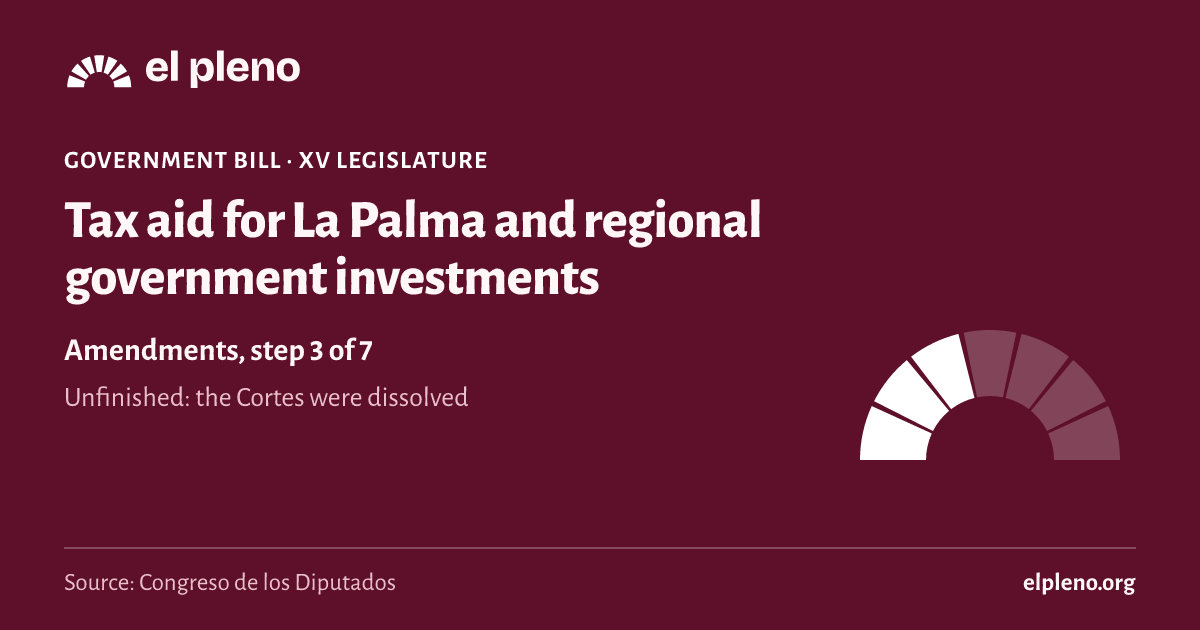
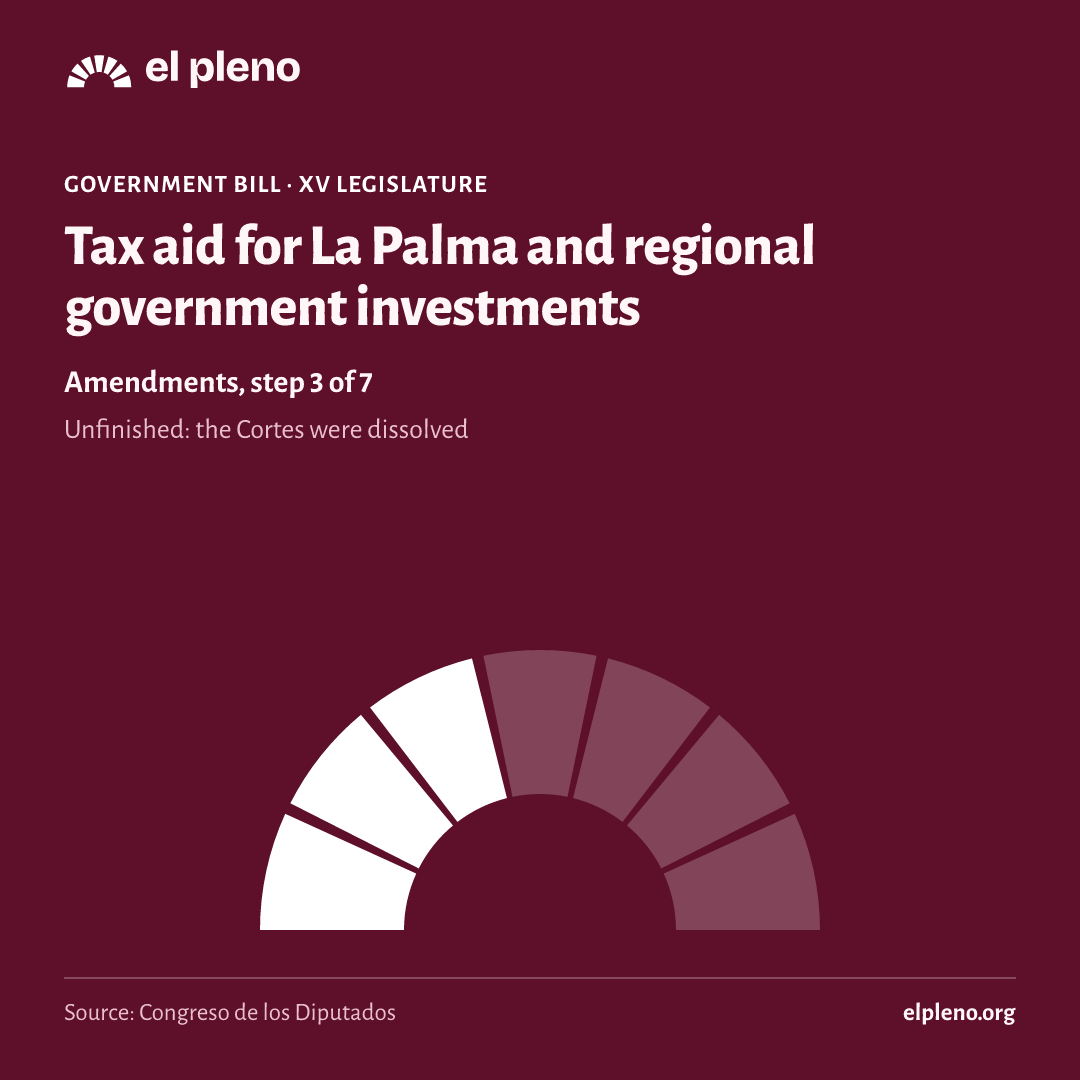
It took 3 of 7 steps. It reached Amendments, and today it is lapsed.
- Introduced23 September 2026Someone registers the text in the Congreso.
- Admitted29 September 2026The Bureau of the Congreso accepts it and, for a members’ bill, the plenary decides whether to consider it.
- Amendments2 October 2026Groups propose changes.
- Committeenot reachedA committee goes through the text in detail.
- Plenarynot reachedAll 350 deputies vote.
- Senatenot reachedThe Senate can pass it, amend it or veto it.
- BOEnot reachedIt is published in the Official State Gazette (BOE) and comes into force.
See the 5 official steps on a timeline
Was there a plenary vote?
We have no plenary vote linked to this law in the Congreso’s data.
What happens next
What happens now?
The legislature ended before it finished. To go on, someone would have to introduce it again in the new Cortes.
Sources
Where does all this come from?
- Congreso de los Diputados, file 121/000115
Official title, type, author, dates and stage.
Retrieved 11 November 2026
- Congreso de los Diputados, procedure
The date of each step, with its official wording.
Retrieved 12 November 2026
- The data comes from the open files of the Congreso, the Senate and the BOE, unaltered.
- Each deputy’s province is the one of their seat on the day of the vote.
- We never say “passed” because of a vote: the files do not say which majority was needed.