What it is
Bill proposes economic aid and stronger public services for Ceuta
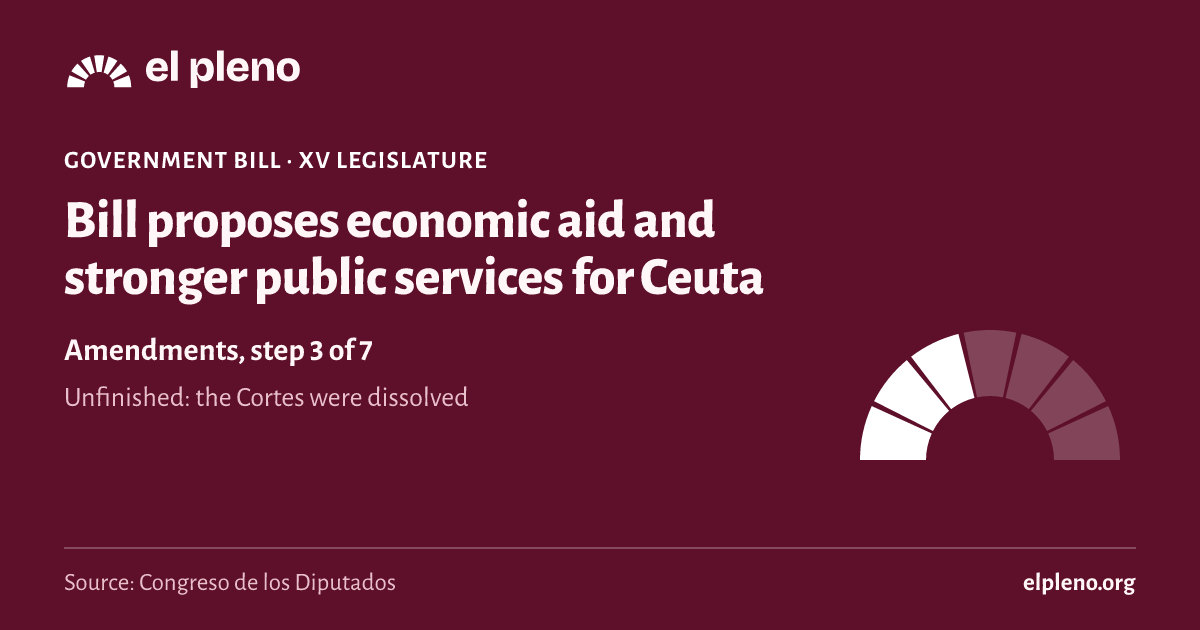
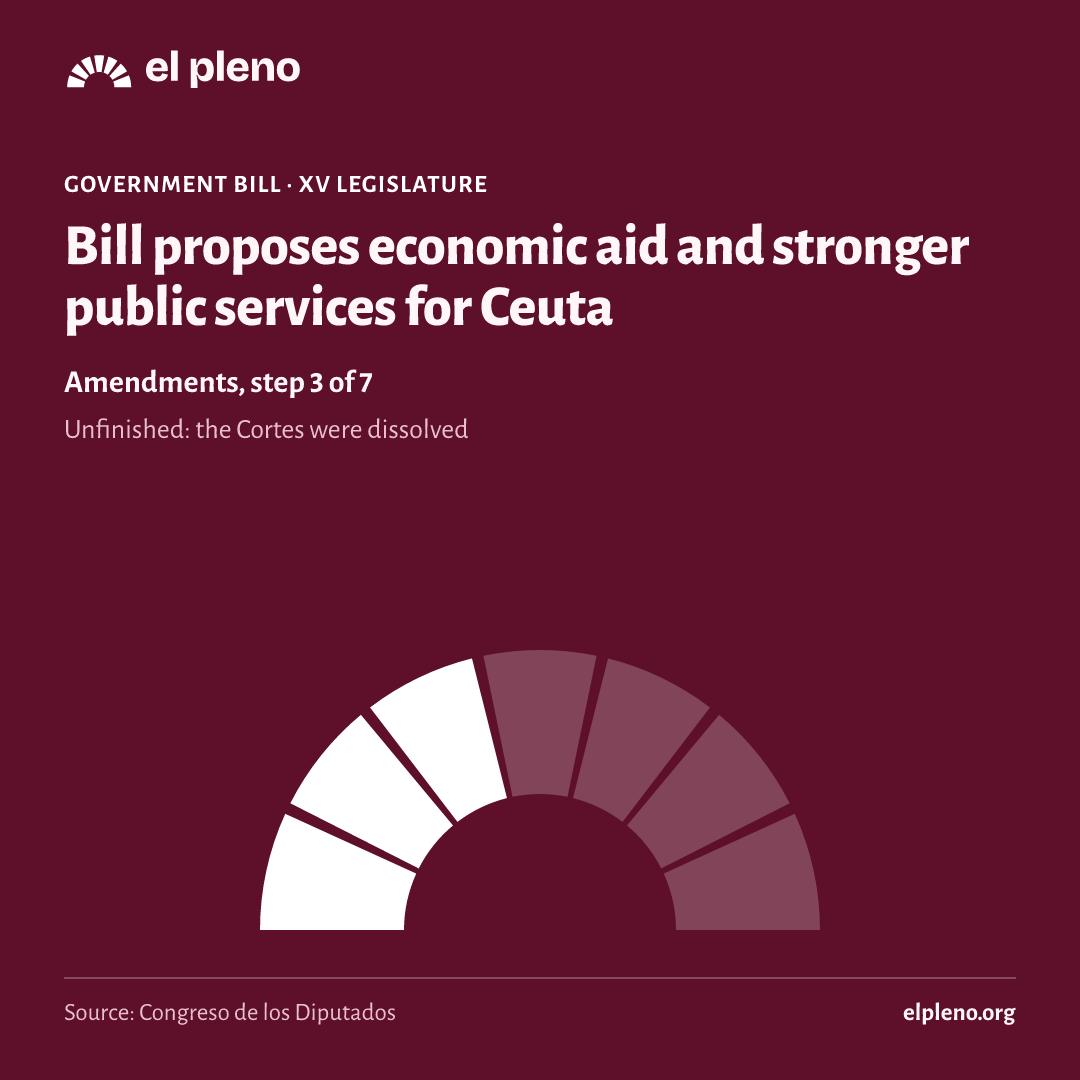
Amendments step 3 of 7· LapsedIt is a government bill. Introduced by the Government. It was introduced on 16 September 2026. Introduced by: Gobierno.
Official title: Government bill approving urgent social and economic measures of support for the city of Ceuta (originating from Royal Decree-Law 22/2026, of September 1).
Source: Congreso de los Diputados, file 121/000114· updated 11 Nov
Automatic summary, not yet reviewed
- The bill would create direct aid for companies and self-employed workers in Ceuta: €5,000 for the self-employed and between €10,000 and €150,000 for companies, depending on their revenue. Applications would be filed on the Tax Agency's electronic office until November 30, 2026, and the aid would be exempt from personal income tax and corporate tax.
- The corporate tax credit for income obtained in Ceuta and Melilla would rise from 50% to 60%, and the limits for considering income as obtained there would be expanded: €60,000 per full-time employee, up to 20 employees, and €120,000 per employee during the first two fiscal years.
- The bill would allocate €14 million to the Official Chamber of Commerce of Ceuta to fund vouchers, promotion campaigns and support for retail, hospitality and tourism, in two tranches for commerce and two for tourism and hospitality.
- A State-backed guarantee line of up to €50 million would be approved, managed by the ICO, so that banks and credit institutions can lend to companies and self-employed workers in Ceuta. Operations formalized through December 31, 2026 could be covered.
- €2 million would be injected into the technical provisions fund of a mutual guarantee society, chosen through competitive tender, so that SMEs and the self-employed in Ceuta have guarantees to access credit, something the city currently lacks.
- The bill provides budget allocations to strengthen reception and public services: €39.5 million for humanitarian aid to migrants, €62.9 million for unaccompanied minors, €3.5 million for health care (INGESA), and supplements for the National Police, Civil Guard, Defense, Justice and the Immigration Office.
- Self-employed workers in Ceuta who lose at least 50% of their income could apply for an extraordinary cessation-of-activity benefit, at 70% of the regulatory base and for up to four months. They could also defer Social Security payments at a reduced 0.5% interest rate.
- Companies in Ceuta with temporary layoff plans (ERTEs) caused by these events would be exempt from 100% of the employer's Social Security contributions from September to December 2026, and suspensions would be treated as force majeure, with no waiting period for unemployment benefits.
Who it affects
- Companies and self-employed workers in Ceuta: They would receive direct aid, guarantees, tax breaks and exemptions from Social Security contributions.
- Migrants in Ceuta: Humanitarian aid, shelter and processing of international protection applications would be strengthened.
- Unaccompanied foreign minors: Extra budget allocations and grants to organizations such as Save the Children and UNHCR would fund their care.
- Employees in Ceuta: If their contracts are suspended or their hours reduced, they would receive unemployment benefits as if it were force majeure, with no waiting period.
- Retail, hospitality and tourism in Ceuta: Vouchers, campaigns and promotion programs would be funded through the Chamber of Commerce.
Words worth knowing
- Real decreto-ley (royal decree-law)
- A rule with the rank of law that the Government can approve urgently, without first going through the full parliamentary process. Congress must later validate it.
- Expediente de regulación temporal de empleo (ERTE)
- A procedure by which a company temporarily suspends contracts or reduces working hours, usually with unemployment protection for workers.
- Sociedad de garantía recíproca (mutual guarantee society)
- An entity that provides guarantees (sureties) to small companies and self-employed workers so banks will lend them money.
- Convalidación (validation)
- A vote by Congress approving a royal decree-law already issued by the Government; if not validated, it stops having effect.
- Bonificación (credit or rebate)
- A discount or reduction applied to a tax or to contributions due.
It summarizes the text as it was introduced. It is written by artificial intelligence and may contain mistakes: the official text is what counts. Read the official text · How we make summaries
Where it stands
How far did it get?
It took 3 of 7 steps. It reached Amendments, and today it is lapsed.
- Introduced16 September 2026Someone registers the text in the Congreso.
- Admitted22 September 2026The Bureau of the Congreso accepts it and, for a members’ bill, the plenary decides whether to consider it.
- Amendments25 September 2026Groups propose changes.
- Committeenot reachedA committee goes through the text in detail.
- Plenarynot reachedAll 350 deputies vote.
- Senatenot reachedThe Senate can pass it, amend it or veto it.
- BOEnot reachedIt is published in the Official State Gazette (BOE) and comes into force.
See the 5 official steps on a timeline
Was there a plenary vote?
We have no plenary vote linked to this law in the Congreso’s data.
What happens next
What happens now?
The legislature ended before it finished. To go on, someone would have to introduce it again in the new Cortes.
Sources
Where does all this come from?
- Congreso de los Diputados, file 121/000114
Official title, type, author, dates and stage.
Retrieved 11 November 2026
- Congreso de los Diputados, procedure
The date of each step, with its official wording.
Retrieved 12 November 2026
- The data comes from the open files of the Congreso, the Senate and the BOE, unaltered.
- Each deputy’s province is the one of their seat on the day of the vote.
- We never say “passed” because of a vote: the files do not say which majority was needed.