What it is
Bill proposes job and social protections for wildfire victims
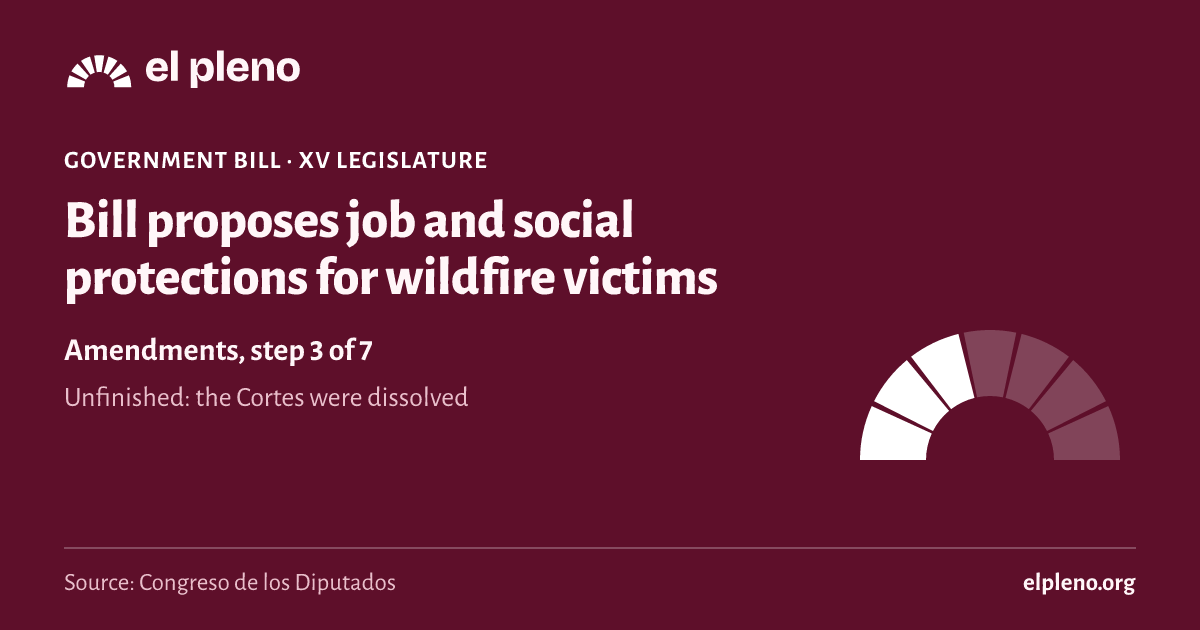
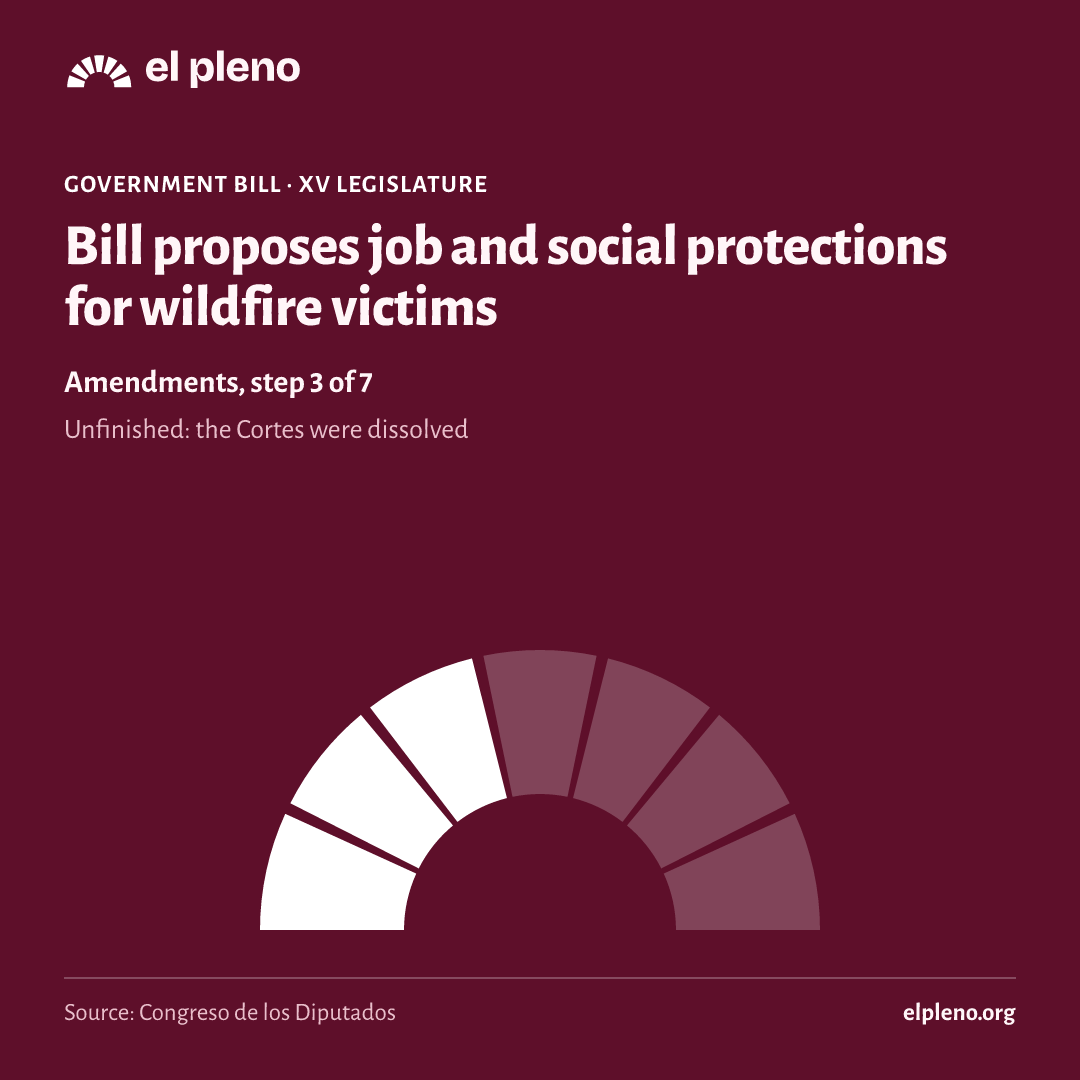
Amendments step 3 of 7· LapsedIt is a government bill. Introduced by the Government. It was introduced on 9 September 2026. Introduced by: Gobierno.
Official title: Government bill establishing urgent labor and social protection measures against forest fires (originating from Royal Decree-Law 20/2026, of July 29).
Source: Congreso de los Diputados, file 121/000113· updated 11 Nov
Automatic summary, not yet reviewed
- The bill would allow workers affected by the wildfires to suspend their employment contract and receive an extraordinary emergency benefit, similar to unemployment pay, in situations such as being unable to reach their home, having to clean or repair their housing, or caring for affected relatives.
- The benefit would pay 70 % of the calculation base, last at most four months, require no minimum prior contributions, and would not use up contributions already made.
- The paid leave for the death of a family member would be extended to up to five working days after the funeral when the death is related to the wildfires.
- Self-employed workers who stop their activity because of the wildfires could claim the cessation-of-activity benefit without proving a minimum contribution period or force majeure, for up to four months.
- Companies in affected municipalities with a temporary layoff plan (ERTE) could be fully exempt from their Social Security contributions for workers whose activity is suspended or reduced, from August to November 2026.
- Court deadlines would be suspended from July 27 to 31, 2026 in seven affected judicial districts, and notaries and property registrars would offer free services to recover lost documents.
Who it affects
- Employees in municipalities affected by the wildfires: They could suspend their contract and receive the extraordinary benefit without losing job rights.
- Self-employed workers in the affected areas: They could receive the cessation-of-activity benefit without the usual contribution requirements.
- Companies in affected municipalities: They could request Social Security contribution exemptions if they have a temporary layoff plan (ERTE).
- People in the included judicial districts: Their court deadlines would be suspended and they would get free notarial and registry help.
- Public sector employees: The situations in Artículo 2 would count as force majeure to justify absences.
Words worth knowing
- Prestación por emergencia extrema
- An unemployment-like payment a worker would receive while their contract is suspended because of the wildfires.
- ERTE (expediente de regulación temporal de empleo)
- A Spanish procedure allowing a company to temporarily suspend or reduce its employees' work.
- Cese de actividad
- The situation of a self-employed worker who stops working, fully or partially, and can claim an unemployment-like benefit.
- Plazos procesales
- Court deadlines for legal steps such as filing lawsuits or appeals.
- Prescripción y caducidad
- Loss of the right to make a claim when too much time passes without exercising it.
It summarizes the text as it was introduced. It is written by artificial intelligence and may contain mistakes: the official text is what counts. Read the official text · How we make summaries
Where it stands
How far did it get?
It took 3 of 7 steps. It reached Amendments, and today it is lapsed.
- Introduced9 September 2026Someone registers the text in the Congreso.
- Admitted15 September 2026The Bureau of the Congreso accepts it and, for a members’ bill, the plenary decides whether to consider it.
- Amendments18 September 2026Groups propose changes.
- Committeenot reachedA committee goes through the text in detail.
- Plenarynot reachedAll 350 deputies vote.
- Senatenot reachedThe Senate can pass it, amend it or veto it.
- BOEnot reachedIt is published in the Official State Gazette (BOE) and comes into force.
See the 5 official steps on a timeline
Was there a plenary vote?
We have no plenary vote linked to this law in the Congreso’s data.
What happens next
What happens now?
The legislature ended before it finished. To go on, someone would have to introduce it again in the new Cortes.
Sources
Where does all this come from?
- Congreso de los Diputados, file 121/000113
Official title, type, author, dates and stage.
Retrieved 11 November 2026
- Congreso de los Diputados, procedure
The date of each step, with its official wording.
Retrieved 12 November 2026
- The data comes from the open files of the Congreso, the Senate and the BOE, unaltered.
- Each deputy’s province is the one of their seat on the day of the vote.
- We never say “passed” because of a vote: the files do not say which majority was needed.