What it is
Bill would expand smoke-free spaces and regulate vaping
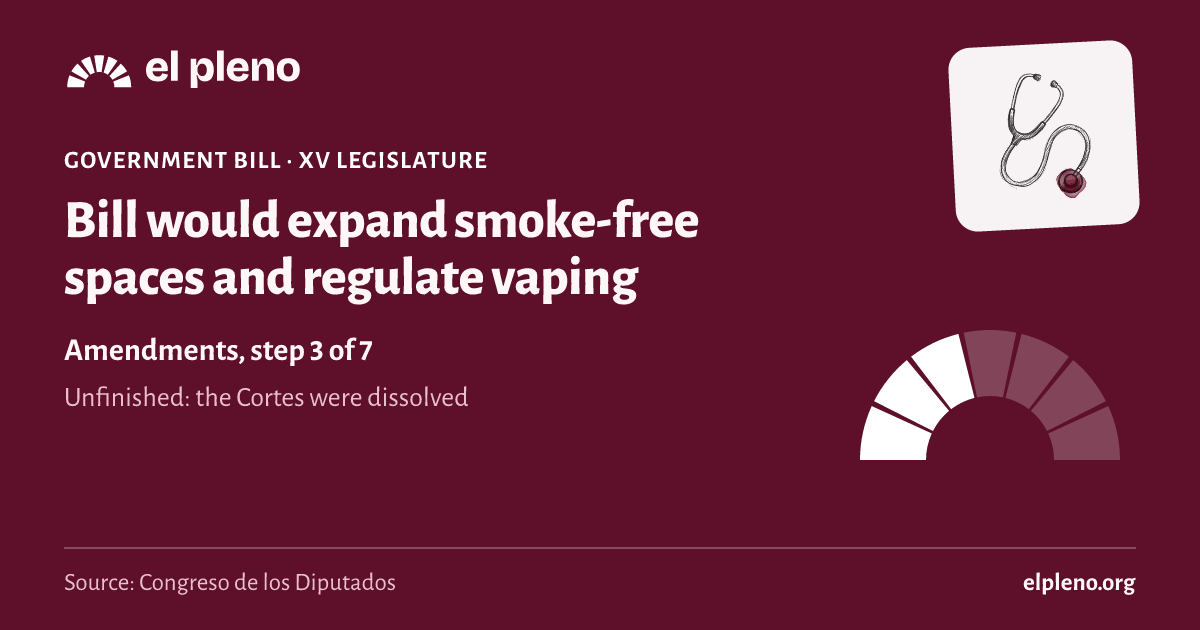
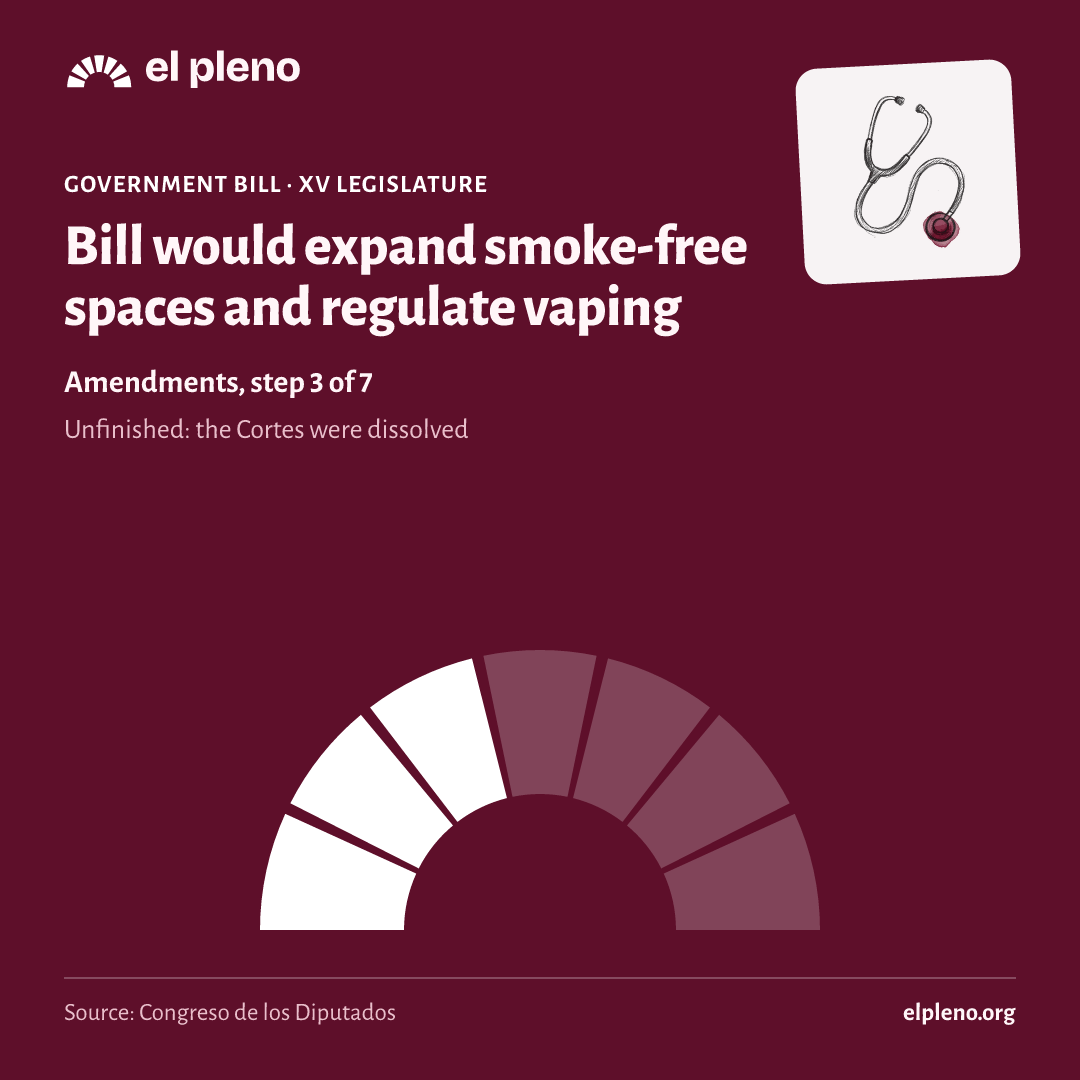
Amendments step 3 of 7· LapsedIt is a government bill. Introduced by the Government. It was introduced on 24 July 2026. Introduced by: Gobierno.
Official title: Government bill amending Law 28/2005, of December 26, on health measures against tobacco and regulating the sale, supply, consumption and advertising of tobacco products.
Source: Congreso de los Diputados, file 121/000110· updated 11 Nov
Automatic summary, not yet reviewed
- The bill would update the 2005 anti-smoking law to cover related products, such as e-cigarettes and nicotine pouches, and the devices used to consume them.
- It would ban smoking and tobacco use for people under 18 and greatly expand smoke-free spaces: outdoor areas of bars and restaurants, beaches, playgrounds, shared pools, concerts, open-air bus stations, and vehicles for hire with driver, among others. It would also ban use within 15 meters of the entrances of health, education and sports centers and playgrounds.
- It would extend the ban on advertising, promotion and sponsorship to e-cigarettes and other related products in all media, with very limited exceptions, such as publications for professionals or promotion inside tobacco shops and specialized stores.
- Related tobacco products could only be sold in specialized stores, a new type of shop that must meet requirements set by ministerial order, including a minimum share of sales from these products.
- Fines would rise: minor offenses from €200 to €600, serious ones from €601 to €10,000, and very serious ones from €10,001 to €600,000. Smoking occasionally in a banned place would carry a fine of up to €200.
- It would recreate the Observatory for Smoking Prevention, which had been abolished, and the law would enter into force twenty days after publication in the Official State Gazette.
Who it affects
- People under 18: They could not smoke or use tobacco or related products, and could not buy them.
- Bars, restaurants and entertainment venues: They could not allow smoking on their terraces or at beaches, concerts and other newly covered outdoor spaces.
- Tobacco shops and stores selling tobacco or vaping products: They could only sell related products in specialized stores and would face new signage duties.
- Manufacturers and advertisers of tobacco and related products: All advertising, promotion and sponsorship of these products would be banned, with very limited exceptions.
- The general public and nonsmokers: They could request the cessation of unlawful advertising and benefit from the new smoke-free spaces.
Words worth knowing
- Productos relacionados (related products)
- Products that contain no tobacco but are used like it or imitate it: e-cigarettes with or without nicotine, nicotine pouches, or herbal smoking products.
- Entornos de protección reforzada (reinforced protection areas)
- Special places, such as health or education centers, where use is also banned within 15 meters of their entrances.
- Tienda especializada (specialized store)
- A shop authorized to sell tobacco-related products, which must meet requirements set by ministerial order.
- Cesación tabáquica (smoking cessation)
- Quitting smoking. The law refers to programs that help people stop using tobacco.
- Proyecto de ley (bill)
- A text proposed by the Government and being processed in Congress; it is not yet an approved law.
It summarizes the text as it was introduced. It is written by artificial intelligence and may contain mistakes: the official text is what counts. Read the official text · How we make summaries
Where it stands
How far did it get?
It took 3 of 7 steps. It reached Amendments, and today it is lapsed.
- Introduced24 July 2026Someone registers the text in the Congreso.
- Admitted8 September 2026The Bureau of the Congreso accepts it and, for a members’ bill, the plenary decides whether to consider it.
- Amendments11 September 2026Groups propose changes.
- Committeenot reachedA committee goes through the text in detail.
- Plenarynot reachedAll 350 deputies vote.
- Senatenot reachedThe Senate can pass it, amend it or veto it.
- BOEnot reachedIt is published in the Official State Gazette (BOE) and comes into force.
See the 5 official steps on a timeline
Was there a plenary vote?
We have no plenary vote linked to this law in the Congreso’s data.
What happens next
What happens now?
The legislature ended before it finished. To go on, someone would have to introduce it again in the new Cortes.
Sources
Where does all this come from?
- Congreso de los Diputados, file 121/000110
Official title, type, author, dates and stage.
Retrieved 11 November 2026
- Congreso de los Diputados, procedure
The date of each step, with its official wording.
Retrieved 12 November 2026
- The data comes from the open files of the Congreso, the Senate and the BOE, unaltered.
- Each deputy’s province is the one of their seat on the day of the vote.
- We never say “passed” because of a vote: the files do not say which majority was needed.