What it is
Bill on partial retirement for public staff and Balearic Islands pay
Amendments step 3 of 7· LapsedIt is a government bill. Introduced by the Government. It was introduced on 23 July 2026. Introduced by: Gobierno.
Official title: Government bill on urgent measures regarding early partial retirement of staff of the Public Administrations and insularity supplement in Illes Balears (originating from Royal Decree-Law 19/2026, of June 29).
Source: Congreso de los Diputados, file 121/000108· updated 11 Nov
Automatic summary, not yet reviewed
- The bill would set rules so that public administration staff can take partial retirement despite the requirement of a simultaneous relief contract. It creates a gradual system: first use the public employment offer, and only if that is not possible, hire temporary replacement staff.
- If the permanent relief worker's contract (or the temporary one) ends before two years have passed since the partially retired worker moves to full retirement, temporary staff may be hired to meet that deadline.
- To certify the relief arrangement, the personnel body will issue a certificate identifying the person retiring and the relief worker. Also, relief hires will not require being unemployed or holding a temporary contract.
- Until April 1, 2027, partial retirement could be linked to a permanent full-time contract signed from April 1, 2024 onward through ordinary public employment offer openings.
- The Government would review, within six months, the residence allowances of state public sector staff assigned to the Illes Balears, after collective bargaining. Current amounts could not be reduced.
- The rule would take effect the day after its publication in the Official State Gazette (Boletín Oficial del Estado).
Who it affects
- Public administration staff seeking partial retirement.: They would have specific rules to meet the relief contract requirement, with temporary flexibility until April 1, 2027.
- People hired as relief or replacement workers.: They could be hired without being unemployed or previously holding a temporary contract.
- State public sector employees assigned to the Illes Balears.: Their residence allowances would be reviewed upward, never downward.
- Public administrations.: They must plan partial retirements in their public employment offer and issue relief certificates.
Words worth knowing
- Contrato de relevo (relief contract)
- A contract by which an employer hires someone to cover the work left open by a person retiring part time.
- Oferta de empleo público (public employment offer)
- The annual list of positions each administration approves to hire staff.
- Indemnización por residencia (residence allowance)
- Extra pay for those working in areas with special conditions, such as islands or a high cost of living.
- Real decreto-ley (royal decree-law)
- A rule with the force of law that the Government can pass urgently and that Congress must later validate.
- Tasa de reposición (replacement rate)
- A legal cap on the new positions an administration can create to replace departing staff.
It summarizes the text as it was introduced. It is written by artificial intelligence and may contain mistakes: the official text is what counts. Read the official text · How we make summaries
Where it stands
How far did it get?
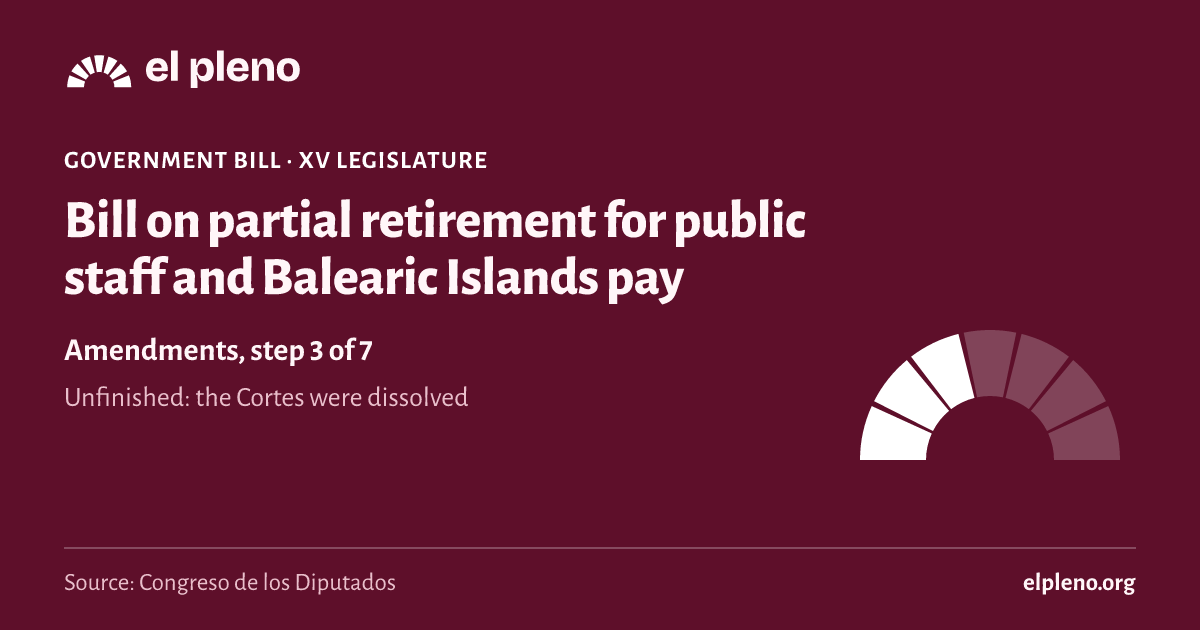
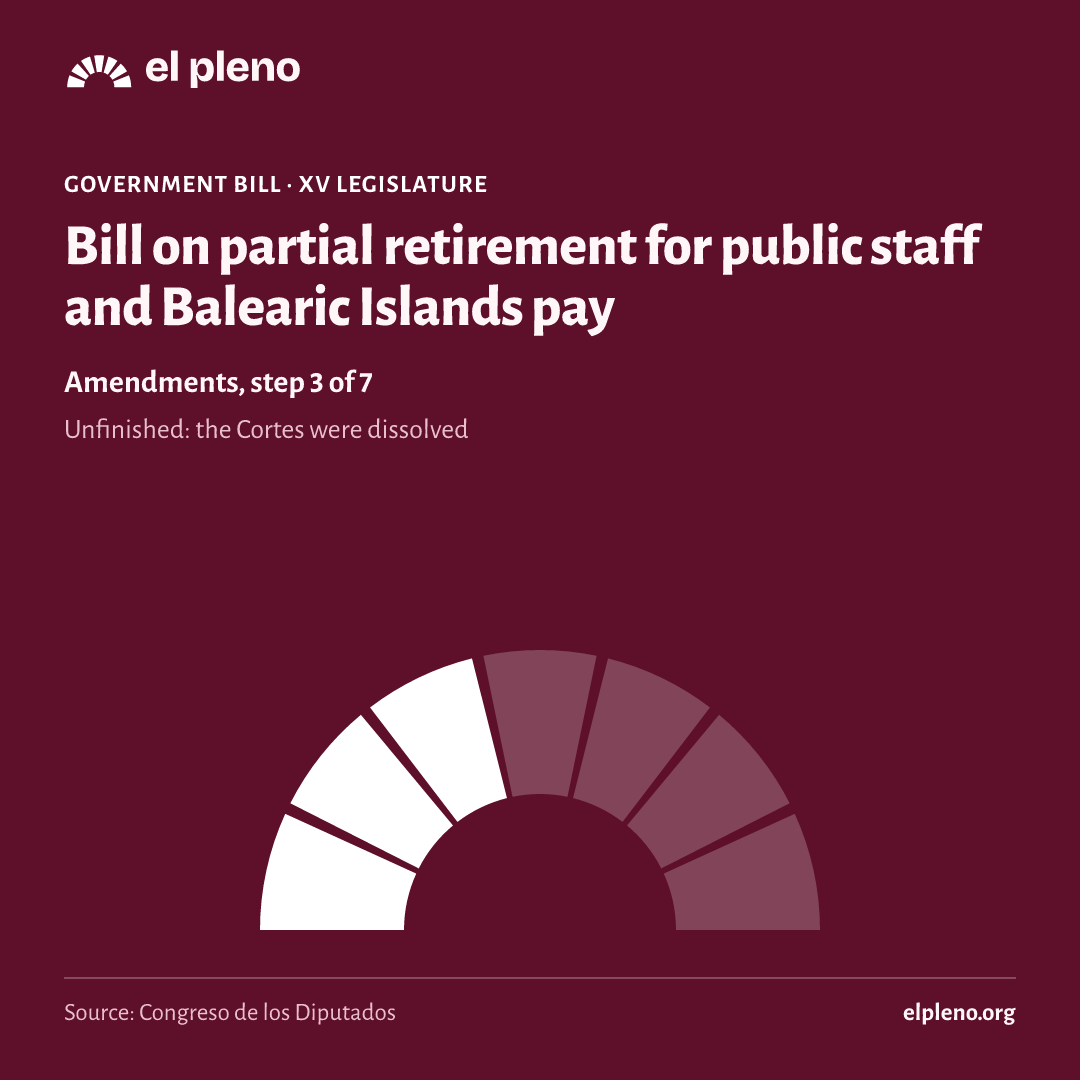
It took 3 of 7 steps. It reached Amendments, and today it is lapsed.
- Introduced23 July 2026Someone registers the text in the Congreso.
- Admitted8 September 2026The Bureau of the Congreso accepts it and, for a members’ bill, the plenary decides whether to consider it.
- Amendments11 September 2026Groups propose changes.
- Committeenot reachedA committee goes through the text in detail.
- Plenarynot reachedAll 350 deputies vote.
- Senatenot reachedThe Senate can pass it, amend it or veto it.
- BOEnot reachedIt is published in the Official State Gazette (BOE) and comes into force.
See the 5 official steps on a timeline
Was there a plenary vote?
We have no plenary vote linked to this law in the Congreso’s data.
What happens next
What happens now?
The legislature ended before it finished. To go on, someone would have to introduce it again in the new Cortes.
Sources
Where does all this come from?
- Congreso de los Diputados, file 121/000108
Official title, type, author, dates and stage.
Retrieved 11 November 2026
- Congreso de los Diputados, procedure
The date of each step, with its official wording.
Retrieved 12 November 2026
- The data comes from the open files of the Congreso, the Senate and the BOE, unaltered.
- Each deputy’s province is the one of their seat on the day of the vote.
- We never say “passed” because of a vote: the files do not say which majority was needed.