What it is
Bill would extend energy tax cuts and aid from the Middle East crisis plan
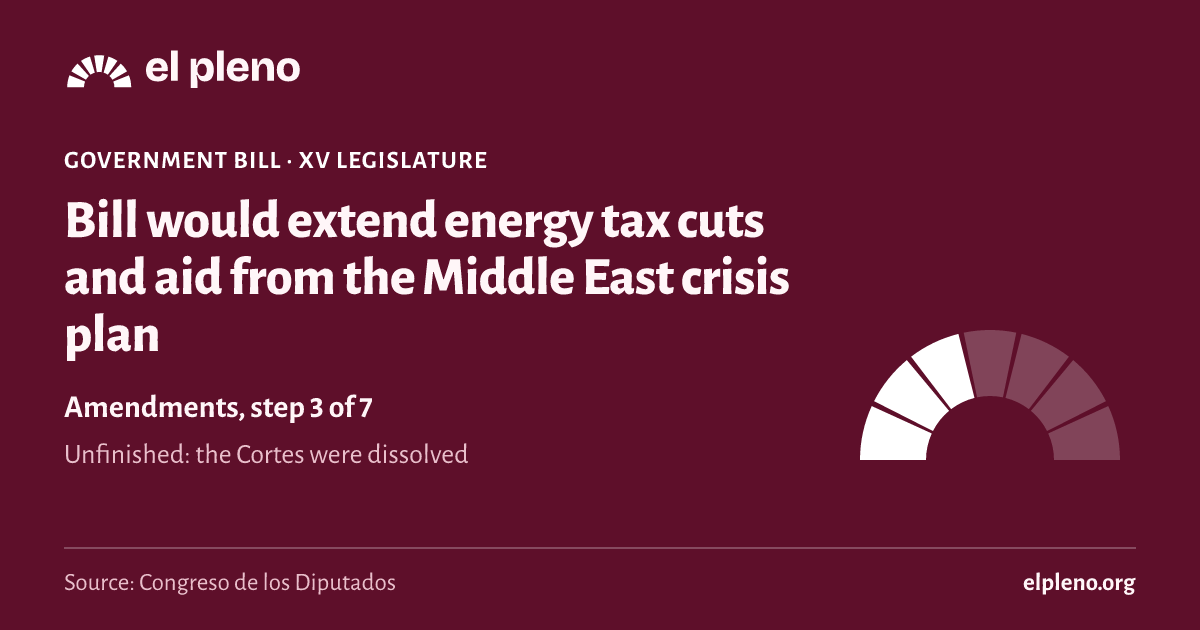
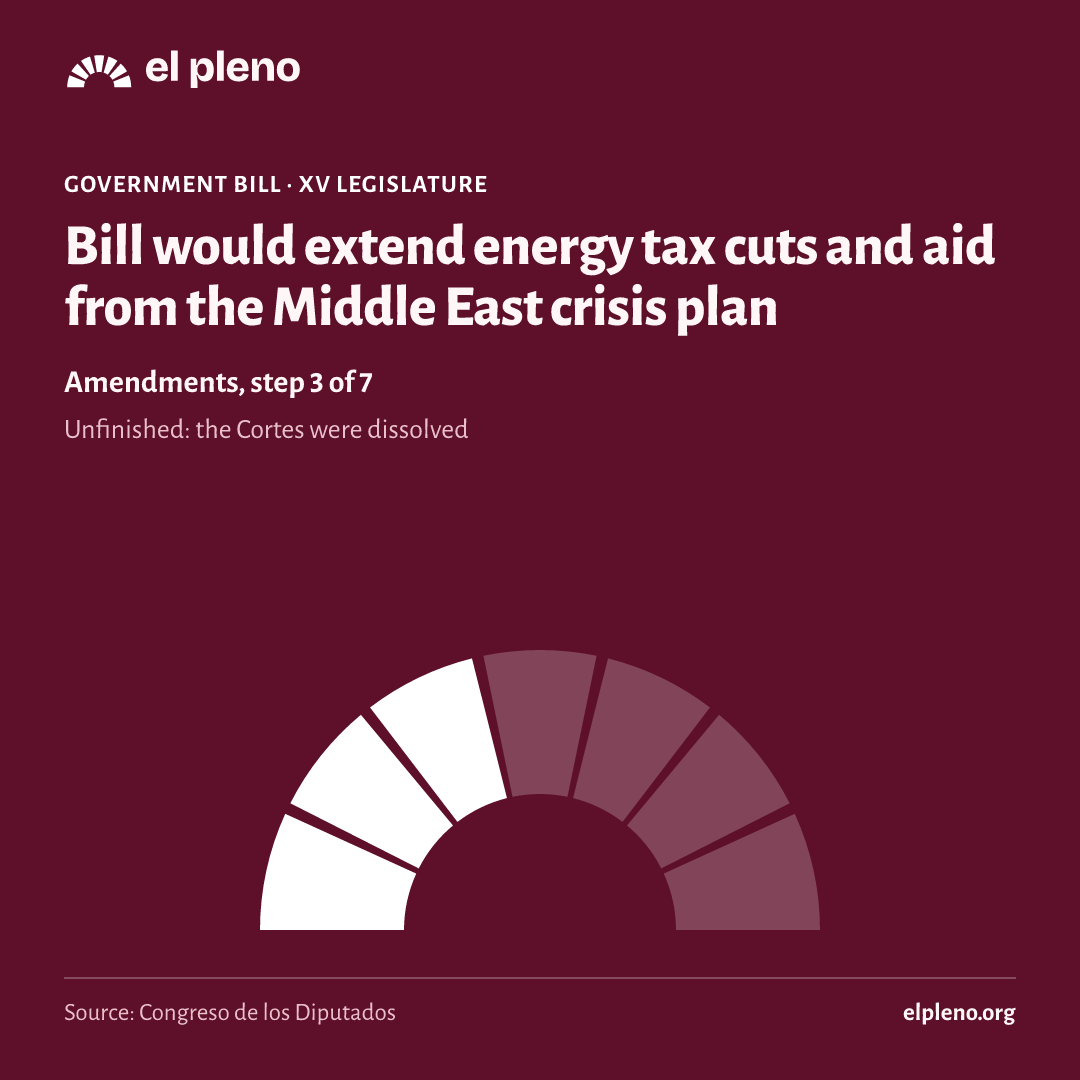
Amendments step 3 of 7· LapsedIt is a government bill. Introduced by the Government. It was introduced on 23 July 2026. Introduced by: Gobierno.
Official title: Government bill adopting certain measures within the framework of the Comprehensive Response Plan to the Crisis in the Middle East (originating from Royal Decree-Law 18/2026, of June 29).
Source: Congreso de los Diputados, file 121/000107· updated 11 Nov
Automatic summary, not yet reviewed
- The bill would keep the measures from the Middle East crisis response plan in place until the end of September 2026, phasing them out gradually, with a mechanism to reactivate them in full if energy prices rise sharply.
- It would cut the Hydrocarbons Tax on gasoline and diesel: 15 cents per liter less in July, 10 in August and 5 in September. If the CPI for gasoline or diesel rises more than 15% from the previous year, the cut would be larger (20 and 15 cents).
- The reduced 10% VAT rate and the reduced 0.5% Special Electricity Tax would return in August and September 2026, but only if the CPI for electricity or natural gas rises more than 15% from the same month of the previous year.
- The tax on the value of electricity production would drop to 3.5% in 2027 and 0% from 2028 on, and in 2026 part of producers' revenues would be deducted when calculating the tax base.
- Aid for agricultural and fishing diesel would be extended to September 30, 2026, and the fertilizer aid amounts would increase (38.33 euros per hectare of dryland and 92.50 for irrigated land).
- Road transport companies with the partial professional diesel tax refund would get aid of 10 cents per liter in July, 15 in August and 20 in September. Those without that right (taxis, buses, vans, ambulances, etc.) could apply for direct aid per vehicle, with applications from September 1 to October 30, 2026.
- Companies receiving the direct aid could not lay off workers for economic, technical, organizational, production or force majeure reasons linked to this situation until September 30, 2026; if they do, they must return the aid and the dismissal would be void.
- It would strengthen fuel market oversight: the CNMC could demand information from wholesalers, closely monitor distribution margins, and publish a list of gas stations with possibly anomalous behavior, which consumers could use as evidence in their complaints.
Who it affects
- Households and consumers: They benefit from fuel tax cuts and, if prices rise sharply, again from the reduced VAT and special tax on electricity and gas.
- Farmers, livestock breeders and fishers: Extension of agricultural and fishing diesel aid and a larger fertilizer aid.
- Road transport companies, taxis and buses: Direct aid per liter of diesel or per vehicle, depending on the case.
- Rail freight and coastal shipping companies: New or extended direct aid to offset fuel costs.
- Workers at aided companies: Protection against layoffs linked to the crisis until September 30, 2026.
Words worth knowing
- Real decreto-ley (royal decree-law)
- A rule with the force of law that the Government can pass urgently, without full parliamentary procedure first; Congress must later approve it.
- Convalidación (validation)
- The vote by which the Congress of Deputies accepts a royal decree-law already passed by the Government.
- IPC (CPI)
- Consumer Price Index: the indicator that measures how much the prices of what we buy go up.
- Bono social (electricity social bonus)
- A discount on the electricity bill for households in a situation of vulnerability.
- Mecanismo de capacidad (capacity mechanism)
- A system that pays to guarantee there is enough capacity to produce, store or consume electricity when needed.
It summarizes the text as it was introduced. It is written by artificial intelligence and may contain mistakes: the official text is what counts. Read the official text · How we make summaries
Where it stands
How far did it get?
It took 3 of 7 steps. It reached Amendments, and today it is lapsed.
- Introduced23 July 2026Someone registers the text in the Congreso.
- Admitted8 September 2026The Bureau of the Congreso accepts it and, for a members’ bill, the plenary decides whether to consider it.
- Amendments11 September 2026Groups propose changes.
- Committeenot reachedA committee goes through the text in detail.
- Plenarynot reachedAll 350 deputies vote.
- Senatenot reachedThe Senate can pass it, amend it or veto it.
- BOEnot reachedIt is published in the Official State Gazette (BOE) and comes into force.
See the 5 official steps on a timeline
Was there a plenary vote?
We have no plenary vote linked to this law in the Congreso’s data.
What happens next
What happens now?
The legislature ended before it finished. To go on, someone would have to introduce it again in the new Cortes.
Sources
Where does all this come from?
- Congreso de los Diputados, file 121/000107
Official title, type, author, dates and stage.
Retrieved 11 November 2026
- Congreso de los Diputados, procedure
The date of each step, with its official wording.
Retrieved 12 November 2026
- The data comes from the open files of the Congreso, the Senate and the BOE, unaltered.
- Each deputy’s province is the one of their seat on the day of the vote.
- We never say “passed” because of a vote: the files do not say which majority was needed.